
Photographers with a small bag
You want to take just one small camera on an early-morning walk, with as few separate accessories as possible. Compare the space needed for the complete kit, not just the camera body.


When bag space is limited, a compact camera with a built-in lens is a good fit if its fixed angle of view or zoom suits your chosen spot. A small mirrorless camera works if you want interchangeable wide-angle lenses and can carry the complete kit. The Consumentenbond notes that a small camera is easier to take with you, so if you’re considering a mirrorless camera, compare the body with the lens and any support you might need. Also think about how you want to expose for the bright sky and dark foreground.
You want to take just one small camera on an early-morning walk, with as few separate accessories as possible. Compare the space needed for the complete kit, not just the camera body.
You want to capture both the bright morning sky and the details in the dark polder landscape, and are happy to adjust the exposure and, if needed, edit your photos afterwards.
You want to be able to choose between a wide view and a distant detail from an accessible path. The angle of view or optical zoom will play a part in your choice.
A good fit if: you have limited space and can work with a single wide angle of view from your chosen spot. Ricoh lists the GR IV as having an approximately 28 mm full-frame equivalent focal length.
The trade-off: with a fixed angle of view, you can’t use optical zoom to make a distant subject appear larger in the frame.
A good fit if: you want to switch between a wide horizon and a tighter frame without changing lenses. Sony lists the RX100 VII at 24–200 mm and Panasonic the TZ99 at 24–720 mm full-frame equivalent.
The trade-off: a greater zoom range alone doesn’t tell you how well a camera will perform at sunrise. Also compare the maximum aperture at the zoom setting you’ll use.
A good fit if: you want to choose a lens for a wider foreground, or use different angles of view later on. The Canon EOS R50 is compatible with RF-S lenses.
The trade-off: the weight and bag space you’ll need depend on the lens you take with you. The R50 kit with the RF-S 18–45mm is not the same combination as the separate RF-S 10–18mm.
| What to consider | What to look for when buying | Who should weigh this more heavily? |
|---|---|---|
| Complete kit to carry | Compare the dimensions and weight of the camera, lens and any support together. Canon lists the EOS R50 at approximately 375 g with battery and card, without a lens. | If I want to pack as little as possible for an early-morning walk, I compare the complete kit, not just the body. Around 36% of consumers prioritise taking a compact kit with them. |
| Exposure control | Check the recording formats and exposure controls you want to use for the exact model. Also consider whether you can set the camera up steadily. | When there’s a bright sky above a dark foreground, I want to decide for myself how to expose the shot and how much to edit afterwards. Around 29% of consumers give exposure control top priority. |
| Framing from a path | Compare angles of view in full-frame equivalent and check whether the zoom is optical. Ricoh lists the GR IV at approximately 28 mm, Sony the RX100 VII at 24–200 mm and Panasonic the TZ99 at 24–720 mm. | From an accessible spot, I want to keep the horizon wide and frame a distant detail too. Around 21% of consumers prioritise having this choice of angle of view. |
| Damp and cold conditions | Check the protection offered by both the body and the specific lens. OM SYSTEM lists the OM-5 Mark II body as IP53 rated; Canon says the RF-S 10–18mm is not dust- and moisture-resistant. | If I also take photos in damp or cold weather, I want to know what protection the complete combination offers. Around 14% of consumers give this consideration top priority. |
With a mirrorless camera, you’ll need to add the lens to the body. The camera’s weight alone doesn’t tell you how much space the complete kit will take up. For example, Canon lists the EOS R50 with battery and card, while the lens is a separate part of the kit.
Compare the camera with the lens you actually want to take, and factor in any support you might need.
Zoom helps you choose how to frame a shot, but it doesn’t on its own determine how a camera captures a high-contrast sunrise.
First choose the angle of view that suits your location, then consider which exposure controls and lens aperture meet your needs.
A protection rating for a camera body doesn’t automatically apply to an attached lens. The stated protection depends on the model and the individual component.
Check the specifications and usage conditions for both the exact body and the lens you want to use.
The GR IV is a compact camera with a fixed wide-angle lens, designed for those with limited bag space who want to shoot wide.
The RX100 VII is a compact camera with built-in zoom for anyone who wants to shoot both wide and tight without changing lenses.
The EOS R50 is a mirrorless camera for anyone who wants to choose an interchangeable lens to get the angle of view they need.
The OM-5 Mark II is a mirrorless camera for anyone who values body protection and stabilisation and is happy to carry a separate lens.
The LUMIX TZ99 is a compact camera with built-in zoom for anyone who wants to switch between a wide view and a distant subject from one spot.
This selection includes compact cameras with built-in zoom and one Sony Alpha A6100 kit with a 16–50mm lens, for anyone looking for a compact camera set-up with the flexibility to shoot different types of frame.
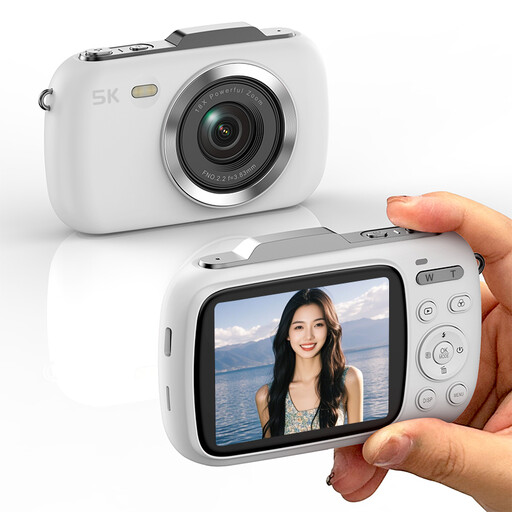 No image available
The built-in zoom suits anyone who wants to frame a distant subject more tightly while out and about, without carrying a separate lens.
The product name lists 5K, 80 MP and 18× zoom.
 No image available
The built-in optical zoom could be a good fit if you want to frame a distant subject larger without changing lenses.
The product name lists 12× optical zoom, 4K, 64 MP and Wi-Fi.
 No image available
The built-in zoom is an option if you want to frame a distant subject more tightly without carrying an extra lens.
The product name lists 5K, 64 MP and 8× optical zoom.
 No image available
The built-in zoom could be a good fit if you want to bring a distant subject closer in the frame without changing a separate lens.
The product name lists 5K, 56 MP and 10× optical zoom, with a front and rear camera.
 No image available
This kit is a good fit if you’re looking for a mirrorless camera that comes with a lens and want to shoot different types of frame with an interchangeable-lens camera.
The product name lists a 16–50mm f/3.5–5.6 OSS II lens.
No, not for every shot. Consider whether you’ll be shooting handheld or using a longer exposure or exposure bracket. For the latter, a stable set-up is important. In-camera stabilisation doesn’t guarantee that every shot will be sharp without support.
Check the exact box contents and lens mount before you choose. According to Canon, the standard Canon EOS R50 kit includes an RF-S 18–45mm lens; the RF-S 10–18mm is a separate lens that Canon lists as compatible with the R50.
No, check the protection offered by the lens you’re using too. OM SYSTEM lists the OM-5 Mark II body as IP53 rated, but that doesn’t automatically mean every lens has the same protection. Canon says the RF-S 10–18mm is not dust- and moisture-resistant.
Check the rules for the exact location before you set off. Natuurmonumenten generally allows visitors in its nature reserves between sunrise and sunset. The same applies to most Staatsbosbeheer sites, although local exceptions may apply. Check visitor information and access signs, and stick to permitted paths.