
Small households who want to get the portions just right
If bread is a side dish, you may only want to buy one or two rolls. Buying them individually makes it easier to match the amount to your meal.


If you’re cooking for one or two, buying a single roll is the easiest way to get the right amount of bread for your Sunday roast. A pack of four makes sense if you’ll use all the rolls or already know what you’ll do with any leftovers. If you’re also keeping an eye on fibre, compare wholemeal and multigrain options by checking the ingredients list and nutritional information per 100 g. For bake-at-home rolls, check the cooking and storage instructions for the exact product.
If bread is a side dish, you may only want to buy one or two rolls. Buying them individually makes it easier to match the amount to your meal.
A pack of part-baked rolls can be a good fit if you plan the oven around your Sunday roast and have a use in mind for any leftovers.
As well as the number of rolls, you may want to compare white, wholemeal and multigrain options. According to the Netherlands Nutrition Centre, wholegrain products contain more fibre than white grain products. Ingredients and allergens vary by product.
First, work out how many rolls you’ll need with your Sunday roast. Then decide whether you’d prefer to buy them fresh or bake them at home. Once you’ve narrowed down your options, compare the ingredients.
| What to consider | What to check when buying | Who it matters to |
|---|---|---|
| Portion size | Check whether the rolls are sold individually or in packs of two or four, and read the storage advice in case you have any left over. | I want to serve bread to one or two people without having an opened multipack left over. For around 46% of consumers, portion control is the top priority when making this choice. |
| Serving time | For bake-at-home rolls, check the cooking method, temperature and timings on the exact pack. | When the main course comes out of the oven, I want to know whether I’ll still have time to bake the rolls. Around 27% of consumers give serving time the highest priority. |
| Ingredients | Compare wholemeal and multigrain options using the ingredients list and nutritional information per 100 g. Also check the allergens and whether iodised salt is listed. | I want to know which grains and allergens the rolls contain, and how much fibre they provide. For around 27% of consumers, ingredients and nutritional information matter most. |
You may have rolls left over after a small meal. The Netherlands Nutrition Centre lists bread among the product groups that Dutch households waste a lot.
Decide in advance how many rolls you want to serve. Choose a single roll if that’s enough, or plan how you’ll use or store the rest according to the pack instructions.
The part-baked rolls we looked at have different cooking times and oven temperatures. A time that works for one product may not suit another.
Read the instructions on the pack you buy and fit baking the rolls around your Sunday roast.
The PLUS multigrain and spelt rolls we looked at contain gluten-containing grains. Some varieties also list other allergens.
Check the allergen information for the exact product. Don’t rely on the type of grain or the name of the preparation method alone.
According to the Netherlands Nutrition Centre, using baker’s salt in bread is not compulsory. The type of salt can therefore vary from one recipe to another.
Read the ingredients list if the presence of iodised salt or baker’s salt matters to you.
For a choice between an individual wholemeal roll and white part-baked rolls in a divisible pack of four.
An option if you’re planning to serve four white part-baked rolls with your meal.
For comparing white, multigrain and spelt rolls in 300 g bags.
For white and rustic multigrain rolls in packs of four.
A shop option if a single white roll suits you better than a pack of four.
A shop option for an individual white roll.
This pack of four white rolls is a good fit for a meal where you want to serve four. Check the cooking and storage instructions if you plan to serve the rolls at different times.
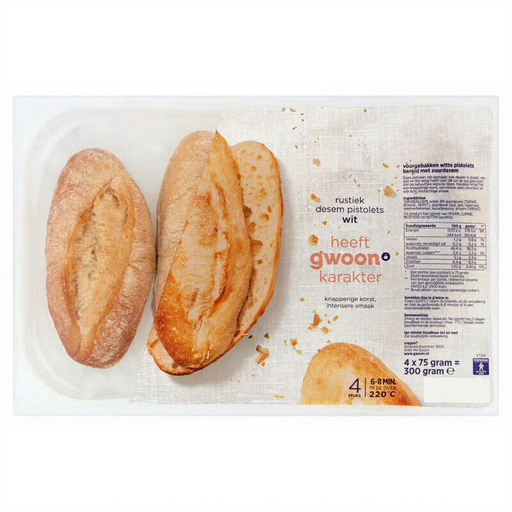 Image unavailable
A pack for anyone who wants to serve four white rolls with their Sunday roast.
Before buying, check whether the rolls need baking and what storage advice applies to this pack.
No. They’re four individual rolls, not a loaf sold as half a loaf. So decide how much you need based on the number of rolls you want to serve with your meal.
Buying rolls individually is the most straightforward option if you only need one or two. If you do buy a pack of four, think ahead about when you’ll use the rest and follow the storage advice for that product.
It depends on the product. The Netherlands Nutrition Centre recommends freezing bread in portions straight after purchase, but Albert Heijn says the white rolls we looked at aren’t suitable for home freezing. So follow the instructions on the pack you buy.
No. According to the Netherlands Nutrition Centre, bread doesn’t have to be made with baker’s salt. Check the ingredients list for the specific roll to see whether baker’s salt or iodised salt is listed.
Not necessarily. The PLUS multigrain and spelt rolls we looked at contain gluten-containing grains. Check the allergen information and only assume a product is gluten-free if the exact product is labelled as such.