Choose a fresh roll if you want to eat it on the day you leave, a bake-at-home roll if you have the time and equipment to prepare it, or a frozen option if you want to stock up at home for later. Check the preparation and storage instructions for each product. If you’re specifically looking for ‘medium sliced’, don’t assume rolls are cut in a standard way: check the packaging or ask the shop what it means.
Which type of roll is right for you?
If you want rolls to eat on the day you leave
Want to take rolls with you for breakfast, lunch or the journey without baking them first? A fresh roll is a good fit for that occasion. ALDI and Lidl show this type of white roll in their shop ranges; choose an amount that you’ll eat before you leave.
If you want to bake rolls at home
If you have an oven or air fryer available before you leave or when you get home, bake-at-home rolls are worth considering. PLUS gives oven and air-fryer instructions for the rolls reviewed, while the white Jumbo rolls reviewed are prepared in the oven. Always follow the instructions on the packaging you choose.
If you need to check ingredients and allergens
A standard wheat roll and a product specifically labelled gluten-free are not interchangeable. PLUS lists a separate gluten-free white roll. Check the current ingredients, allergens and any warnings about possible traces on the packaging every time you buy.
What should you look for when choosing?
First, decide when you want to eat the rolls and whether you can bake or freeze them. Then check the packaging of your chosen option for its ingredients, preparation and storage instructions.
| What to consider | What to check when buying | Who it matters to |
|---|
| Ready to eat |
Check whether you’re buying a fresh roll or a product that needs baking first. |
If I want a roll on the day I leave without using an oven, it needs to suit that occasion. Around 29% of consumers prioritise being able to eat it straight away. |
| Stocking up and storage |
Read the use-by and storage instructions, and check that you have enough freezer space. |
If I’m saving rolls for after my holiday, I want to avoid buying fresh ones that might go uneaten. Around 36% of consumers prioritise planning their supplies. |
| White or multigrain |
Compare the ingredients and nutritional information for the exact options, such as fibre per 100 g. |
When I’m choosing between white and multigrain, I want to know exactly what each roll contains. That makes ingredients the main consideration for around 21% of consumers. |
| Ingredients and allergens |
Check the current label for wheat, gluten, other allergens and any mention of iodised salt. |
If I need to avoid certain ingredients, I can’t rely on the product name alone. Around 14% of consumers give this check top priority. |
Common mistakes
-
Assuming ‘medium sliced’ is a standard specification for rolls
A roll may be sold whole and sliced open for filling, as Albert Heijn Allerhande shows in a recipe. The term alone doesn’t tell you how the roll you’re buying has been cut.
Check the product name and packaging, or ask the shop whether ‘medium sliced’ describes how this specific product is cut.
-
Assuming white, multigrain and gluten-free are interchangeable
These terms don’t mean the same thing when it comes to ingredients. PLUS lists white, multigrain and separate gluten-free rolls; a standard wheat option is not a substitute for a product specifically labelled gluten-free.
Compare the ingredients, nutritional information and allergens on the exact packaging rather than looking only at the front.
-
Buying more fresh rolls than you’ll eat before you leave
Fresh rolls left uneaten don’t suit a plan that involves being away for a few days. The Netherlands Nutrition Centre advises buying what you expect to eat during your holiday.
Count how many times you’ll eat rolls before you leave and buy accordingly. If you want to keep some for later, check whether and how you can freeze your chosen product.
-
Assuming every roll contains iodised salt
The Netherlands Food and Consumer Product Safety Authority outlines the conditions for adding iodine compounds through bakers’ salt. This doesn’t mean every roll contains iodised salt.
If the type of salt matters to you, check the ingredients list for the specific product.
Brands and shops to consider
Albert Heijn
Albert Heijn Allerhande uses a brown roll that you slice open for a filling.
- A useful example if you’re looking for a roll to fill for lunch.
- A recipe doesn’t confirm how a product is cut or which options are currently available in store.
Jumbo
Jumbo lists several types of rolls, including white bake-at-home rolls and brown frozen rolls.
- The different options make it easier to consider eating them straight away, baking them and storing them separately.
- The white option reviewed needs to be baked in an oven; the brown frozen option says to store at −18 °C and not to refreeze after defrosting. Check the instructions for the option you choose.
PLUS
PLUS lists white, multigrain and separate gluten-free rolls.
- For the white and multigrain bake-at-home rolls reviewed, PLUS gives oven and air-fryer instructions.
- Ingredients and allergens vary between options; check the current packaging before comparing products.
Dirk
Dirk lists white and rustic multigrain bake-at-home rolls from 1 de Beste in packs of four.
- A pack of four makes it easier to match the quantity to your planned mealtimes.
- Both options shown need baking; check the packaging you choose for preparation instructions.
ALDI
ALDI lists a single white roll as a freshly baked in-store item.
- Buying them individually suits a specific mealtime on the day you leave.
- Check the current ingredients and allergen information in store if it matters to your choice.
Lidl
Lidl describes its white roll as a white wheat roll listed as an in-store item.
- An in-store roll is an option if you don’t want to plan time for baking.
- Check the details and allergens of the roll you actually take with you in store.
Rolls at Joybuy
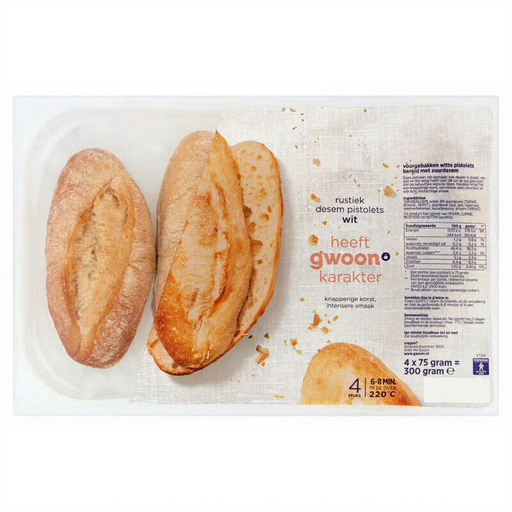
This pack of four rolls could be a good fit if you want to match the quantity to your holiday shopping. If you’re choosing rolls to eat straight away or store for later, also check the product’s preparation and storage instructions.
 No image available
g'woon White Rustic Pistolet, 4 rolls
A pack of four gives you a specific quantity to compare with your planned mealtimes. Before buying, check whether the rolls need baking, how to store them and whether they have the cut you’re looking for. If you have an allergy, check the current label too.
View at Joybuy
Frequently asked questions
Do Dutch rolls always contain iodised salt?
Don’t assume this is the case for every roll. The Netherlands Food and Consumer Product Safety Authority outlines the conditions for adding iodine compounds through bakers’ salt, but this doesn’t establish the ingredients of any individual roll. Check the current ingredients list if the type of salt used matters to your choice.
How should I store bake-at-home rolls just before my holiday?
For a sealed pack, follow the use-by and storage instructions on the label. For an opened pack of bake-at-home rolls, the Netherlands Nutrition Centre recommends 2 to 4 days in the fridge or 1 to 3 months in the freezer. Plan how many rolls you’ll eat before you leave, and check whether freezing is suitable for your product.
Can I refreeze frozen rolls once they’ve defrosted?
Follow the instructions on the packaging you choose. Jumbo says its brown frozen rolls must not be refrozen after defrosting; don’t assume this product-specific instruction applies to other rolls.


