
If you’re looking for strictly sugar-free cereal
You want cereal that meets the threshold for the ‘sugar-free’ claim. A pack labelled only ‘no added sugars’ doesn’t give you enough information to be sure.


If you need to avoid sugar completely, choose cereal labelled ‘sugar-free’ and check that the nutrition information lists no more than 0.5 g of sugars per 100 g, the threshold set by EU Regulation (EC) No 1924/2006. ‘No added sugars’ means something different: this cereal may still contain sugars. Also decide whether you want crunchy flakes or would rather prioritise wholegrains and fibre, with toppings of your choice.
You want cereal that meets the threshold for the ‘sugar-free’ claim. A pack labelled only ‘no added sugars’ doesn’t give you enough information to be sure.
You want to avoid added sugars without giving up a crunchy texture. If you’re comparing products with no added sugars, check the total sugars per 100 g too.
Compare the grain base and fibre content, even if that means choosing a different type of grain breakfast rather than classic cornflakes. According to the Netherlands Nutrition Centre, wholegrain products contain more fibre than products made with white flour.
Start with your sugar goals: the strict ‘sugar-free’ claim needs a different check from ‘no added sugars’. Then compare the grain base, fibre and ingredients of products that suit your breakfast.
| What to consider | What to check | Who it matters most to |
|---|---|---|
| Strictly sugar-free | Check the claim and the ‘of which sugars’ figure per 100 g. For solid breakfast cereals, the EU threshold for the claim is no more than 0.5 g per 100 g. | If sugar-free is a must for me, I don’t want to rely on the front of the pack alone. Around 33% of consumers make this strict requirement their top priority. |
| No added sugars | Read the exact claim and compare the total sugars per 100 g across different varieties. | I want a sweet or crunchy breakfast with no added sugars, but don’t require the product to be sugar-free. Around 27% of consumers make this distinction their top priority. |
| Wholegrains and fibre | Check the type of grain in the ingredients list and compare fibre per 100 g; assess sugars separately. | For my breakfast, wholegrains and fibre matter more than a light, flaky texture. This is the main consideration for around 20% of consumers. |
| Adding your own flavour | Check the ingredients in the base product and the sugars per 100 g before choosing toppings. | I’d rather choose the ingredients that add flavour to my breakfast, such as fruit, even if that means more preparation. Around 20% of consumers prioritise having this choice. |
Under EU Regulation (EC) No 1924/2006, solid breakfast cereals labelled ‘sugar-free’ must contain no more than 0.5 g of sugars per 100 g. A product with no added sugars may contain more than this.
Read the claim carefully, then check the ‘of which sugars’ figure per 100 g.
Vitamins alone don’t tell you how much sugar a product contains. Kellogg’s lists 34 g of sugars per 100 g for Smacks; the ingredients list includes sugar and glucose syrup.
Compare the nutrition information and ingredients of the specific product, not just the look of the packaging.
These are two separate qualities. Albert Heijn lists 10 g of fibre and 4.6 g of sugars per 100 g for Brinta Volkoren grain breakfast.
First check that the product meets your sugar target, then compare the fibre content.
Ingredients and allergy information can change. According to the Netherlands Food and Consumer Product Safety Authority, allergens must be clearly identified in the ingredients list on the label.
Check the current packaging again, especially if wheat, nuts, milk or other allergens matter to you.
The range includes different types of cereal; check the sugar and fibre content of each product.
A grain breakfast for anyone happy to choose a different base from crunchy flakes and add their own toppings.
The own-brand range includes different categories, including cornflakes and muesli; the category name doesn’t tell you how much sugar a product contains.
Worth considering if you want to compare crunchy cruesli with varieties marketed as ‘zero sugar added’.
These Quaker Cruesli varieties are included for comparison if you’re looking for a crunchy breakfast and want to avoid added sugars. They aren’t a selection for anyone who wants only products that meet the strict ‘sugar-free’ threshold. Check the current nutrition information and ingredients for each variety.
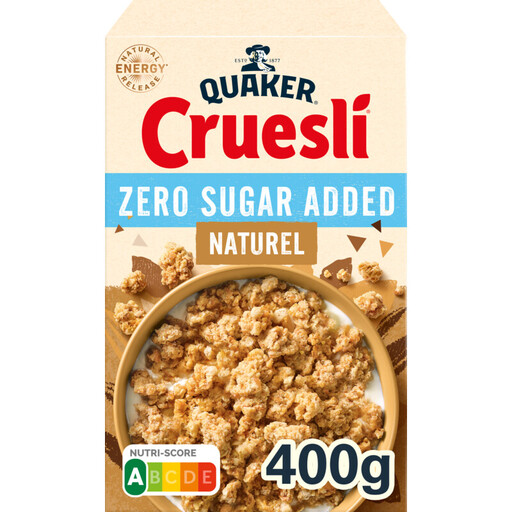 Image unavailable
The Natural variety is worth comparing if you want crunchy muesli without a strong fruit flavour or a nut variety.
Check what the sugar claim means for this variety and how much total sugar is listed per 100 g on the pack.
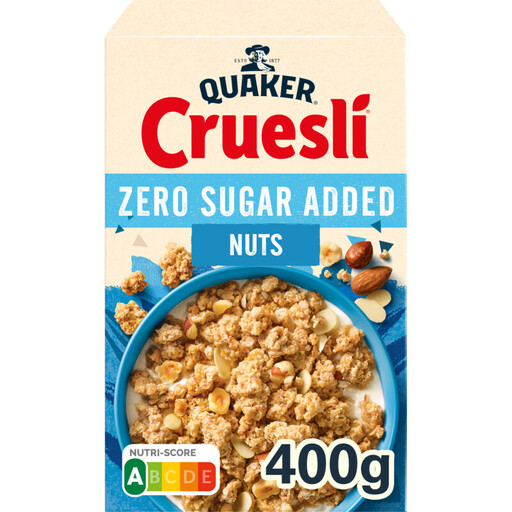 Image unavailable
Compare this nut variety if you’re looking for crunchy cruesli with nuts.
Don’t assume that ‘Zero Sugar’ in the product name means the total sugars meet the ‘sugar-free’ threshold. Check the nutrition information and current allergen details.
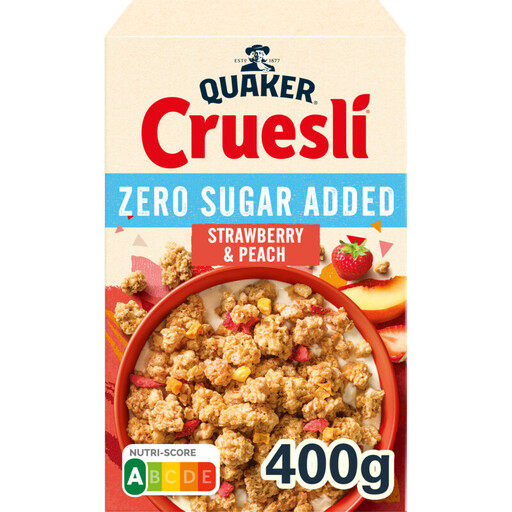 Image unavailable
The Strawberry & Peach variety is worth considering if you’re looking for fruity-flavoured crunchy muesli.
‘Zero Sugar Added’ isn’t the same as ‘sugar-free’. Compare the total sugars per 100 g and read the ingredients on the current packaging.
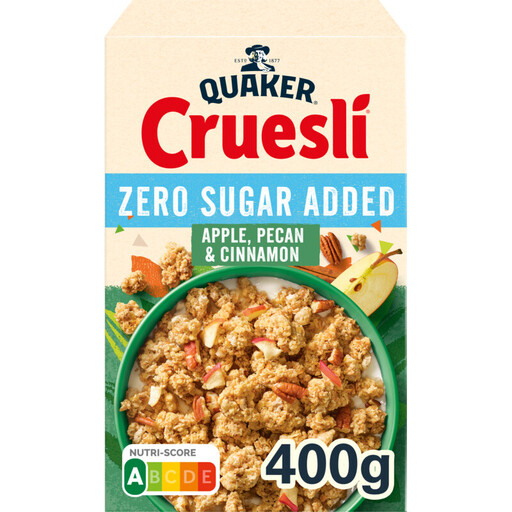 Image unavailable
Compare this apple, pecan and cinnamon variety if you want fruit and nuts in your crunchy muesli.
As well as checking the total sugars per 100 g, check the allergens on the current packaging, especially if nuts matter to you.
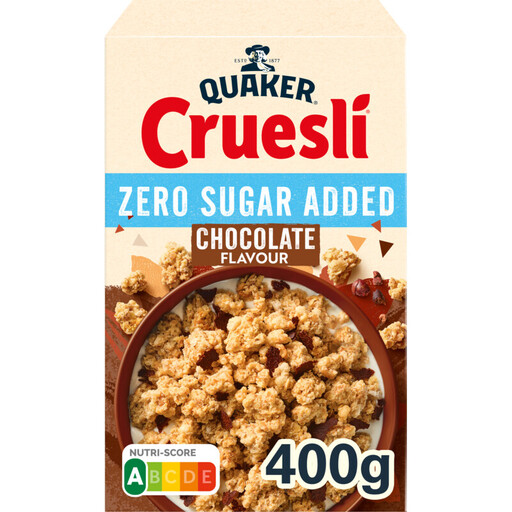 Image unavailable
The Choco variety is worth comparing if you’re looking for crunchy muesli with a chocolate flavour.
Check the total sugars per 100 g rather than relying on ‘Zero Sugar’ in the name. If you also want to compare fibre, use the same measure on the packaging for every variety.
No. Under EU Regulation (EC) No 1924/2006, a solid product labelled ‘sugar-free’ may contain no more than 0.5 g of sugars per 100 g. So check the nutrition information even when a product carries this claim.
No. Cereal with no added sugars may still contain sugars. Check the ‘of which sugars’ figure per 100 g if you want to know whether a variety also meets your limit for total sugars.
Compare fibre and sugars as separate values per 100 g. According to the Netherlands Nutrition Centre, wholegrain products contain more fibre than products made with white flour, but wholegrain doesn’t automatically mean sugar-free. For example, Albert Heijn lists 10 g of fibre and 4.6 g of sugars per 100 g for Brinta Volkoren grain breakfast.
Read the ingredients list and allergen information on the current packaging for your chosen variety. According to the Netherlands Food and Consumer Product Safety Authority, allergens that must be declared need to be clearly shown on the label. Check which grains or nuts are listed if these matter to you.
Yes. Check the packaging again if ingredients, nutrition values or allergens are important to your choice. Albert Heijn says that this product information can change.