
If you’re looking for strictly sugar-free cereals
You want ‘sugar-free’ to apply literally to your choice, so you compare total sugars per 100 g rather than relying on a claim about no added sugars.


Looking for genuinely sugar-free breakfast cereals for your weekly shop? Don’t rely on ‘no added sugars’: under the Annex to Regulation (EC) No 1924/2006, a product can only be called ‘sugar-free’ if it contains no more than 0.5 g of sugars per 100 g. If naturally occurring sugars are acceptable to you, you can also compare cereals with no added sugars. Check the ‘of which sugars’ figure per 100 g, the ingredients and allergens, and how much you’ll need for the week.
You want ‘sugar-free’ to apply literally to your choice, so you compare total sugars per 100 g rather than relying on a claim about no added sugars.
You’re looking for a cereal with a suitable wholegrain base and nutritional profile. You may be happy with naturally occurring sugars, and check the ingredients and allergen information for each variety.
You compare pack sizes and price per kilo, while also making sure the label suits your household’s preferences.
First decide whether sugar-free is essential or whether no added sugars is enough. Then compare the other nutritional information and the pack size for your weekly shop.
| What to consider | What to check when buying | Who it matters to |
|---|---|---|
| Genuinely sugar-free | Check the ‘sugar-free’ claim and total sugars per 100 g; ‘no added sugars’ means something different. | If all the sugars listed count towards my choice, I don’t want to rely on the front of the pack alone. Around 40% of consumers make this strict check their top priority. |
| Fibre and ingredients | Compare fibre on the same basis and check the ingredients and allergens for each flavour. | For my usual breakfast, I want to know which grains are included and whether the variety meets my ingredient and allergy requirements. This is the top priority for around 30% of consumers. |
| Pack size for the week | Compare pack sizes and price per kilo, and consider whether you’ll use the quantity. | I buy enough for several breakfasts at once and want to choose a suitable quantity without losing sight of the label. This is the top priority for around 30% of consumers. |
Albert Heijn lists 5.7 g of sugars per 45 g serving for Quaker Cruesli Zero Sugar Added Naturel, despite the no added sugars claim.
If you need a strictly sugar-free product, check both the claim and the ‘of which sugars’ figure per 100 g on the pack.
Breakfast cereal ranges include products both with and without added sugar. A familiar brand name tells you nothing about the nutritional value of an individual variety.
Compare the sugars, fibre and ingredients for each product rather than looking only at the front of the pack.
For Quaker Cruesli Zero Sugar Added Noten & Zaden, Albert Heijn lists milk, nuts and cereals containing gluten among the allergens.
Check the allergen information for the exact variety you’re buying, even if another variety carries the same sugar claim.
It can be difficult to compare packs of different weights using the pack price alone.
Check the price per kilo and choose a quantity that suits your household’s needs.
Worth considering if you want to compare crunchy muesli with no added sugars.
A wholegrain cereal breakfast to consider if you’d prefer a warm breakfast to crunchy flakes.
Offers several types of breakfast cereal, so check each variety individually.
A retailer whose product pages provide information about individual breakfast cereals.
A retailer where you can compare different types of cornflakes and other breakfast cereals side by side.
These products suit those choosing between crunchy cruesli and a wholegrain cereal breakfast. Don’t take ‘Zero Sugar Added’ in a product name as confirmation that the product is sugar-free: check the label to be sure.
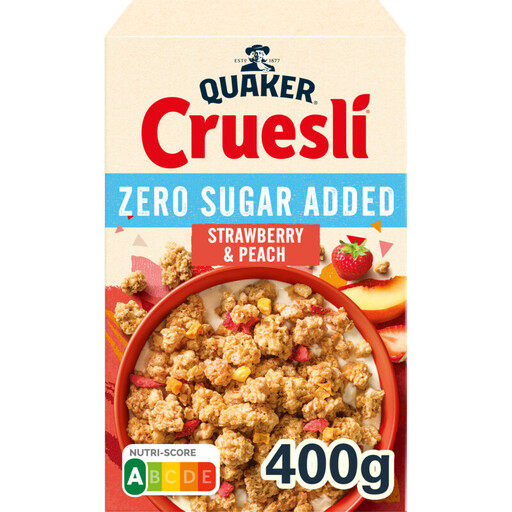 Image unavailable
For anyone looking for cruesli in the Strawberry & Peach variety who doesn’t rule out naturally occurring sugars. The pack is 400 g; check the total sugars and allergens for this variety on the label.
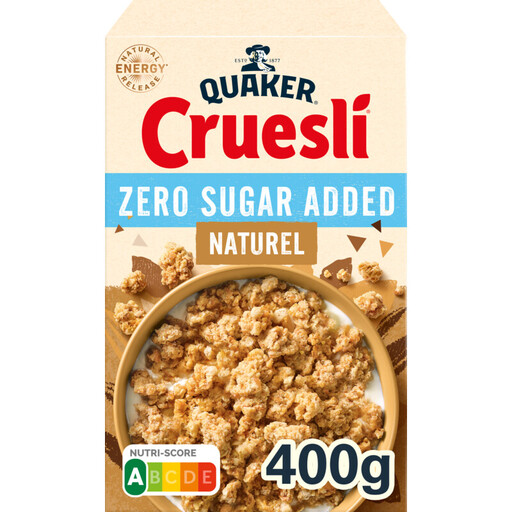 Image unavailable
For anyone wanting to compare the Natural variety of Cruesli with other breakfast cereals. The pack is 400 g; if you need a sugar-free product, check the total sugars per 100 g and the allergens on the label.
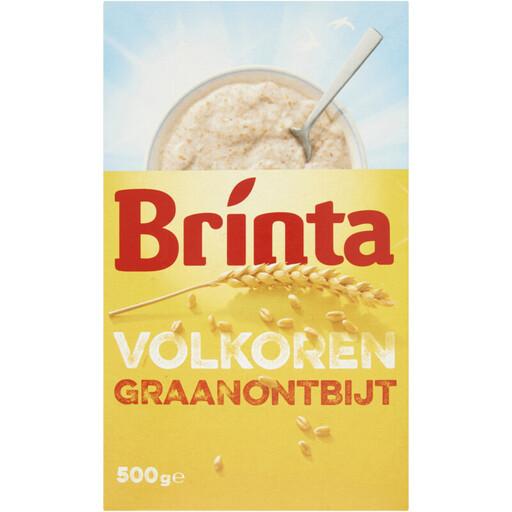 Image unavailable
For anyone wanting to compare a wholegrain cereal breakfast with crunchy flakes or cruesli. The pack is 500 g; check the total sugars per 100 g if sugar-free is essential.
No. Under the Annex to Regulation (EC) No 1924/2006, ‘sugar-free’ can only be used for products containing no more than 0.5 g of sugars per 100 g. A product with no added sugars may still contain naturally occurring sugars. For example, Albert Heijn lists 5.7 g of sugars per 45 g serving for Quaker Cruesli Zero Sugar Added Naturel.
As well as sugars, compare the ingredients, fibre, salt and fat in each product. The Netherlands Nutrition Centre lists wholegrain breakfast cereals as a breakfast option and recommends checking for added sugar and salt. Also read the allergen information if it’s relevant to your choice.
Compare the price per kilo and nutritional information per 100 g, then decide which pack size suits your household’s needs. A lower pack price alone doesn’t tell you which product is better value per kilo or what ingredients it contains.
Yes. Check the packaging of the product you’re buying, especially for ingredients and allergens. Albert Heijn warns in its product information that nutritional values and allergen information, among other details, may change.