What should you look for when choosing?
Start by understanding the sugar claim, then compare the nutritional information per 100 g. Next, choose between an oat base you can customise and ready-to-eat crunchy muesli; fibre, sweeteners and allergens may affect your decision.
| What to look for |
What to check when buying |
Who it matters to |
| Sugar claim and total sugars |
Read the claim and the ‘of which sugars’ figure per 100 g. For solid foods, the EU limit for a ‘sugar-free’ claim is no more than 0.5 g per 100 g. |
If I’m looking for a genuinely sugar-free product, I don’t want to confuse ‘no added sugar’ with the stricter claim. Getting the sugar claim right is the top priority for around 36% of consumers. |
| Wholegrain and fibre |
Check the ingredients and compare fibre per 100 g; check sugars and salt separately. |
I want to choose a grain base for more than just its sweetness, without assuming that fibre tells me anything about its sugar content. Around 29% of consumers say wholegrains and fibre come first. |
| Crunchy muesli and sweeteners |
Compare sugars per 100 g and check whether the ingredients list includes sweeteners such as maltitols. |
For my yoghurt bowl, I want something crunchy, but I want to decide for myself whether sweeteners suit that breakfast. This combination is the main priority for around 21% of consumers. |
| Allergens and dietary suitability |
Read the current allergen information; if you have coeliac disease, check for the official Crossed Grain symbol on oat products. |
If I have a grain or nut allergy, I need to know whether the ingredients are suitable for me before choosing based on taste. This check comes first for around 14% of consumers. |
Brands and product ranges compared
A brand name doesn’t determine whether a breakfast cereal is sugar-free: even within one brand, oats, crunchy muesli and bran products differ in their ingredients and nutritional information.
Quaker
Quaker offers both Havermout Original and crunchy Cruesli Zero Sugar Added Naturel; they’re different options for a Sunday breakfast.
- According to Quaker, Havermout Original contains no added sugars. Its product information lists 1.1 g of sugars per 100 g.
- Albert Heijn lists Cruesli Zero Sugar Added Naturel as containing no added sugars or sweeteners, but it does contain 5.7 g of sugars per 45 g serving and includes oats and wheat.
Albert Heijn
AH Krokante muesli noten 0% suiker is a crunchy option for shoppers who are happy to have sweeteners in the ingredients.
- Albert Heijn lists 1.3 g of sugars per 100 g and 0% added sugar for this nut variety.
- This variety contains maltitols, nuts and cereals containing gluten; the pack warns that excessive consumption may have a laxative effect.
Brinta
Brinta Volkoren graanontbijt and Brinta Havermout are two simple grain bases you can prepare yourself.
- According to Albert Heijn’s product information, Brinta Volkoren graanontbijt is made from 100% wholegrain wheat, while Brinta Havermout is made from 100% oat flakes.
- When comparing products, check whether the nutritional values refer to the dry product or a prepared serving. The ingredients alone don’t confirm a ‘sugar-free’ claim.
Kellogg’s
All-Bran Fibre Plus is worth comparing if fibre matters to you, but it isn’t necessarily a low-sugar option.
- Kellogg’s lists 11 g of wheat bran fibre per serving of All-Bran Fibre Plus.
- The product information also lists 18 g of sugars per 100 g. Compare the sugar figure separately from the fibre figure.
Nestlé
Nestlé KitKat Cereals shows why wholegrain ingredients or added vitamins are no substitute for checking the sugar content.
- Albert Heijn’s product listing mentions wholemeal wheat flour and added vitamins and minerals.
- Albert Heijn lists 25 g of sugars per 100 g for KitKat Cereals. If keeping total sugar low is your priority, that’s an important trade-off.
Oats and crunchy muesli on Joybuy
These two products suit different ways of putting together a sugar-conscious Sunday breakfast: oats you can customise and a crunchy Cruesli variety labelled Zero Sugar Added. That label alone doesn’t confirm that a product meets the ‘sugar-free’ limit.
 No image available
Quaker Oatmeal 600 g
For anyone who wants to use oats as the base for a breakfast bowl they can customise.
600 g pack. If you’re choosing strictly by sugar content, compare the nutritional information per 100 g with the EU limit for ‘sugar-free’.
If you have coeliac disease, check the pack for the official Crossed Grain symbol.
View at Joybuy
 No image available
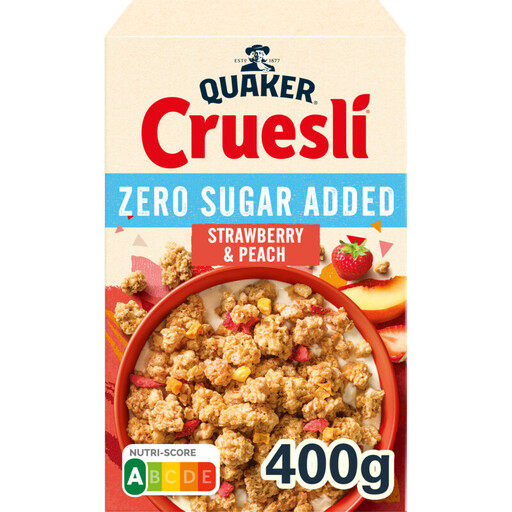
Quaker Cruesli Zero Sugar Added Strawberry & Peach 400 g
For anyone who likes crunchy muesli with yoghurt or milk and wants to keep an eye on added sugars.
400 g pack. To check the total sugar content, read the nutritional information per 100 g; the name Zero Sugar Added does not mean ‘sugar-free’.
If you have an allergy or coeliac disease, check the current ingredients and allergen information on the pack.
View at Joybuy
Frequently asked questions
Does ‘no added sugar’ mean the same as sugar-free?
No. Under European Union Regulation (EC) No 1924/2006, a solid food can only be labelled ‘sugar-free’ if it contains no more than 0.5 g of sugars per 100 g. A product with no added sugars may still contain naturally occurring sugars, so check the ‘of which sugars’ figure in the nutritional information, too.
Which option lets me choose what to add to my breakfast?
Plain oats let you choose whether to add yoghurt, fruit or nuts, for example. According to Quaker, Quaker Havermout Original contains no added sugars, but its stated 1.1 g of sugars per 100 g is above the EU limit for the ‘sugar-free’ claim.
Are regular oats suitable for people with coeliac disease?
Not automatically. The Voedingscentrum points out that oats can become contaminated with gluten. If you have coeliac disease, check whether the pack carries the official Crossed Grain symbol.
How do I compare the sugar content of two breakfast cereals?
First compare the ‘of which sugars’ amount per 100 g, so different serving sizes don’t skew the comparison. Then consider how much you’ll serve and what else you’ll add to your bowl.
Why should I check the packaging after comparing products online?
The current pack is the best source of information on the ingredients, nutritional values and allergens for the exact variety you’re buying. Albert Heijn advises reading the pack before use because this information can change; for crunchy muesli, pay particular attention to sweeteners, nuts and cereals containing gluten.


