If you need your cereal to be ‘sugar-free’, only choose products whose label lists no more than 0.5 g of sugars per 100 g: this is the threshold for the claim under EU Regulation 1924/2006. If your main aim is to avoid added sugars, a product labelled ‘no added sugars’ may suit you, but it could still contain naturally occurring sugars. For a quick breakfast, also compare the serving size, other nutritional values and allergens. Remember that crunchy muesli or granola is not the same product as simple flakes.
Which choice is right for you?
If you’re looking for something literally sugar-free
‘No added sugars’ isn’t enough for you. Check the ‘of which sugars’ value per 100 g: under EU Regulation 1924/2006, the ‘sugar-free’ claim allows a maximum of 0.5 g of sugars per 100 g, or per 100 ml for a drink.
If you want to avoid added sugars
You want to serve breakfast cereal quickly with milk, yoghurt or a plant-based alternative, and you’re happy with sugars that occur naturally in the ingredients. According to the Voedingscentrum, ‘no added sugars’ doesn’t mean a product contains no sugars. If you want to avoid sweeteners too, check the ingredients list separately.
If fibre is your priority
You’re looking for easy-to-serve flakes and want to take fibre into account without mistaking a fibre claim for a sugar claim. The Voedingscentrum’s guidance on food labels also recommends comparing sugars, salt and energy per 100 g, and checking how much you actually eat.
What should you look for when choosing?
First, decide whether you mean literally sugar-free or simply no added sugars. Then compare the nutritional information on the same basis and check that the option you choose suits the way you eat breakfast.
| What to consider |
What to check before buying |
Who it matters to |
| Sugar-free or no added sugars |
Check the ‘of which sugars’ value per 100 g. Under EU Regulation 1924/2006, ‘sugar-free’ means no more than 0.5 g of sugars per 100 g; treat ‘no added sugars’ as a different claim. |
If I’m looking for something literally sugar-free, I don’t want to accidentally choose a product that only contains no added sugars. Around 50% of consumers make this strict sugar requirement their priority. |
| Fibre and nutritional value |
Compare fibre, sugars, salt and energy per 100 g, then check the serving size. A fibre claim on its own says nothing about whether a product is sugar-free. |
For my breakfast, I mainly want to know how much fibre I’m choosing and how the other nutritional values compare. Around 30% of consumers make this their priority. |
| Quick to serve and ingredients |
Check the serving size, serving suggestion and allergen information for the exact product. Make sure you know whether the nutritional values are for dry cereal or a prepared serving. |
If I’m putting breakfast together just before I leave, the serving needs to be easy to pair with my chosen milk, yoghurt or alternative, and the ingredients need to suit me. This is the main concern for around 20% of consumers. |
Common mistakes
-
Reading ‘no added sugars’ as ‘sugar-free’
A product with no added sugars may still contain naturally occurring sugars. This means it may not meet a strict sugar-free requirement, as the Voedingscentrum also explains.
For ‘sugar-free’, use the threshold in EU Regulation 1924/2006: no more than 0.5 g of sugars per 100 g. If you only want to avoid added sugars, still check the total sugars in the nutrition table.
-
Looking only at the claim on the front
A sugar claim doesn’t tell you how much energy, fat or salt the cereal contains. One product’s serving size may also differ from another’s.
First compare the nutritional information per 100 g, then consider the serving size you want to have.
-
Comparing a prepared serving with dry cereal
Nutritional values for cereal with yoghurt or milk include the values for those additions. A prepared serving like this can’t be directly compared with values for 100 g of dry cereal.
Check what the figures refer to, and take into account the milk, yoghurt or plant-based alternative you use.
-
Overlooking allergens because of a sugar claim
Whether cereal is sugar-free or contains no added sugars tells you nothing about the presence of ingredients such as gluten-containing grains or nuts.
Read the ingredients and allergen information on the packaging of the exact product before choosing it.
Brands to consider
The product ranges below show why a brand name or breakfast cereal category isn’t enough: check the claim and nutritional information for each product.
Kellogg's
Kellogg's makes products including Corn Flakes and All-Bran Flakes. They answer different shopping needs: one is a classic cornflake, while the other is worth considering if you want to compare fibre.
- According to Kellogg's, Corn Flakes contain maize, barley malt extract, sugar and salt. So the ingredients list is a good place to check if you want to avoid added sugar.
- A fibre claim on All-Bran Flakes doesn’t automatically make it sugar-free. Check the sugars per 100 g for this product too.
W. K. Kellogg
The range includes crunchy muesli with no added sugars, including an option with coconut, cashew and almond. This is a different product category from simple cereal flakes.
- According to Kellogg's, this option contains no added sugar or artificial sweeteners.
- Kellogg's also states that it contains naturally occurring sugars. If you need a product to be literally sugar-free, check the sugars per 100 g and read the allergen information for the option you choose.
Quaker
Quaker Cruesli Zero Sugar Added Naturel is a crunchy muesli for people looking for no added sugars; it doesn’t confirm that the product is sugar-free.
- The product information at Albert Heijn states that this Naturel option contains no added sugars and no sweeteners.
- The same product information states that it contains naturally occurring sugars. When comparing, also bear in mind the difference between values for dry cereal and a prepared serving.
Albert Heijn
The own-brand range includes granola labelled ‘0% added sugar’, including a nut option.
- This may be a useful choice if you specifically want to avoid added sugar and are looking for granola.
- ‘0% added sugar’ isn’t a sugar-free claim. For the exact product, compare the total sugars per 100 g and check the ingredients and allergens.
Crunchy muesli on Joybuy
These two Quaker Cruesli options suit a quick breakfast if you’re looking for no added sugars and are happy with naturally occurring sugars. They’re crunchy muesli, not simple flakes, and they’re not confirmed sugar-free options.
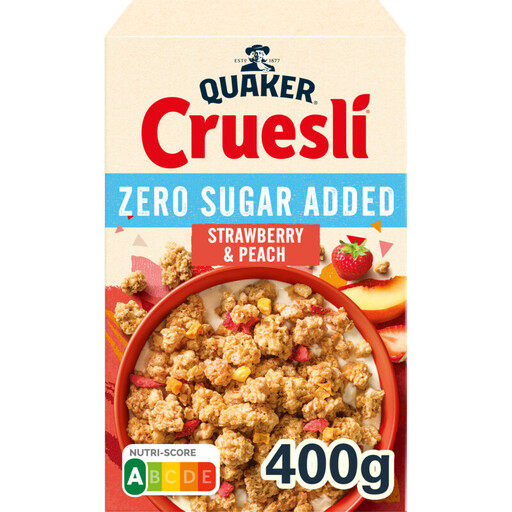 Image unavailable
Quaker Cruesli Zero Sugar Added Strawberry & Peach, 400 g
A crunchy muesli for a quick breakfast if you want to avoid added sugars but are happy with naturally occurring sugars.
Strawberry and peach flavour in a 400 g pack. If you need a product to be strictly sugar-free, check the ‘of which sugars’ value per 100 g on the packaging, and read the allergen information.
Joybuy
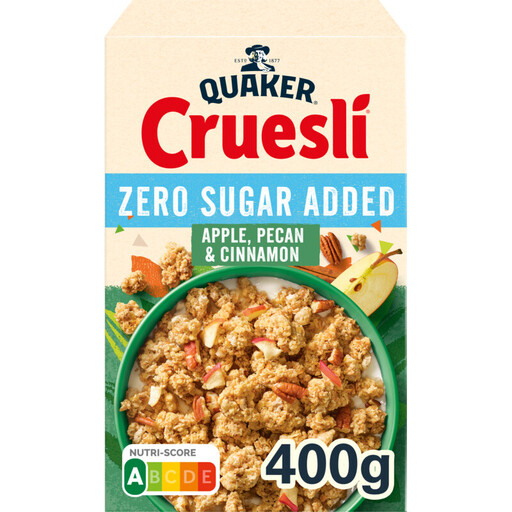 Image unavailable
Quaker Cruesli Zero Sugar Added Apple, Pecan and Cinnamon, 400 g
A crunchy muesli for a quick breakfast if you want to avoid added sugars but are happy with naturally occurring sugars.
Apple, pecan and cinnamon flavour in a 400 g pack. If you need a product to be strictly sugar-free, check the ‘of which sugars’ value per 100 g. Also read the allergen information, especially for pecan.
Joybuy
Frequently asked questions
Is cereal with no added sugars also sugar-free?
No, not necessarily: according to the Voedingscentrum, it may still contain naturally occurring sugars. Under EU Regulation 1924/2006, the ‘sugar-free’ claim allows a maximum of 0.5 g of sugars per 100 g or 100 ml. So, for breakfast cereal, check the ‘of which sugars’ value per 100 g.
How do I compare flakes with crunchy muesli or granola?
First compare the nutritional information for the exact products per 100 g, so different serving sizes don’t skew the comparison. Check sugars, fat, fibre, salt and energy, then look at the serving size you plan to eat and any additions such as yoghurt.
How can I tell if breakfast cereal contains sweeteners?
Read the ingredients list: according to the Voedingscentrum, any sweetener used must be listed on the label. A statement about added sugars alone won’t tell you whether the product’s ingredients suit your preferences.
How should I store flakes or muesli for a quick breakfast?
Follow the storage instructions on your product’s packaging and seal the pack well after use. Instructions may vary by product; the product information for Quaker Cruesli Zero Sugar Added Naturel says to store in a cool, dry place.


