
A host with a strict sugar-free requirement
You want to serve a biscuit for New Year’s Eve with a verifiable sugar-free claim, not just a reduced-sugar option.


If sugar-free is a must for your New Year’s Eve, choose a biscuit whose specific packaging carries that claim; ‘reduced sugar’ and ‘no added sugar’ mean something different. Also compare portion sizes and nutritional information, and check the ingredients, allergens and any polyol warning before serving. Sugar-free doesn’t automatically mean low-calorie or suitable for every guest.
You want to serve a biscuit for New Year’s Eve with a verifiable sugar-free claim, not just a reduced-sugar option.
You’re looking for something to serve with coffee or later in the evening, and want to decide how much to serve each guest without assuming sugar-free means low-calorie.
You want to know which sweeteners a biscuit contains and whether there’s a warning on the packaging. According to the Netherlands Nutrition Centre, large amounts of polyols can cause digestive problems.
First decide whether sugar-free is a must. Then choose between a packaged biscuit, a reduced-sugar option or home-baked biscuits. Under European Union Regulation (EC) No 1924/2006, the claim ‘sugar-free’ may only be used when a product contains no more than 0.5 g of sugars per 100 g or 100 ml.
When: Choose this option if the sugar-free claim on the packaging of the exact product variant is essential to you.
Consider: The Netherlands Nutrition Centre points out that sugar-free biscuits can still be high in calories and low in nutrients.
When: Consider this if sugar-free isn’t a must and you’re looking for a product with less sugar than a comparable biscuit.
Consider: ‘Reduced sugar’ is a comparison, not proof that the biscuit meets the threshold for a sugar-free claim.
When: Baking your own gives you control over the ingredients and the size of the biscuits.
Consider: Ingredients such as dates may still contain sugars, so a recipe with no added sugar isn’t automatically sugar-free.
| What to consider | What to check when buying | Who is this most important for? |
|---|---|---|
| Sugar-free claim | Check the claim and the ‘of which sugars’ figure per 100 g on the packaging of the exact product variant. | I want to serve a biscuit that’s clearly labelled sugar-free, not just sugar-conscious. For around 36% of consumers considering this purchase, that claim is the main deciding factor. |
| Portion size and nutritional value | Compare the nutritional information per 100 g and per portion, and check how many biscuits you can serve. | With several snacks over a long evening, I want to be able to portion out the biscuits for each guest. Around 29% of consumers prioritise portion size and nutritional value. |
| Sweeteners | Read the ingredients list and check for any polyol warning. | If I need to take sensitivity to polyols into account, I want to know what’s in the biscuit before it’s served. This is the main concern for around 21% of consumers. |
| Ingredients and allergens | Read the allergen information on the current packaging of the product variant you’ve chosen. | When guests need to avoid certain ingredients, I want to be able to point them to a suitable biscuit without relying on the product name. Around 14% of consumers prioritise this check. |
A biscuit may contain less sugar than a comparable product without meeting the threshold for a ‘sugar-free’ claim.
If sugar-free is essential, check the claim and nutritional information on the packaging of the exact product variant.
The Netherlands Nutrition Centre notes that sugar-free biscuits can still be high in calories and low in nutrients.
Compare the energy content per 100 g and per portion, and decide how many biscuits you want to serve.
According to the Netherlands Nutrition Centre, large amounts of polyols can cause digestive problems.
Read the ingredients and warnings on the packaging, especially if guests say they’re sensitive to polyols.
Albert Heijn says that product ingredients and allergen information can change.
When you buy the biscuits and before you serve them, check the current packaging of the product you’re actually offering.
Jumbo lists Céréal biscuits with different sugar claims, including variants with ‘Sugar Free’ and ‘Reduced Sugar’ in the name.
Albert Heijn lists products including AH Digestive 0% sugar in its range of sugar-conscious biscuits.
Jumbo’s Céréal range includes biscuits with both ‘Sugar Free’ and ‘Reduced Sugar’ in the product name.
Lotus Bakeries describes Biscoff as a caramelised biscuit. It could be a regular biscuit option for guests who don’t need a sugar-free choice.
These biscuit bars are only an option if you don’t need to serve strictly sugar-free products for New Year’s Eve. The description ‘Less Sugar’ isn’t a sugar-free claim.
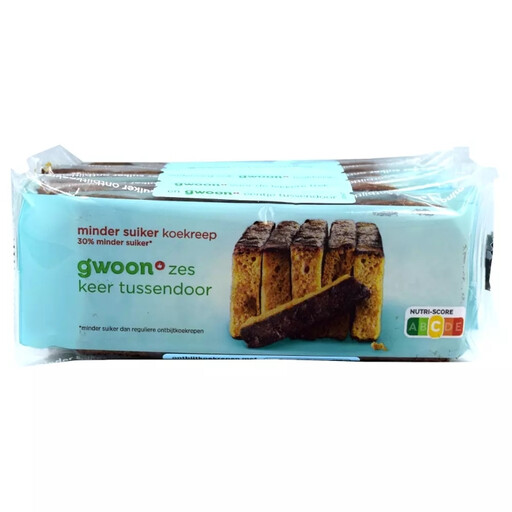 Image unavailable
Worth considering if a sugar-free claim isn’t essential and you want to share the biscuit bars among your guests. Before serving, check the current nutritional information, ingredients and allergens; the description ‘Less Sugar’ alone doesn’t show how the sugar content compares with a similar product.
Under European Union Regulation (EC) No 1924/2006, this nutrition claim may only be used if a product contains no more than 0.5 g of sugars per 100 g or 100 ml. ‘Reduced sugar’ and ‘no added sugar’ don’t mean the same thing, so check which claim appears on the specific packaging.
No, that doesn’t follow from the sugar-free claim. The Netherlands Nutrition Centre points out that sugar-free biscuits can be high in calories and low in nutrients, so compare the nutritional information and portion size too.
According to the Netherlands Nutrition Centre, large amounts of polyols can cause digestive problems. Read the ingredients list and check for any warning, especially if a guest says they’re sensitive to them.
Use the website to shortlist biscuits, but read the current packaging before serving. Albert Heijn says that product information, including ingredients and allergen information, can change.