What should you look for when choosing?
First, check what the sugar claim means. Then check the allergens and school rules, and decide how many biscuits to pack.
| What to consider |
What should you check? |
Who is this most important for? |
| Sugar claim |
Read the exact claim and compare ‘of which sugars’ per 100 g. ‘No added sugars’ does not mean the same as ‘sugar-free’. |
If I want to limit sugar, I don’t want to rely on the word ‘zero’ alone. For around 44% of consumers, clarity about the sugar claim comes first. |
| Allergens and school rules |
Read the current allergen information and check what can be brought to school or an after-school club. |
If I’m packing something for a group with allergy rules, the biscuit needs to meet them. Around 33% of consumers give this suitability the highest priority. |
| Portion and snack time |
Check the quantity per biscuit and decide how many to pack. Also compare the nutritional value of products per 100 g. |
After school, I want to offer a small snack without accidentally packing several biscuits. For around 23% of consumers, an easy-to-manage portion is the most important consideration when buying. |
Brands compared
Always compare the specific variety: a brand name alone doesn’t tell you what sugar claims, allergens or sweeteners a biscuit contains.
Céréal
Céréal has varieties labelled ‘No Sugars’. Jumbo lists 0 g of sugars per 100 g for the Coconut Flavour variety and 0.4 g per 100 g for the Speculoos variety with pieces of almond.
- The Coconut variety comes in individual 11 g biscuits; Jumbo lists 4.1 g of fibre per 100 g.
- Both varieties mentioned contain wheat. For the variety with pieces of almond, also check the other allergens on the packaging.
Albert Heijn
Albert Heijn describes AH Digestive 0% sugar as sugar-free biscuits with sweeteners.
- The product description makes it clear which biscuit variety you can assess in terms of its sugar claim.
- Albert Heijn warns that excessive consumption may have a laxative effect. Check the current packaging for ingredients and allergens.
Verkade
According to Albert Heijn’s product information, Verkade San Francisco zero is a biscuit with ‘0% added sugar’, not an example of a product with 0 g of sugars.
- Albert Heijn lists 1.7 g of sugars per 100 g and around 8.6 g per biscuit, so you can consider the sugar content and portion size separately.
- For this variety, allergens listed include cereals containing gluten, milk and soya.
Biscuits to consider
This biscuit may be worth considering if you’re looking for an option with no added sugar for after school, but not if you specifically need a product with the claim ‘sugar-free’. Before packing it, also check the current allergen information and the rules at your child’s school or after-school club.
 No image available
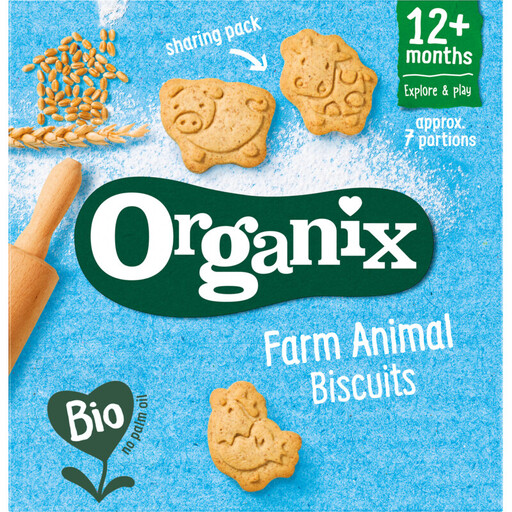
Organix Bio Farm Animal Biscuits 100 g
An option to consider if you’re looking for a biscuit with no added sugar; don’t treat it as a sugar-free biscuit. Before packing it, check the sugars per 100 g, allergens and portion size on the packaging.
View on Joybuy
Frequently asked questions
Does ‘no added sugars’ mean the same as sugar-free?
No. A biscuit with no added sugars may still contain sugars. Under European Regulation (EC) No 1924/2006, the claim ‘sugar-free’ can only be used if a product contains no more than 0.5 g of sugars per 100 g or 100 ml. So check the nutrition table too.
Is a sugar-free biscuit automatically an everyday snack for children?
No. The sugar claim doesn’t assess the full nutritional value or the portion size. For children aged 4 to 12, the Netherlands Nutrition Centre recommends snacks including fruit and vegetables. If you’re choosing biscuits, compare the nutritional information per 100 g too.
Can a biscuit containing gluten be taken to school?
That depends on allergies and the rules at the school or after-school club in question. Read the allergen information on the current packaging and check what can be brought in.
Why do some sugar-free biscuits carry a warning about a laxative effect?
If consumed excessively, this warning may relate to added polyols such as maltitol. The Netherlands Nutrition Centre explains this warning for products containing more than 10% added polyols. Check the ingredients and wording on the packaging of the biscuit you choose.
How should I store an opened pack of sugar-free biscuits?
Store the biscuits in a cool, dry, dark place in a tightly sealed container, as recommended by the Netherlands Nutrition Centre. Also follow the storage instructions on the packaging.


