
Organiser of a one-off class lunch
Looking for sugar-coated aniseeds to serve on bread, rusks or yoghurt at a celebratory group event, and wants to work out how many packs they’ll need.


For a one-off, celebratory school lunch, a 330 g pack of De Ruijter Muisjes is an option if you need a bread topping for a group; if you need a smaller quantity, you could consider the 270 g pack of Gestampte Muisjes. Before buying, check that a larger bag called ‘muisjes’ really is a sugar-coated aniseed bread topping: a listing for 1 kg of Joris Muisjes is categorised as sweets. Don’t use sugar-coated aniseeds as a regular lunch staple, and check the current ingredients, allergen information and school guidelines before serving them.
Looking for sugar-coated aniseeds to serve on bread, rusks or yoghurt at a celebratory group event, and wants to work out how many packs they’ll need.
Wants to distinguish between an occasional sweet treat and a topping that is served regularly at lunch. The Netherlands Nutrition Centre advises against choosing high-sugar toppings too often.
Wants to check the ingredients and allergens before serving, even if the sugar-coated aniseeds are offered outside their original packaging.
First decide whether you’re looking for sugar-coated aniseeds as a bread topping, and how much you need. Then weigh up the celebratory occasion against the place of sweet toppings in the lunch menu, and check the allergens before serving.
| What to consider | What to check when buying | Who it matters most to |
|---|---|---|
| Product type and quantity | Check that the product is sugar-coated aniseeds for bread, and read the net weight. The regular De Ruijter packs reviewed are 270 g and 330 g; a listing for 1 kg of Joris Muisjes is categorised as sweets. | If I’m looking for a bread topping for a class, I don’t want to accidentally order a large bag of sweets, and the quantity needs to suit the group event. Around 40% of consumers prioritise choosing the right product type and quantity. |
| One-off or regular use | Decide whether the sugar-coated aniseeds are for a celebration or a regular lunch. Albert Heijn lists 79 g of sugars per 100 g for De Ruijter Feestmuisjes; the Netherlands Nutrition Centre advises against choosing high-sugar toppings too often. | For a regular school lunch, I want to be able to offer other toppings rather than making a celebratory treat the standard choice. Around 30% of consumers prioritise this consideration. |
| Allergens and serving | Read the current label and keep the allergen information available alongside the portions. The Feestmuisjes and Gestampte Muisjes reviewed list wheat and cereals containing gluten. | When I serve sugar-coated aniseeds to a group, I want to know in advance who needs to avoid the product and what information I can show them. Allergens and clear serving information are the main concern for around 30% of consumers. |
The Joris Muisjes 1 kg listing reviewed is in a sweets category. So the product name alone doesn’t tell you whether you’re buying sugar-coated aniseeds for bread or rusks.
Check the product category and description before choosing a larger pack for lunch.
Albert Heijn lists 79 g of sugars per 100 g for De Ruijter Feestmuisjes. The Netherlands Nutrition Centre advises against choosing high-sugar toppings too often.
Save sugar-coated aniseeds for an occasional celebration, and choose a topping for a regular lunch that fits the Netherlands Nutrition Centre’s dietary guidelines.
With individual portions, the ingredients list is no longer immediately visible. The Feestmuisjes and Gestampte Muisjes reviewed list wheat and cereals containing gluten.
Check the school guidelines in advance, and keep the current packaging or suitable written allergen information available when serving.
The brand behind the sugar-coated aniseeds reviewed here, sold as a bread topping in packs including 270 g and 330 g.
A supermarket with product information for items including De Ruijter Feestmuisjes.
A supermarket whose range of sugar-coated aniseeds reviewed here includes 270 g and 330 g De Ruijter varieties.
A supermarket whose online range reviewed here includes 270 g De Ruijter Gestampte Muisjes and several 330 g varieties of sugar-coated aniseeds.
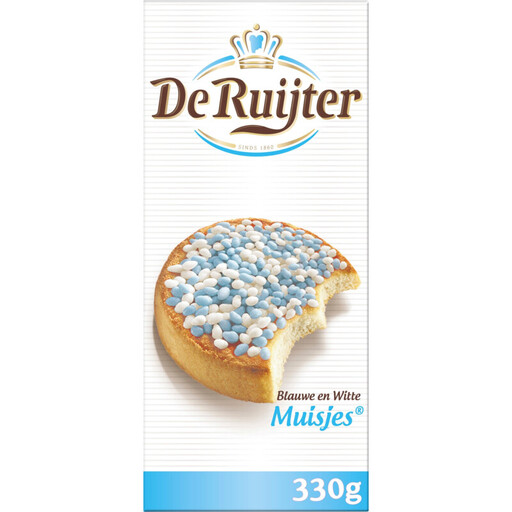
This blue-and-white De Ruijter variety in a 330 g pack is suitable for an occasional lunch when you want sugar-coated aniseeds as a bread topping or garnish. Choose the colour only if it suits the occasion, and check that 330 g will be enough for your group.
 No image available
For a one-off celebration when blue-and-white sugar-coated aniseeds make a fitting bread topping or garnish.
330 g pack. According to Joybuy product information, this variety contains 79 g of sugars per 100 g and gluten from wheat.
Check the current packaging for allergen information, and work out whether the quantity is enough for the portions you plan to serve.
No. The Joris Muisjes 1 kg listing reviewed is categorised as sweets. Check the category and description if you’re looking to buy sugar-coated aniseeds for bread or rusks.
Consider De Ruijter Gestampte Muisjes in a 270 g pack if you need less than a 330 g pack. Work out how many portions you want to serve in advance, and check that the crushed variety is suitable for the type of bread topping you have in mind.
It’s better to use them as an occasional sweet topping than as a regular lunch staple. Albert Heijn lists 79 g of sugars per 100 g for De Ruijter Feestmuisjes; the Netherlands Nutrition Centre advises against choosing high-sugar toppings too often.
Keep the current packaging or suitable allergen information available when serving, and check the school guidelines. The Netherlands Food and Consumer Product Safety Authority says that businesses and caterers offering unpackaged food to consumers must provide information about any allergens present. This obligation for businesses does not automatically apply to every initiative organised by parents.