
Vandaag of morgen in huis

Kwaliteit gegarandeerd

Welkomstaanbiedingen ontgrendelen: GRATIS bezorging | Tot 80% korting | Gratis 30 dagen JoyPlus-proefperiode
Download de app
A suction-cup shower grab rail can be useful if you need extra balance when getting into the bath, standing up in the shower or moving around the bathroom. Older people, pregnant women, people recovering from an injury and carers often look for a solution that doesn’t require drilling.
However, not every suction-cup grab rail is suitable for every bathroom. The main differences aren’t just about price: the surface, how the rail is attached and how it can be used all matter.
A suction cup only works properly on a smooth, non-porous and airtight surface. Suitable examples include glass, smooth tiles, metal, stainless steel, acrylic and some marble surfaces.
A wall with textured tiles, porous stone, wallpaper, plasterboard or damaged paint may let air through, reducing the suction. Small grout lines or uneven tiles can also limit the contact area. So check where you plan to place your bathroom grab rail before you buy.
Product descriptions sometimes state a maximum capacity, for example 240 lb per grab rail, which is around 109 kg. This doesn’t automatically mean you can hang from it or put your full body weight on it.
The TAILI models mentioned here are intended for balance support, not as full-support grab rails. If you need a fixed grab rail to pull yourself up with your full weight, consider having a screw-mounted rail professionally installed.
A longer grab rail isn’t always more comfortable. Positioning, grip and the distance from the wall are just as important. An anti-slip shower grab rail with a strip along the top may provide more friction, while a ridged underside leaves room for your fingers.
Also consider the colour. A grey or black grab rail may not stand out clearly against dark tiles. A glow-in-the-dark shower grab rail may be easier to see at night, but its glow-in-the-dark material is no substitute for bathroom lighting.
Choose a removable shower grab rail with a clear locking mechanism. The TAILI models in this guide use two suction cups with locking levers. According to the product description, they can be attached in around five seconds, without screws, adhesive or tools.
The practical steps:
The grab rail should only be attached to a suitable, smooth surface. A bathroom grab rail that doesn’t require drilling isn’t automatically suitable for every wall.
Look at the materials and contact points. The products mentioned are made from plastic with TPE suction cups. An anti-slip strip on top is designed to increase friction when you grip the rail. The wavy underside is designed to let your fingers rest in a more natural position.
These are verifiable product features, but the grip may feel different to each user. If your hands are wet or you have limited grip strength, test the grab rail gently first without putting your full weight on it.
A grab rail measuring around 12 inch may suit a compact shower or the area beside a toilet. A 16.8 inch model offers more length for users who want a larger gripping area. Measure the available space in advance, and take tiles and grout lines into account.
For bathroom safety for older people, a contrasting colour can make the grab rail easier to spot. The glow-in-the-dark models are mainly designed to improve visibility in the dark. The product description says they are water-resistant; nevertheless, always check that the suction cups are firmly attached after cleaning.
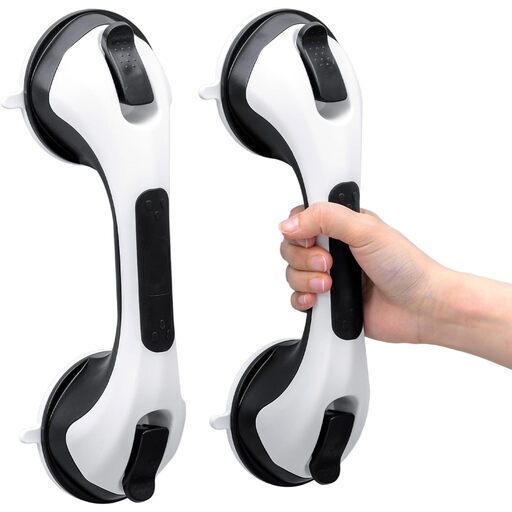
Why it suits this user: The set of two grab rails is a practical option if you want support in more than one place, such as by the shower and toilet.
The product description mentions an anti-slip strip, a ridged underside and two locking suction cups. The surface requirements still apply.
Two grab rails, 12 inch length, removable design and a stated capacity of 240 lb per grab rail, according to the product description.
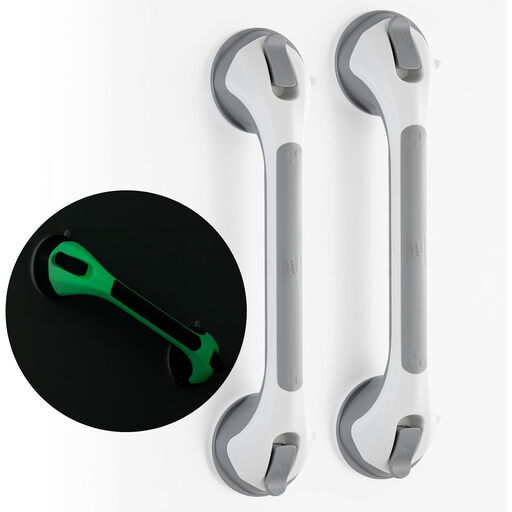
Why it suits this user: This longer model with glow-in-the-dark material is a good fit for users who value better visibility and a larger gripping area.
This grab rail is about more than just its colour: the description mentions an anti-slip strip, finger grooves and two locking levers. It still needs to be fitted to a suitable wall.
16.8 inch length, glow-in-the-dark material, a set of two and a stated capacity of 240 lb per grab rail, according to the product description.
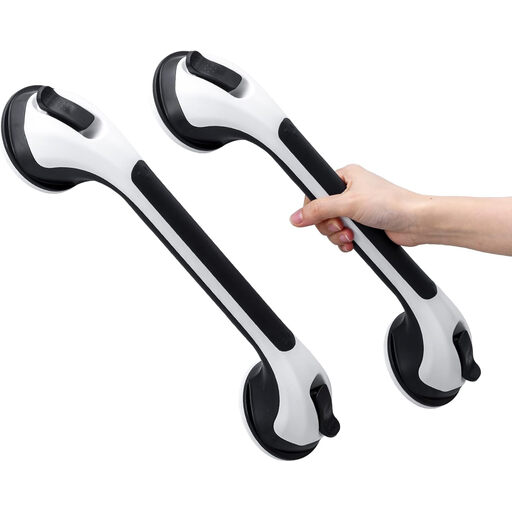
Why it suits this user: This set is designed for anyone who wants temporary support in different parts of the home without making permanent changes to the walls.
The grab rails are removable and don’t require drilling, screws or adhesive. If you use them frequently, check more often that both suction cups are still fully locked.
A set of two, water-resistant plastic construction, an anti-slip strip and a 12 inch size for the bath, shower, toilet or kitchen.
We’ve put together a complete, up-to-date list of products that meet these strict selection criteria and the applicable European safety regulations.
Clean the grab rail with a damp cloth and mild soap. Let the suction cups dry completely before attaching them again. If the suction weakens, the product description says you can wash the suction cup in warm water, dry it and test it again on a smooth glass surface.
Don’t rely on the grab rail as your only safety measure. Make sure the bathroom is well lit, keep the floor as dry as possible and, if you’re unsure, ask an installer or occupational therapist for advice about a fixed grab rail.
It depends on the surface, correct installation and how it’s used. A suction-cup model is intended to provide balance support. It isn’t automatically a substitute for a fixed grab rail that someone can put their full weight on.
How long it stays attached varies depending on the surface, moisture, temperature and wear to the suction cup. Check the locking mechanism before use and inspect the grab rail regularly. Don’t place the product in direct sunlight or near extreme heat.
No. The tile or wall needs to be smooth, non-porous and airtight. According to the product information, textured tiles, open grout lines, porous stone, wallpaper and plasterboard are unsuitable. Measure and check the intended position before buying a shower grab rail for older people.
