
Vandaag of morgen in huis

Kwaliteit gegarandeerd

Welkomstaanbiedingen ontgrendelen: GRATIS bezorging | Tot 80% korting | Gratis 30 dagen JoyPlus-proefperiode
Download de app
A suction cup shower caddy can keep shampoo, conditioner and shower gel tidy without drilling holes in your tiles. That makes it a handy choice for renters, students, travellers and small bathrooms. However, not every suction cup bathroom shelf works on every wall. A smooth shower screen is very different from a textured tile or a grouted surface.
So don’t just focus on how it looks. The fixings, drainage and maximum load all affect whether a shower organiser that needs no drilling will work well in practice.
Suction cups need a smooth, non-porous surface. Suitable materials include glass, mirrors, smooth tiles, stainless steel and acrylic. They may not hold as securely on grout, rough tiles, wallpaper, painted walls or textured panels.
A common mistake is placing the suction cup directly over a grout line. This can let air in underneath and reduce its grip. First, check that there’s enough flat space around your chosen mounting spot.
A manufacturer may state a maximum load, but that doesn’t mean the caddy will be equally stable on every surface or in every position. A wet bottle is also heavier than a dry one. Place heavier bottles as close to the wall as possible and spread the contents around the caddy.
The products below have a stated capacity. Treat it as an upper limit and always check that the suction cups are firmly attached before adding anything to the caddy.
A solid plastic container holds on to water for longer. This can leave the bottoms of bottles wet and mean more cleaning. Look for drainage holes, ventilation and a design that lets you remove the caddy.
A removable shower caddy is especially useful if you clean regularly, move house or want to change the layout of your shower.
Check whether the product description mentions your type of wall. According to their product specifications, TAILI models are designed for smooth, non-porous surfaces such as glass, metal, smooth tiles, stainless steel and acrylic. To install, press the suction cup into place by hand to push out the air.
Clean and dry the surface first. Don’t place the suction cup over a grout line. Dirt or limescale underneath it can prevent a good seal. A shower shelf without screws is therefore best suited to a flat, clean mounting spot.
An ABS plastic shower caddy is lightweight and suitable for use in a damp room. TPE is used for the suction cups on TAILI models. The product information lists drainage holes on several models, with some versions also featuring a slightly sloped base.
Also check for sharp edges, the finish and whether the caddy can be taken apart. A caddy that’s easy to clean with mild soapy water will generally need less maintenance than a model with hard-to-reach corners.
Measure the space before ordering. A standard rectangular shower caddy won’t necessarily fit next to your shower tap or beneath a recess. For a corner, a corner suction cup shower caddy is a natural choice, but check that your corner is a true 90-degree angle.
The product specifications list the following capacities, among others:
These are product specifications, not a guarantee that every wall or mounting spot will give the same results.
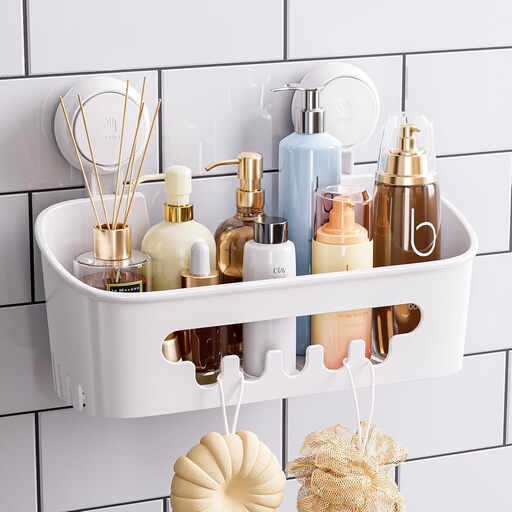
Why it suits this profile: This single shower caddy is a good choice if you want to try out one compact spot for storing shampoo, shower gel or conditioner.
The specifications list 22 drainage holes and installation without screws, nails or glue. The warning about grout lines and rough surfaces still applies.
Single ABS plastic caddy with two TPE suction cups and a stated capacity of 22 lb.
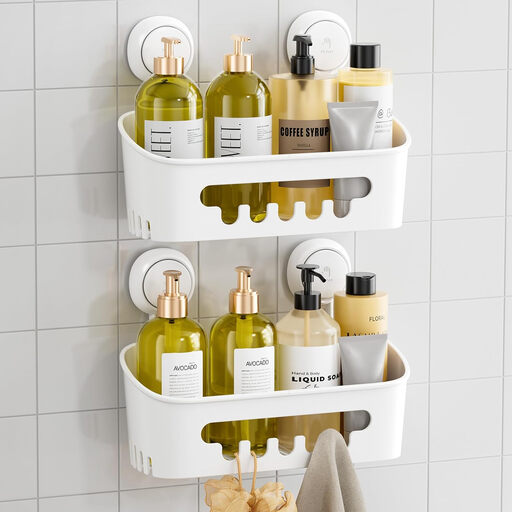
Why it suits this profile: Two caddies give you space to organise toiletries by person or by when you use them.
Four suction cups spread the fixings across the two caddies. The product information mentions a sloped base and drainage holes to let water run away.
Set of two ABS caddies, removable design and a stated capacity of 22 lb.
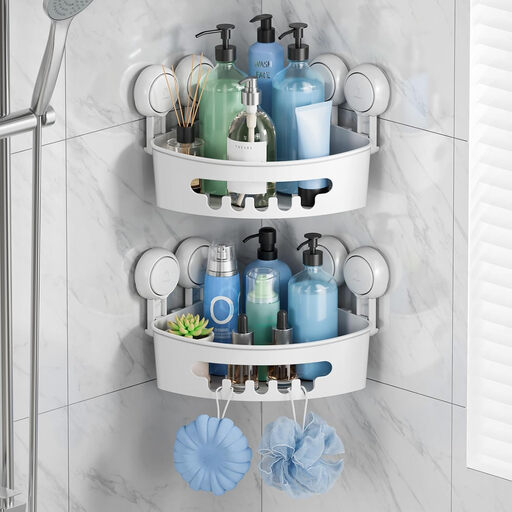
Why it suits this profile: This model makes use of an unused shower corner and is designed for a smooth 90-degree corner.
The corner design means you don’t have to position a straight caddy at an angle. The product specifications do warn against grout lines, textured tiles and porous walls.
Corner design, ABS and TPE, drainage holes all round and a removable construction.
We’ve put together a complete, up-to-date list of products that meet these strict selection criteria and the applicable European safety regulations.
Avoid extreme heat and prolonged direct sunlight if the product information advises against them. Only move a bathroom organiser after carefully releasing the suction cup; pulling on the caddy can put unnecessary strain on the fixing.
No. Suction cups work best on smooth, non-porous tiles. Grout lines, raised patterns, matt textured tiles and porous materials can stop the suction cup forming a good seal. Check the mounting spot before ordering a product.
How long it stays up depends on the surface, cleaning, moisture, load and the quality of the seal. There’s no fixed lifespan that applies to every bathroom. Check the suction cups regularly and don’t exceed the stated capacity.
Often, yes, if the model can be attached to a smooth surface and uses no glue or screws. A removable shower caddy may be more practical than a fixed one. However, check the manufacturer’s installation instructions and bear in mind the possibility of marks or damage.
