
Vandaag of morgen in huis

Kwaliteit gegarandeerd

Welkomstaanbiedingen ontgrendelen: GRATIS bezorging | Tot 80% korting | Gratis 30 dagen JoyPlus-proefperiode
Download de app
A stunt scooter for children needs to do more than simply roll smoothly. Jumps, landings and barspins put extra strain on the deck, fork, handlebars and wheels. Yet many models look alike. Marketing terms such as “pro”, “freestyle” and “high performance” don’t tell you much on their own about whether a scooter is right for your child.
The main pitfalls to avoid are:
For young riders, a lightweight stunt scooter is easier to lift and turn. The models in this selection weigh around 3.6 to 4.4 kg. You’ll notice the difference most when practising a tailwhip or moving the scooter around the skate park.
Also check the maximum load capacity. Several models list a limit of up to 100 kg or 220 lb. This is a product specification, not a recommendation that every rider up to that weight is automatically suited to intensive stunt use. Take clothing, protective gear and the way the scooter will be used into account.
The handlebar height should suit the rider’s height. Handlebars that are too high can make tricks harder; handlebars that are too low can be uncomfortable. Check the exact measurements on the product page rather than relying on phrases such as “from 6 years” or “for teenagers”.
An aluminium stunt scooter is often relatively lightweight. Product information may specify 6061 aluminium, aluminium frames and reinforced decks. A model with fixed handlebars, a rigid construction and a fixed fork has fewer moving parts than a folding scooter.
Look out for these features:
A scooter for the skate park usually has hard, solid polyurethane wheels. This selection includes 100 or 110 mm wheels. Smaller wheels can feel more manoeuvrable, while 110 mm wheels may roll a little more smoothly on the street.
Some models list ABEC-9 bearings. The ABEC rating relates to bearing tolerances, but it doesn’t tell you on its own how a complete scooter will perform in practice. Check the wheel material, wheel core and brake too.
A rear or foot brake is common. Some versions list a front brake in their specifications. So check which version you’re selecting, as colour options or model names may come with different features.
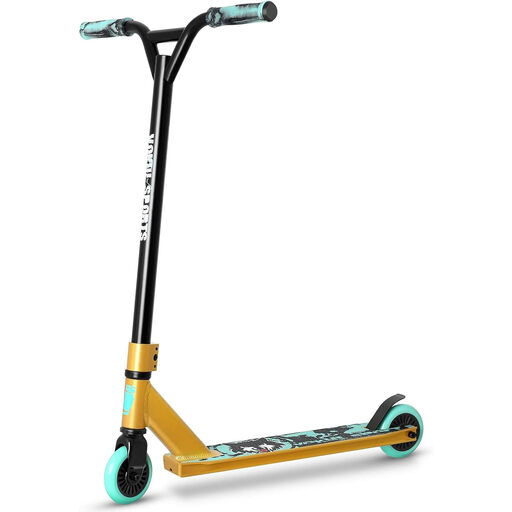
Why it suits this type of rider: According to the product information, this model is designed for beginners and stunt riding. It weighs 3.6 kg and has a stated load capacity of 100 kg.
The fixed handlebar construction and rigid suspension avoid a folding mechanism and suspension that could develop unwanted play during tricks.
Aluminium and alloy steel, solid 100mm PU wheels and a rear brake.
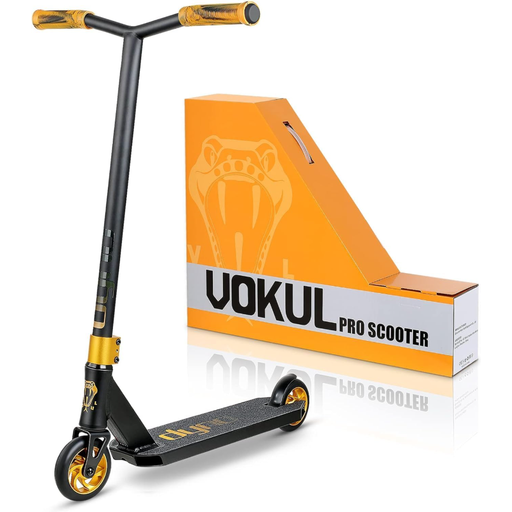
Why it suits this type of rider: The K1 is aimed at children aged 8 and over, teenagers, and beginner to intermediate riders who practise more often at the skate park.
The product description lists a one-piece T4T6 fork, a T-6061 aluminium deck and a fixed construction without suspension.
110mm PU wheels, ABEC-9 bearings, a non-slip deck and delivery that is described as around 95% assembled.
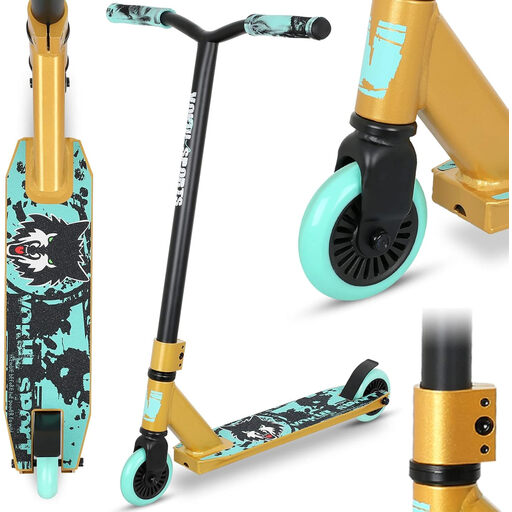
Why it suits this type of rider: This version is designed for riders aged 6 and over looking for a BMX freestyle scooter for tricks and skate park use.
The fixed HIC compression system and welded construction are specific features to compare with basic city scooters.
6061 aluminium deck and frame, 100mm wheels, ABEC-9 bearings and a stated load capacity of 100 kg.

Why it suits this type of rider: Its stated minimum age of 8 and 110mm wheels make it a good fit for teenagers and adult riders who mix street and park tricks.
The fixed three-bolt clamp, one-piece T4T6 fork and non-folding design are features you can check for repeated trick use.
T-6061 aluminium deck, 110mm PU wheels, ABEC-9 bearings and soft 145 mm rubber grips.
After unpacking, first check that the contents match the product page. According to the descriptions, several models only require the three-bolt clamp to be tightened. Use the right tools, then check that the handlebars have no play.
Make these checks part of your routine:
We’ve put together a complete, up-to-date list of products that meet these strict selection criteria and the applicable European safety regulations.
It varies by model. This selection includes versions for children aged 6 and over, as well as models for ages 8 and up. Age is only a guide. Compare handlebar height, weight, load capacity and your child’s coordination and experience too. Supervision is important for young riders.
Its lifespan depends on how it’s used, the riding surface, landings and maintenance. A scooter used every day at a skate park will wear out faster than one used occasionally. The wheels, bearings, grips, brake and bolted connections all need regular checks.
Maintenance is usually limited to checking the bolts, inspecting parts, cleaning the scooter and replacing worn wheels or grips. Don’t use it if the handlebars are loose, the deck is damaged or the brake isn’t working properly.
