
Vandaag of morgen in huis

Kwaliteit gegarandeerd

Welkomstaanbiedingen ontgrendelen: GRATIS bezorging | Tot 80% korting | Gratis 30 dagen JoyPlus-proefperiode
Download de app
A stunt scooter for children needs to do more than just roll forwards. Tricks, jumps and skatepark sessions put much more strain on the frame than everyday riding on a standard children’s scooter. Yet many models look alike in online shops. A colourful design or the word “pro” doesn’t automatically mean a scooter is right for your child.
Look out for these three common pitfalls:
Aluminium frames and decks are common in a sturdy stunt scooter. T-6061 aluminium is often used because it combines relatively low weight with a solid construction. Some models combine aluminium with steel, for example in the handlebars. This can add weight, but may also give the scooter a different feel.
The fork is an important component for tricks. A one-piece fork, such as the T4T6 fork listed for various VOKUL K1 models, has no separate joints between multiple fork sections. Also check that the handlebars are secured with a sturdy clamp. A triple clamp is used on the VOKUL S2 range.
100 or 110 mm wheels are common on freestyle scooters. A 100 mm wheel may feel easier to manage for young beginners; according to the product specifications, 110 mm wheels offer a slightly larger rolling surface and are often chosen for skatepark use.
Pay attention to the material, too. The VOKUL models mentioned use solid polyurethane wheels, including 88A wheels on several K1 versions. Hardness affects how the scooter feels to ride, but doesn’t guarantee a particular lifespan. ABEC-9 refers to a bearing rating; also consider the finish, maintenance and condition of the bearings.
A stunt scooter for beginners should be easy to control. A scooter that’s too heavy makes learning tricks more difficult. Handlebars that are too low can be uncomfortable, while handlebars that are too high may affect control during jumps.
Always check:
The product descriptions for the models below list weight capacities of up to 220 lb, approximately 100 kg. This is a product specification, not a recommendation to ride at the maximum limit. Remember to factor in clothing, a backpack and the extra force generated on landing.
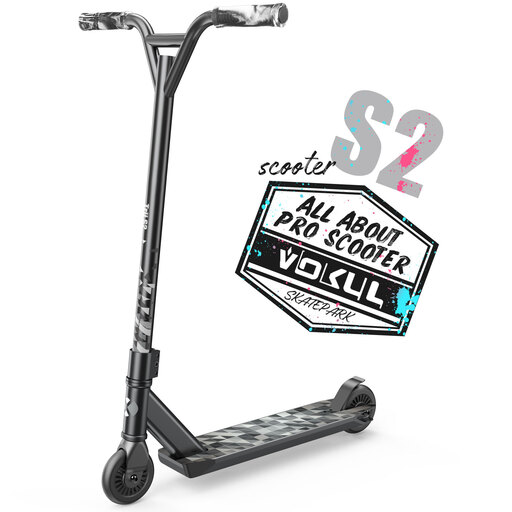
Why it suits this rider: According to the product description, this fixed freestyle scooter is designed for young people aged around 7 to 14 who want to learn basic tricks. It arrives mostly assembled.
It’s not a foldable scooter for getting around town, but a fixed model with a reinforced deck, chromoly handlebars and a triple clamp.
6061 aluminium frame, 4130 chromoly handlebars, fixed construction and solid 100 mm wheels.
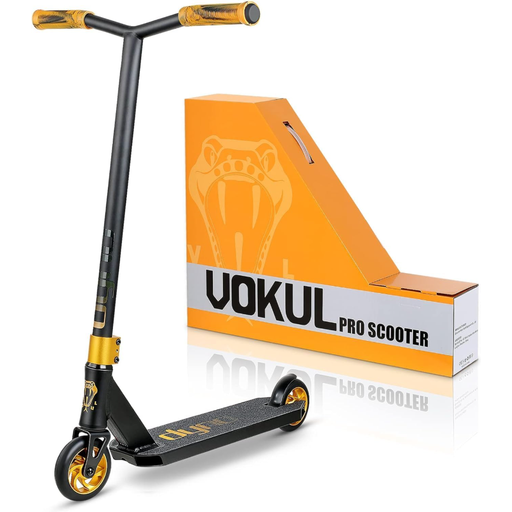
Why it suits this rider: This model is aimed at riders aged 8 and over, teenagers and adults looking for a freestyle scooter for the street and skatepark.
The specifications list a T-6061 aluminium deck, a one-piece T4T6 fork and an anti-slip deck, rather than relying on vague marketing terms.
110 mm wheels, 88A polyurethane, ABEC-9 bearings, soft 145 mm grips and a 3-bolt clamp.

Why it suits this rider: For teenagers and adults who practise regularly and want a fixed stunt scooter for tricks, street riding and skatepark sessions.
This model doesn’t rely on a folding mechanism. It has a fixed fork, an anti-slip deck and a rear brake.
T-6061 aluminium deck, 110 mm wheels, ABEC-9 bearings and a one-piece T4T6 fork; according to the product information, suitable for ages 8 and over.
The stunt scooters mentioned arrive mostly assembled. Usually, all you need to do is tighten the 3-bolt clamp around the handlebars. Before the first ride, check that all the bolts are secure and that the handlebars have no play.
For regular maintenance:
Wear a properly fitted helmet, knee and elbow pads, and wrist guards when learning tricks. Follow the age and weight limits in the product information. When buying, also check that the manual, manufacturer details and European product safety information are available.
We’ve put together a complete, up-to-date list of products that meet these strict selection criteria and the applicable European safety requirements.
It depends on the model. Some VOKUL S2 versions are sold for children from around 6 or 7 years old, while the product information lists the K1 models as suitable from age 8. Don’t look at age alone; also consider the rider’s height, handlebar height, weight and experience.
Its lifespan depends on the rider’s weight, the surface, how often tricks are practised and how well the scooter is maintained. Check the bolts, wheels, bearings, brake and fork regularly. A stunt scooter used at the skatepark will generally wear out faster if it’s landed on hard frequently or ridden on rough surfaces.
With normal recreational use, maintenance is limited to cleaning and checking the bolts. Over time, you may need to replace the bearings, grips, wheels or brake components. Before buying, check that replacement parts and warranty information are readily available.
