
Backing vocal mixer
You want to assess vocal layers and their stereo balance from a fixed listening spot. So start with a symmetrical setup; Genelec recommends this as the basis for monitor placement.


Start with two monitors that can be positioned symmetrically at your usual listening spot and connected to your audio source. A compact stereo set can save space, while separate nearfield monitors offer different connections and adjustment options. Neither option, however, automatically cancels out the room’s acoustics or prevents sound from disturbing housemates and neighbours.
You want to assess vocal layers and their stereo balance from a fixed listening spot. So start with a symmetrical setup; Genelec recommends this as the basis for monitor placement.
You need to fit two speakers alongside your other equipment and want to know whether a compact stereo set or two separate nearfield monitors will work better in your workspace. IK Multimedia describes the iLoud Micro Monitor as a compact stereo set.
You want to consider listening time and noise for housemates or neighbours. The World Health Organization identifies both sound level and duration of exposure as relevant factors; the Dutch government advises trying to reach an agreement with your neighbours first if noise becomes a problem.
| What to consider | What should you look for? | Who should pay particular attention? |
|---|---|---|
| Vocal balance and stereo image | Position both speakers at the same height and distance, and angle them towards your listening spot. Genelec recommends a symmetrical setup as a starting point. | If I’m assessing vocal layers from a fixed spot, I want to hear the left and right channels under similar conditions. Around 31% of consumers put the balance between vocal layers first. |
| Room acoustics and placement | Consider how much space you have between the monitors and the walls, and check which adjustment controls the exact model offers. Yamaha lists ROOM CONTROL for the HS5; PreSonus specifies an Acoustic Space control for the Eris Studio 4. | If my desk or room determines where the monitors can go, I want to adapt the setup and available settings accordingly. Room acoustics are the main priority for around 25% of consumers. |
| Space for two speakers | Measure the space on both sides and check the product dimensions and package contents. IK Multimedia describes the iLoud Micro Monitor as a stereo pair. | With a crowded desk, I want to fit two speakers without having to sit off-centre. Space for two speakers is the top priority for around 19% of consumers. |
| Quiet listening | Check whether you can easily adjust the playback volume, and bear in mind that music may be audible outside the room. The World Health Organization highlights both volume and listening time. | During long sessions, I want to be able to adjust the volume easily and consider housemates or neighbours. Quiet listening is the main priority for around 13% of consumers. |
| Connections and set contents | Compare the outputs on your audio source with the model’s inputs, and check whether the package contains one speaker or a pair. Yamaha states that the HS5 is sold individually. | I want to make sure my source, cables and both speakers work together as a stereo set. Connections and set contents are the top priorities for around 12% of consumers. |
The Yamaha HS5 is sold individually, as is the PreSonus Eris Studio 4. So an offer for one speaker doesn’t automatically give you a complete stereo set.
Before buying, check how many speakers you’ll receive and which connections you need.
You may need to buy a second speaker and suitable cables.
The published lower frequency limits for the Yamaha HS5 and ADAM T5V use different dB references. Without measurements on the same basis, they can’t be compared directly. What you hear at your listening spot is also affected by the room.
Only compare frequency specifications when they use the same measurement basis, and assess the monitors in a setup that works for you.
Adjusting a monitor won’t remove the effects of speaker positioning or reflections in the room.
Start with a symmetrical setup at your usual listening spot, then use the available controls to fine-tune the monitors.
ADAM Audio describes the T5V as an active nearfield monitor for small control rooms.
Yamaha describes the HS5 as an active nearfield monitor with analogue XLR and TRS inputs.
PreSonus describes the Eris Studio 4 as a compact active monitor for spaces including small mixing rooms; the model is sold individually.
IK Multimedia describes the iLoud Micro Monitor as a compact stereo set for workspaces where space is limited.
This Joybuy product selection is suited to a fixed listening spot and assessing backing vocals with two monitors.
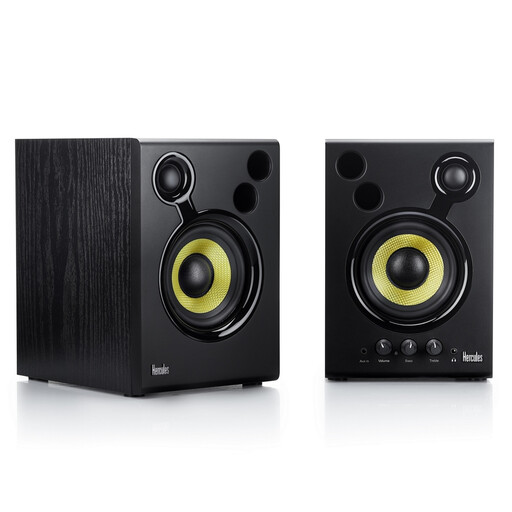 No image available
The description specifies two speakers and recommends positioning them in a triangle with your listening spot.
The speakers have a 4-inch woofer and bass and treble controls. The listed connections are RCA and 3.5 mm; according to the product description, leave at least 10 cm of space behind the bass ports.
Angle both monitors towards your usual listening spot, and try to keep them at the same height and distance on the left and right. Genelec recommends a symmetrical setup, ideally in an equilateral triangle. Then listen in your own room.
No, not without taking the measurement basis into account. Yamaha lists 54 Hz at −10 dB for the HS5, while ADAM Audio lists 45 Hz at −6 dB for the T5V. Without measurements on the same basis, these figures don’t provide a reliable ranking of bass performance at your listening spot.
Not necessarily. According to the Netherlands Authority for Consumers and Markets, the seller is responsible for the statutory guarantee when you buy as a consumer. Depending on the circumstances, they may offer a repair, replacement or, in some cases, a refund. This is separate from any commercial manufacturer’s warranty.
According to ACM ConsuWijzer, online purchases usually come with a cooling-off period of up to 14 days after delivery. Check which exceptions and returns conditions apply to your purchase.
Consider both the volume and duration of your listening, as well as how much sound reaches housemates or neighbours. If noise becomes a problem, the Dutch government advises trying to reach an agreement with your neighbours first. If the disturbance continues, it suggests contacting your landlord, residents’ association or local council, among others.