
Student in a noisy room
You edit speech while noise from housemates or your surroundings could affect your judgement. Shure Europe describes closed-back headphones as an option for studio recording, but fit and seal still matter.


If you work in a shared or noisy student bedroom, start by considering a well-fitting, closed-back pair of wired headphones. They’re designed to help block out more background noise while you listen, although the seal also depends on the fit. Shure Europe describes closed-back models as a suitable choice for studio recording. Open-back models can offer a different listening perspective in a quiet room, but let sound in and out. Also check that the connection works with your laptop or audio interface, and remember that no single specification proves you’ll hear every editing artefact.
You edit speech while noise from housemates or your surroundings could affect your judgement. Shure Europe describes closed-back headphones as an option for studio recording, but fit and seal still matter.
You compare edited speech with the original recording to spot any sounds that remain or new artefacts. iZotope emphasises that editing should not introduce distracting artefacts.
As well as sound, you consider fit, cables and parts that may wear out. Manufacturers such as Audio-Technica, AKG and Sennheiser describe different cable and maintenance features for each model.
In a shared or noisy room, closed-back headphones are the first option to consider. Open-back models are better suited to quiet spaces where sound leakage isn’t an issue. Shure Service explains that open-back earcups let sound in and out.
| What to consider | What should you check? | Who should give this more weight? |
|---|---|---|
| Background noise | Check whether the earcups are closed-back and fit well. Choose open-back headphones only if isolation isn’t needed. | If I’m listening back to dialogue while others in the room are making noise, I want to minimise how much it affects what I hear. Around 36% of consumers prioritise reducing background noise. |
| Dialogue and artefacts | Compare the same passage before and after editing at a controlled volume. Don’t treat claims about a flat sound as independent tests for detecting faults. | When I want to hear whether editing has changed the speech, I compare the original and edited recordings. Around 29% of consumers give this check top priority. |
| Comfort and maintenance | Try the headphones on if possible, and check whether the pads are replaceable on the exact version you’re considering. | For long sessions, I want a fit that stays comfortable and to know which parts I can replace later. This is the main concern for around 21% of consumers. |
| Connection | Check the output on your laptop or audio interface, which plug or adapter you need, and whether you can get a usable volume without distortion. | If I work with different equipment, I want to know in advance whether the cable and connection are compatible. Around 14% of consumers prioritise this practical consideration. |
Open-back earcups let noise from the room in and can let sound escape. This makes them less suitable when you want to block out background noise.
Choose this option only if the room is quiet enough and sound leakage won’t be a problem. Otherwise, compare closed-back models first.
An impedance rating or a manufacturer’s claim about tuning doesn’t prove that headphones will make every artefact in cleaned-up dialogue audible. Your equipment’s output also plays a part.
Check the connection and usable volume with your own equipment. When assessing your edits, compare the same passage before and after.
An extended warranty doesn’t replace your statutory rights if a product is faulty. The Dutch Government Information Service states that if there’s a problem with a product, you should contact the seller for a solution.
Check exactly what the extended warranty adds, and bear in mind how it differs from your statutory rights.
The closed-back ATH-M40x is a wired option with detachable cables.
The closed-back DT 770 PRO and open-back DT 900 PRO X offer different listening options.
Sony Netherlands describes the MDR-7506 as wired reference headphones for recording and studio use.
According to AKG, the closed-back, foldable K371 is designed for studio monitoring and use on the move.
The HD 280 PRO is a closed-back monitor headphone with model-specific service parts.
This selection includes headphones and headsets with a range of wired, wireless and sound features. The product features listed don’t prove how well a model reproduces dialogue artefacts, so check that the connection, fit and listening features suit the way you work.
 Image unavailable
A wireless over-ear option if you also want to listen without a cable as well as edit. Check that its listening features are suitable for checking dialogue.
The product name lists noise cancelling, 60 hours of battery life, fast charging and 4 microphones. The product description also mentions a 3.5mm cable and adjustable EQ and sound settings.
 Image unavailable
Wired over-ear gaming headphones to consider if you need one of the wired connections listed. The gaming label alone says nothing about how well they reproduce editing artefacts.
The product description lists USB-C and 3.5 mm connections, memory foam ear cushions and a lightweight design.
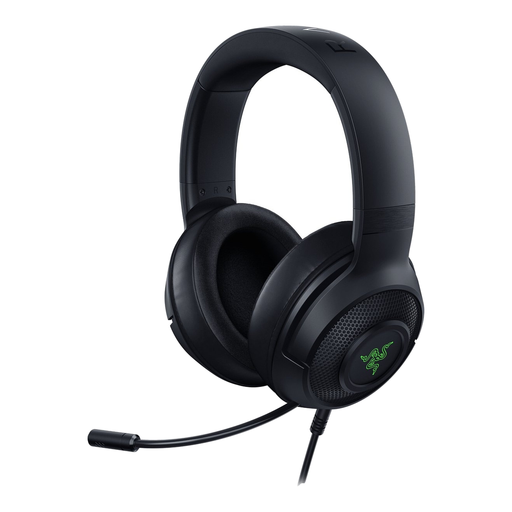 Image unavailable
A wired headset to consider if you listen via USB on a compatible computer. Check which features are relevant to your editing work.
The product description lists 40mm drivers, a USB connection and 7.1 support on Windows. The noise cancelling mentioned applies to the microphone.
 Image unavailable
Wireless headphones with noise cancelling if you also want to reduce background noise. Check whether wireless listening fits in with your editing setup.
The product description lists LDAC audio and up to 30 hours of battery life with noise cancelling switched on.
 Image unavailable
A wired stereo headset to consider if you’re looking for an on-ear design. Check that it remains comfortable during longer listening sessions.
The product description lists a 0.95 m cable, a 3.5mm connection and a USB controller.
Choose closed-back headphones if you monitor through them while recording and want to limit sound reaching the microphone. Open-back models are a separate listening option when you don’t need that isolation.
Listen to the same passage before and after editing at a controlled volume, and check for both remaining noise and new unwanted sounds. A product specification alone doesn’t show that headphones will make every artefact audible.
First, check the output and plug. Make sure the 3.5mm or 6.35mm connection and any adapter are compatible with your laptop or audio interface, then check that you can get a usable volume without distortion.
Look for parts using the full model name and the correct version. For example, Sennheiser lists a pad set for the HD 280 PRO from the 2016 version onwards, while beyerdynamic lists replaceable pads for the DT 770 PRO.
For many consumer purchases made at a distance, you have a 14-day cooling-off period, with some exceptions. Check which terms apply to your purchase. You’re also entitled to a product that works properly: the Dutch Government Information Service states that if a product is faulty, you can ask the seller for a solution.
Not simply because they’re headphones. According to the European Union’s Your Europe website, CE marking is required when the applicable harmonised EU rules require it for the specific product. Whether this applies to a particular wireless or other version must be assessed separately.