
Student with limited kitchen space
You need room for yoghurt and everyday groceries, but have to balance the external dimensions against the fridge capacity.


First, choose a fridge whose fridge compartment can be set to 4 °C and whose temperature you can check after installation; the Netherlands Nutrition Centre recommends keeping your fridge at 4 °C. Then compare the external dimensions and usable fridge capacity, and only choose a freezer compartment if you also store frozen food. Among models that fit, compare the stated annual energy consumption and noise level.
You need room for yoghurt and everyday groceries, but have to balance the external dimensions against the fridge capacity.
You need a freezer compartment as well as fridge space, and want to know how much room that leaves for yoghurt.
You compare models that fit your available space by their energy use in kWh per year, not just their energy rating.
For fresh yoghurt, the Netherlands Nutrition Centre recommends a fridge temperature of 4 °C. Once your fridge is installed, check whether it actually reaches this temperature in your kitchen.
| What to consider | What to look for | Who is this most important to? |
|---|---|---|
| Keeping yoghurt cold | Check whether you can set the temperature, then use a fridge thermometer after installation to see if the fridge reaches 4 °C. | If I mainly store fresh yoghurt, I want to be sure the fridge gets cold enough in my kitchen. Around 31% of consumers prioritise reliable cooling. |
| Dimensions and fridge capacity | Measure the available space and check the external dimensions, door opening and layout of the fridge compartment for the exact model. | In a small student kitchen, I want to know whether the appliance will fit and leave enough room for yoghurt and other groceries. Around 25% of consumers prioritise suitable dimensions and fridge capacity. |
| Energy use | Compare the stated energy use in kWh per year of models that fit your space and capacity requirements. | I don't want to rely on the energy rating alone; I also want to compare annual energy use. Around 19% of consumers prioritise energy use. |
| Noise | Compare the stated noise levels of the exact models and consider where the fridge will be placed. | If the fridge is close to where I study or sleep, I want to take its stated noise level into account. This is the top priority for around 13% of consumers. |
| With or without a freezer compartment | Compare fridge and freezer capacities separately, and check whether the freezer compartment suits what you want to store. | I also store frozen food, so a freezer compartment is useful as long as there is enough fridge space left for yoghurt. Around 12% of consumers make freezer space their top priority. |
Milieu Centraal and the EU energy label list annual energy use as information for comparison. Manufacturer figures for noise or capacity do not, on their own, tell you whether a fridge will reach 4 °C in your kitchen.
The name or temperature dial won't tell you what temperature the fridge will actually reach in your kitchen.
After installation, use a fridge thermometer to check whether the fridge compartment reaches 4 °C, and adjust the setting if necessary.
In a fridge with a freezer compartment, not all the capacity is available for chilled food. For example, Inventum lists the KV550 as having 97 litres of fridge space and 16 litres of freezer space.
Compare the fridge capacity and shelf layout separately. Choose a freezer compartment based on what you actually want to freeze.
The rating alone won't tell you whether the size and fridge capacity suit your needs.
Compare the stated energy use in kWh per year of models that meet your space and capacity requirements. Use your own electricity tariff to estimate running costs.
The TS190040N is a narrow, freestanding under-counter fridge without a freezer compartment, for anyone mainly looking for fridge space.
According to Inventum, the KV550 combines a fridge compartment with a small freezer compartment.
Tomado offers the TRT5501W under-counter model with a freezer compartment and the TLT5501W without one.
The Rd 1200 is an under-counter model without a freezer compartment, for anyone comparing fridge space with a compact width.
This selection includes under-counter fridges for yoghurt and other fresh food, with models both with and without a freezer compartment. For each model, check that the dimensions and fridge capacity suit your kitchen, and measure the temperature after installation to see whether the fridge reaches 4 °C.
 No image available
An option if you're mainly looking for fridge space in a compact under-counter fridge; check after installation whether the fridge compartment reaches 4 °C.
88 litres of fridge capacity; energy class E; 90 kWh per year; dimensions 85 × 48 × 45 cm; adjustable glass shelves and a salad drawer. The product description says it has no freezer compartment.
 No image available
Worth considering if you want to store frozen food as well as yoghurt; bear in mind that the freezer compartment takes up some of the total capacity.
95 litres of fridge space and a 14-litre freezer compartment; 109 litres total capacity; energy class C; 89 kWh per year.
 No image available
One to include in your comparison if you need both fridge space and a freezer compartment; check that the external dimensions fit your kitchen.
107 litres of fridge capacity and a 13-litre freezer compartment; energy class C; 87 kWh per year; dimensions 84,50 × 54,90 × 55,70 cm.
 No image available
An under-counter model to compare if you want to factor in fridge space and annual energy use; check the available space before you buy.
129 litres capacity; energy class E; 92 kWh per year; dimensions 54 × 54 × 88 cm; two glass shelves and a salad drawer.
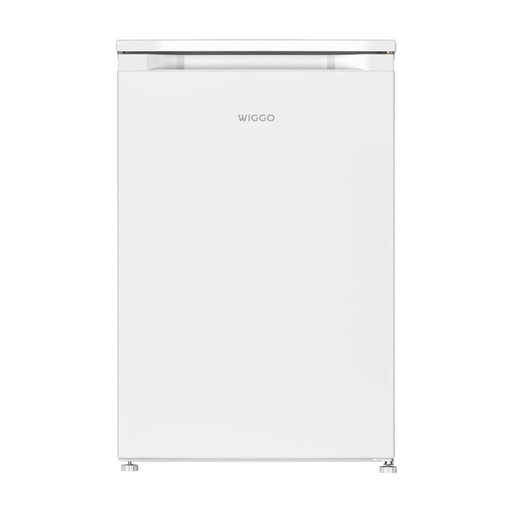 No image available
A freestanding under-counter model to compare if you're looking for fridge space for fresh groceries; measure the space available and check the temperature after installation.
107 litres capacity; energy class D; mechanical temperature control; one glass shelf, a salad drawer and door shelves. The product description says the door is reversible.
The Netherlands Nutrition Centre recommends 4 °C. Place a fridge thermometer in the middle of the bottom shelf and leave it there for half a day or overnight. Adjust the fridge setting if the temperature is higher.
The Netherlands Nutrition Centre says opened full-fat yoghurt keeps for 5–7 days in the fridge. Put it back at 4 °C promptly after use, use clean cutlery, and follow the storage advice and date on the packaging for an unopened pot.
For models of a suitable size, compare the stated energy use in kWh per year. The EU energy label includes details such as the energy class, energy use, capacities and noise level. You'll also need your own electricity tariff to calculate running costs.
Don't place the fridge in direct sunlight or right next to a heat source. Follow the instructions for your chosen model, and check after setting it up that the fridge compartment reaches 4 °C.