
Student sharing a fridge
Wants to store opened cream without unnecessarily buying a second fridge. The available space and actual measured temperature will help you decide whether the shared fridge is enough.


If you only need to store opened cream, you don’t automatically need your own fridge. Use the shared fridge if there’s space and you can check the temperature with a thermometer to ensure it is at the 4 °C recommended by the Netherlands Nutrition Centre. If there isn’t enough room, compare a suitable under-counter fridge and only choose one with a freezer compartment if you also want to store frozen food. Check each model’s energy consumption and noise level too. How long cream lasts after opening depends on the type and the label.
Wants to store opened cream without unnecessarily buying a second fridge. The available space and actual measured temperature will help you decide whether the shared fridge is enough.
Is looking for an under-counter fridge that fits in the kitchen and has enough chilled storage for cream and everyday fresh food.
Needs a freezer compartment as well as chilled storage, so compares the fridge and freezer capacities separately.
First, check that the shared fridge is at the right temperature and has enough space. If you’re considering your own model, look at the space available, the fridge capacity and whether you need freezer space.
| What to consider | What to look for | Who is this important for? |
|---|---|---|
| Fridge temperature | The Netherlands Nutrition Centre recommends 4 °C. Check the actual temperature with a fridge thermometer; reading the dial setting alone doesn’t measure it. | If I store cream in a shared fridge, I want to be able to check the temperature. Around 33% of consumers prioritise a reliable fridge temperature. |
| Space and fridge capacity | Measure the space available and compare the dimensions and capacity in litres of the fridge compartment. On a model with a freezer compartment, the total capacity is not the same as the fridge capacity. | If space is limited but I also want to store other fresh food, the appliance needs to fit without leaving me short on fridge space. Around 27% of consumers give suitable fridge capacity top priority. |
| Energy consumption | Compare the annual consumption on the energy label and weigh it against the fridge capacity and whether you really need a second appliance. The EU label for household fridges uses a scale from A to G. | If the shared fridge is suitable, I want to know whether I need my own appliance. Around 20% of consumers prioritise limiting extra energy use. |
| Freezer compartment | Choose a freezer compartment only if you want to store frozen food yourself. On a fridge-freezer, compare the fridge and freezer capacities separately. | If I want to store frozen food as well as cream, having my own freezer space matters when I’m choosing. Around 13% of consumers give this need top priority. |
| Noise | Compare the stated noise emissions in dB(A) of the models you’re considering. A lower noise rating alone says nothing about fridge capacity or temperature. | If the fridge is close to where I study or sleep, I want to take its stated noise level into account. Around 7% of consumers consider noise their top buying priority. |
If the shared fridge has enough space and reaches the recommended temperature, it may already be suitable for storing opened cream.
Measure the temperature in line with the Netherlands Nutrition Centre’s advice and check that there’s space for the packaging too.
On an under-counter model with a freezer compartment, some of the stated total capacity is for frozen food, not chilled cream.
Compare the separate fridge capacity and decide in advance whether you need the freezer compartment.
The Netherlands Nutrition Centre gives different storage times for opened single cream and cooking cream.
Check the label and storage advice for the specific type of cream, and keep an opened container chilled.
The KV550 is an under-counter model with a fridge compartment and freezer compartment, for anyone looking to compare both.
Offers the TLT5501W without a freezer compartment and the TRT5501W with one, giving you two compact models to compare.
The Rd 1200 Pure is an under-counter model to compare if you don’t need your own freezer compartment.
The KTR15NWEB is an under-counter model without a built-in freezer compartment, for anyone who values fridge space over having their own freezer space.
The TSE1284N is an under-counter model to include in your comparison of compact fridges.
The Joybuy products below include a very compact cooling option and under-counter models, with and without a freezer compartment.
 No image available
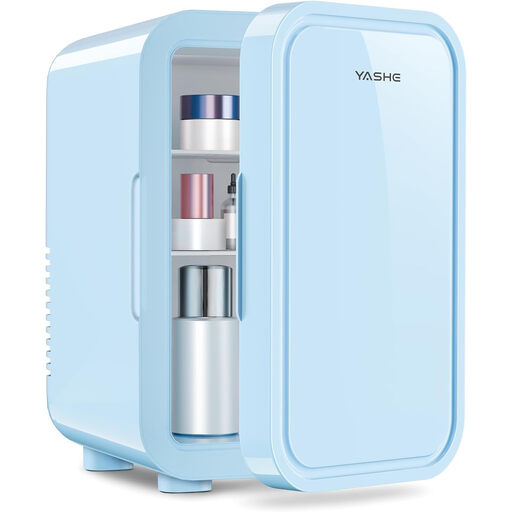
A compact option if you’re looking for a small place to keep things cool in your student room. Use the cooling mode for cream.
The product name specifies 6 litres, space for 8 cans and 220–240 V AC/DC. The description mentions cooling and heating modes, with a cooling mode of 1–2 °C.
 No image available
An under-counter model without a freezer compartment for anyone looking for fridge space but who doesn’t need their own freezer.
Fridge capacity of 88 litres, energy rating E and a mechanical temperature control. The description lists three adjustable glass shelves and a salad drawer.
 No image available
An option if you want separate freezer space as well as chilled cream. Bear in mind that the freezer compartment is included in the total capacity.
109 litres in total: 95 litres of fridge capacity and 14 litres of freezer space. Energy rating C, 89 kWh per year and 37 dB.
 No image available
An under-counter model with a separate freezer compartment for anyone who wants to store both chilled cream and frozen food.
120 litres in total: 107 litres of fridge capacity and 13 litres of freezer space. Energy rating C and 87 kWh per year.
 No image available
An under-counter model to compare if you’re looking for fridge space for opened cream and other food. Check that this version suits your freezer-space needs.
54 cm wide with a net capacity of 129 litres. Energy rating E, 92 kWh per year and 39 dB. The description mentions mechanical temperature control.
The Netherlands Nutrition Centre recommends 4 °C. Place a fridge thermometer in the middle of the bottom shelf and leave it there for half a day or overnight. Adjust the fridge if the thermometer shows a higher temperature. The selected setting alone doesn’t show the actual temperature.
It depends on the product and the label. The Netherlands Nutrition Centre says opened single cream lasts 4–6 days in the fridge, while opened cooking cream lasts 3–5 days. These times aren’t a guarantee for every pack. Follow the label, then check the cream in line with the Netherlands Nutrition Centre’s advice.
Measure the available space and follow the installation instructions for your chosen model. Once it’s up and running, check the temperature with a separate thermometer. Reading the selected setting alone isn’t enough to establish the actual temperature.
The EU energy label for household fridges uses a scale from A to G and shows information including energy consumption, capacity and noise. Compare the stated kWh per year between models. Your own electricity costs also depend on your tariff and how you use the fridge.
According to the Dutch government, if a product is faulty, you can contact the seller to discuss your right to a product that works and a suitable solution. You can take an old fridge to the shop or online service where you buy a similar new appliance, among other options.