
Film-maker showing films in a bright room
You want to show a film project to others during the day, but can’t always block out the light. Consider how much light falls on the projection surface and whether you can darken the room.


If you can’t control the ambient light, choose a projector based on the lighting conditions and its stated light output; a lumen figure doesn’t guarantee a good picture in direct sunlight. If you can darken the room, also consider the set-up, Full HD picture, connections and sound. The model specifications listed here are not a practical test of the projectors in your room.
You want to show a film project to others during the day, but can’t always block out the light. Consider how much light falls on the projection surface and whether you can darken the room.
You’re sharing your film in a small or changing space and want to check before buying whether the picture size, distance and connections will work in the space available.
You can darken the room and want the picture and soundtrack to come across well to your audience. So, as well as checking the resolution, consider your sound set-up.
First, work out how much ambient light you can block out and whether the projector can produce your preferred picture size from your chosen position. Then compare the resolution, connections and sound with your source device and how you plan to show the film.
| What to consider | What should you check? | Who is this important for? |
|---|---|---|
| Picture visibility in daylight | Note where daylight falls on the projection surface, whether you can darken the room and how large the picture needs to be. Compare the stated light output and the basis on which it was measured. | If I sometimes show the film during the day and can’t always block out the light, I want to know what the picture will look like on my screen; around 36% of consumers put picture visibility in daylight at the top of their list when buying. |
| Projection distance and set-up | Measure the distance from the lens to the projection surface and the available picture width. Check that combination against the placement details for the exact model. | In a small or changing space, I want to know in advance whether the projector will fit in the available spot; around 29% of consumers prioritise the set-up and achievable picture size. |
| Picture, connections and sound | Check the stated resolution, whether you can connect your playback device and whether you want to use separate speakers. | When I show the film to a group, I want both the picture and soundtrack to work well for the audience; around 21% of consumers put film playback and sound at the top of their list. |
| Purchase and occasional use | Check which connections and set-up you need, and what light source and usage details are stated for the model. | If I only show films occasionally, I want to choose a set-up that suits that use; around 14% of consumers give ease of occasional use their highest priority. |
Lighting conditions on the projection surface are still what matter; manufacturers’ specifications don’t describe a test in your room. BenQ says that a projector can’t outshine the sun.
First, plan where you’ll show the film and see whether you can darken the room. Then assess the model’s stated light output.
Even a Full HD model needs to be able to produce your preferred picture size from the space available. Zoom or image correction doesn’t replace checking this.
Before buying, measure the distance and picture width, then check the placement details for the exact model.
According to Epson, the Epson EH-TW840 has a built-in 2 W mono speaker. This specification alone doesn’t tell you whether the sound will be loud enough for your audience.
Check the audio connections and decide in advance how you want to play the soundtrack.
The EH-TW840 is a Full HD model worth considering if you’re using a lit indoor space and need two HDMI inputs.
BenQ positions the Full HD TH585P for well-lit rooms; check whether it will fit your room’s layout.
The HD146X is a Full HD lamp model whose stated connections and throw ratio you can check against a fixed set-up.
The compact NeoPix 444 is a Full HD LED model to consider if you can darken the room.
This selection includes projectors for sharing a film. For each model, check the stated picture resolution, light output and connections against your room and playback device.
 No image available
The stated native 1080P resolution and HDMI connection are relevant if you want to share a Full HD film from an HDMI source.
The product title lists 700 ANSI lumens; the description gives brightness settings of 700, 550 and 450 ANSI lumens. Autofocus and automatic keystone correction are also listed.
 No image available
The stated HDMI compatibility may be useful if you want to play the film from an HDMI source; check that the source will work with your set-up.
The title lists a picture size of 50–200 inches, 50%–100% digital zoom, 180° rotation and automatic screen correction.
 No image available
The product information lists 1080p Full HD and HDMI, features to consider if you want to show a film from a compatible source.
The description lists 1,200 ISO lumens, two built-in 5 W speakers and HDMI-ARC.
 No image available
The stated native 1080P Full HD resolution and HDMI are worth checking if you’ll be playing the film from an HDMI source.
The title lists 900 ANSI lumens, Android 14, 180° rotation and automatic keystone correction.
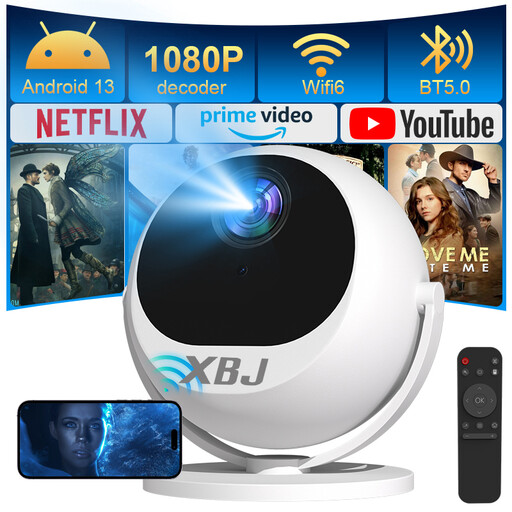 No image available
The title lists Full HD 1080P and HDMI; check that the connection is compatible with your playback device.
Also listed are 500 lumens, 360° rotation and automatic keystone correction. The title doesn’t state the measurement method for the lumen figure.
Don’t expect a clearly visible picture in direct sunlight. BenQ points out that a projector can’t outshine the sun, so block out light falling on the projection surface wherever possible. A lumen figure alone can’t predict what the picture will look like in your room.
Measure the distance to the projection surface and your preferred picture width. Then check the placement details for the exact model; Optoma publishes a throw ratio for the HD146X, while BenQ lists zoom for the TH585P.
No. According to ACM ConsuWijzer, Dutch statutory warranty applies alongside a warranty from the seller or manufacturer. If a product breaks during normal use earlier than you could reasonably expect, the seller is responsible for providing an appropriate solution; there isn’t one fixed statutory time limit for every projector.
Don’t assume that a student project automatically gives you permission. The Government of the Netherlands says that you need the creator’s permission to use copyright-protected films, photographs and music, and that a private copy for personal use can’t be made available to the public. The permission you need, or whether an exception applies to your film and screening, depends on the specific circumstances.