
People stocking up for coffee and tea
You want enough stroopwafels at home for several occasions. The number of waffles, net weight and storage instructions can help you decide which pack suits your needs.


If you want to stock up for coffee or tea breaks, a larger pack of classic stroopwafels could be a good fit, provided you also check the number of waffles and storage instructions. If you need to avoid gluten, choose a product explicitly labelled gluten-free and check the other allergens too. To compare sugar content, read the nutritional information for the specific products. ‘Digestive’ is a separate type of biscuit in the PLUS catalogue, not a proven health benefit of stroopwafels.
You want enough stroopwafels at home for several occasions. The number of waffles, net weight and storage instructions can help you decide which pack suits your needs.
You’re looking for stroopwafels explicitly labelled gluten-free and also checking the other allergens on the label. A gluten-free label alone says nothing about ingredients such as egg or lupin.
You’re comparing the nutritional information per 100 g and per portion, or looking for a smaller size. A product name such as ‘lower sugar’ doesn’t tell you what the full nutritional profile of a particular product looks like.
Start with any allergens you need to avoid. Then compare pack size, nutritional information and portion sizes with the occasions when you plan to enjoy your stroopwafels.
| What to consider | What to check before buying | Who it matters to |
|---|---|---|
| Pack size and quantity | Compare the net weight and number of waffles, and check how to store the product you choose. | If you’re stocking up for several coffee breaks, you’ll want enough waffles without ending up with an inconveniently large opened pack. An estimated 37% of consumers prioritise finding a pack size that suits their needs. |
| Gluten and allergens | Read the current allergen list, including for gluten-free products; check the ingredients and any warnings about possible traces. | If I need to avoid gluten, I want to know for certain which other allergens are in the pack I choose. Around 27% of consumers give allergen suitability top priority. |
| Nutritional information | Compare sugars, fat, fibre and energy per 100 g and per portion; check what any on-pack comparison refers to. | If you’re keeping an eye on sugar, you’ll want to compare what’s in a portion and how products differ. For roughly 18% of consumers, this nutritional comparison matters most. |
| Portion size | Check the number of waffles, the weight of each one and whether they’re individually wrapped. | For taking on the go or sharing, a smaller waffle may be more practical than a large one. Portion size is the deciding factor for around 18% of consumers. |
According to Jumbo’s product information, the gluten-free stroopwafels in its Lekker Vrij van Gluten range contain egg and lupin, and may contain nuts and sesame. PLUS also lists egg and lupin in its gluten-free stroopwafels.
Read the full allergen information for the exact pack you’re buying, rather than relying on the gluten-free label alone.
PLUS lists digestive biscuits and stroopwafels as separate types of biscuit. The name doesn’t provide grounds for assuming that stroopwafels aid digestion.
Choose stroopwafels based on the ingredients, portion size and nutritional information of the product itself.
A larger pack gives you more waffles, but it won’t necessarily suit how often you eat them or how you’ll store them after opening.
Compare the number of waffles and net weight with your needs, and follow the storage instructions on the pack.
Ingredients and allergen information can change when a product is updated. This is especially important if you choose a particular product because of an ingredient or allergen.
Check the current label on the pack when you buy it.
Pack sizes, ingredients and nutritional information vary between products from these brands. So compare the products themselves, not just the brand names.
A classic stroopwafel to enjoy with coffee or tea; Albert Heijn lists a pack of 10 weighing 290 g.
The supermarket’s own brand offers butter stroopwafels in a pack of 12, as well as a separate product with ‘lower sugar’ in its name.
Jumbo lists both 468 g butter stroopwafels and 240 g Lekker Vrij van Gluten Stroop Wafels.
PLUS lists 480 g standard stroopwafels and a separate 240 g gluten-free product.
Lidl describes Sondey butter stroopwafels as a classic product containing 12 waffles and weighing 480 g.
ALDI lists Heerlijck Banket Mini Stroopwafels in a 300 g pack.
This Joybuy selection is a pack of ten stroopwafels for several coffee or tea breaks. If you have specific requirements, also compare the ingredients and allergens on the pack.
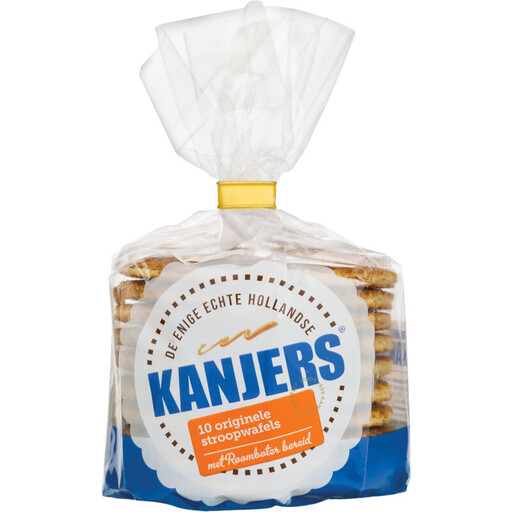 No image available
The pack of ten is ideal for enjoying over several coffee or tea breaks.
If you have allergies, check the current label for wheat or gluten, milk, soya and possible traces of nuts.
No, you can’t infer that from the term. PLUS lists digestive biscuits as a separate product alongside stroopwafels. Assess a stroopwafel based on its own ingredients and nutritional information.
Don’t choose a standard product without checking the label: the standard stroopwafels described from Daelmans, Jumbo and PLUS, among others, contain wheat or cereals containing gluten. Look for a product explicitly labelled gluten-free and read the full allergen information.
No, gluten-free doesn’t mean allergen-free. The gluten-free products described from Jumbo and PLUS contain egg and lupin; Jumbo also lists possible traces of nuts and sesame. Check the label on the pack you’re buying.
Follow the storage instructions for the product you choose and close the pack as directed. Jumbo recommends storing its butter stroopwafels in a cool, dry place; for the butter product described, Albert Heijn advises closing the pack securely after use.