
Buying for a biscuit tin that gets used often
You want to put out enough stroopwafels for several colleagues in one purchase. The pack size and number of waffles will help you work out how often you need to restock.


For an office biscuit tin that gets used regularly, a bulk pack is practical if you mainly want plenty of stock in one purchase. If people eat them slowly or colleagues take waffles away with them, minis or twin packs may be a better fit. Whichever you choose, check the allergens on the packaging and seal any opened stroopwafels well.
You want to put out enough stroopwafels for several colleagues in one purchase. The pack size and number of waffles will help you work out how often you need to restock.
You’re looking for minis or twin packs to offer smaller portions, let colleagues take waffles away with them or avoid opening the whole stock at once.
You want colleagues to be able to check the ingredients and allergens in the stroopwafels. To make that possible, keep the information from the specific pack available, even after filling the tin.
First, work out how quickly the tin empties and whether colleagues take waffles away with them. Then compare the pack format and check the storage and allergen information before putting them out.
| What to consider | What to check when buying | Who should pay particular attention? |
|---|---|---|
| Stock | Compare the net weight and, where stated, the number of waffles per pack. | If several colleagues regularly take waffles from the tin, I don’t want to have to refill it again after just a few occasions. Having enough stock is the top priority for around 36% of consumers. |
| Storage after opening | Check the best-before date and storage advice; seal any remaining waffles well. | When a pack takes a while to finish, I want to stop the rest from drying out. Being able to store them properly is the main concern for around 29% of consumers. |
| Portion size | Check whether they’re minis, individual waffles or separately wrapped twin packs. | If I want people to take them away or restock the tin in measured amounts, I’d rather choose a suitable portion size than one large, open supply. Around 21% of consumers prioritise this convenience. |
| Allergens | Read the ingredients, allergen information and any warnings on the current packaging. | If colleagues with food allergies use the tin, I want to be able to check exactly what’s in it. For around 14% of consumers, this is the main consideration. |
Allergens listed vary from one product to another. The standard packs from Jumbo and PLUS that were checked list wheat or gluten, milk and soya; other varieties may also carry warnings about the possible presence of allergens.
Read the label on each new pack and keep it for as long as the stroopwafels are in the shared tin.
A bulk pack is less suitable for a tin that gets used slowly if the remaining waffles aren’t stored in a sealed container. The Netherlands Nutrition Centre recommends storing stroopwafels in a cool, dry, dark place in a well-sealed container.
If needed, refill the tin in smaller quantities and seal the rest of the pack after use.
A mini stroopwafel is a smaller waffle; a twin pack contains two waffles wrapped together. This difference affects how you hand them out or give them to people to take away.
Check both the waffle size and how the waffles are packed inside the outer pack.
These brands offer examples of bulk packs, minis and twin packs. Always compare the specific product: sizes and ingredients can vary between varieties.
An option if you want to offer stroopwafels in pairs: the 4-pack shown by Albert Heijn contains four twin packs.
The range includes different types of stroopwafels, including a plant-based variety.
Jumbo Butter Stroopwafels, 468 g, are a specific example of a larger pack for a shared tin.
Lidl lists Sondey butter stroopwafels in a pack of 12, weighing 480 g.
ALDI lists both a pack of 12 stroopwafels weighing 378 g and 300 g of mini stroopwafels.
PLUS lists a 480 g pack of stroopwafels, as well as a Korenlanders variety made with butter.
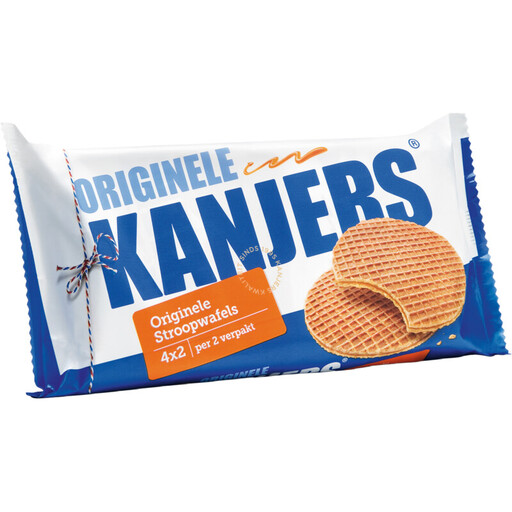
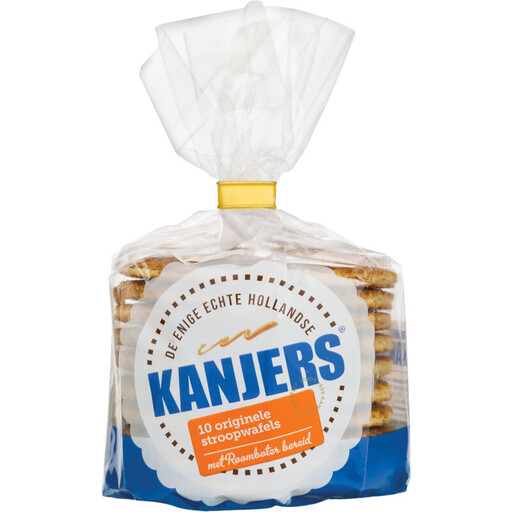
These Kanjers packs are options for a shared office supply. The pack of 8 contains twin packs; if handing out individual portions matters, check how the waffles are packed in the 10-piece pack.
 No image available
Ideal for offering in pairs or taking away: according to the Joybuy product description, the waffles are wrapped in pairs. The pack contains 8 pieces and has a net weight of 320 g.
Check the allergen information on the current packaging before putting the waffles in a shared tin.
 No image available
A pack of 10 for topping up a shared biscuit tin. Check the net weight to see how much stock you’ll get, and look at the packaging to see how the waffles are wrapped if you want to hand them out individually.
Before putting them in a shared tin, also check the current ingredient and allergen information.
Store any remaining stroopwafels in a cool, dry, dark place in a well-sealed container, as recommended by the Netherlands Nutrition Centre. If an office biscuit tin gets used slowly, it’s best to refill it in smaller quantities. Also follow the best-before date and storage advice on the packaging.
Keep the packaging for as long as the stroopwafels are in the tin, so colleagues can check the ingredients and allergens. The Netherlands Food and Consumer Product Safety Authority highlights the allergen information on labels, so check the details for the exact variety every time you open a new pack.
Not necessarily: butter tells you about an ingredient, but not which pack size will suit your tin. Also look at the pack size, number of waffles, portion format and allergens on the specific packaging.
This kind of warning refers to the possible presence of an allergen due to cross-contamination, rather than an ingredient that has been deliberately added. According to the Netherlands Food and Consumer Product Safety Authority, new rules have applied in the Netherlands since 1 January 2026 on how and when producers must include these warnings on labels. If you have a relevant allergy, always check the current packaging.