
Strategy gamer who wants to see the detail
You play ranked matches and use the same screen for studying. You want a clear view of the map, interface and text without putting unnecessary strain on your PC.


Start with the size of your student desk and the resolution your PC can handle in your strategy games. A compact Full HD screen takes up less space, while 27-inch QHD gives you more pixels for detail and study work, but puts more strain on your graphics card. Choose OLED with care if picture quality matters to you, and bear in mind that fixed interface elements can remain visible for long periods. A high refresh rate is only useful if your PC, connection and chosen resolution support it.
You play ranked matches and use the same screen for studying. You want a clear view of the map, interface and text without putting unnecessary strain on your PC.
You need room for the screen and stand alongside your study materials, so a compact size matters more to you than extra screen space.
You want smooth camera movement and check that your PC, connection and settings support the refresh rate you’re after.
A good fit if: desk space or your PC’s graphics capability is your main limitation.
The trade-off: Full HD gives you fewer pixels for map details and study text than QHD.
A good fit if: you have enough desk space and your PC can handle QHD at your preferred frame rate.
The trade-off: RTINGS notes that QHD demands more from your graphics card than Full HD.
A good fit if: contrast and motion clarity are important factors in your choice.
The trade-off: displaying the same HUD or desktop elements for long periods remains a consideration with OLED. Tests of other devices cannot predict the lifespan of a specific model.
| What to consider | What to look for when buying | Who should prioritise this? |
|---|---|---|
| Sharpness and screen space | Compare Full HD and QHD at your preferred screen size, and check how your own strategy game runs on your PC. | If I want to see map details, the game interface and study text on one screen, resolution matters a lot to me. Around 33% of consumers put sharpness and screen space first. |
| Smoothness | Check the refresh rate supported by the input you’ll use at your chosen resolution. | If I play ranked, I want to know what frame rate my PC and connection can actually deliver. Around 25% of consumers give smoothness top priority. |
| Desk fit | Measure the available width and depth, then compare them with the dimensions of both the screen and the stand. | On a small student desk, the screen needs to fit alongside my study materials. Around 25% of consumers make physical fit their main consideration. |
| Power use and long-term use | Compare the EU energy label for the exact version, and consider fixed image elements that remain visible for long periods on OLED. | If I also use my monitor for long study sessions, I want to consider its power use and fixed on-screen elements. Around 17% of consumers prioritise long-term use and power consumption. |
The supported refresh rate may depend on your chosen resolution and input. Check your PC output, cable and monitor port for the combination you want, then set the refresh rate in Windows under Advanced display settings.
For the MSI MAG 272QPF E20, the retailer’s product page gives conflicting information about resolution, refresh rate and panel specifications. Before buying, compare the full model number and relevant modes with MSI’s specifications.
If the same game HUD or desktop elements stay visible for long periods, burn-in is a usage-related consideration. This does not prove that a specific model will suffer burn-in under normal use.
Consider how you use fixed interface elements alongside the picture quality you want, and consult the care instructions for the exact model.
The AOC 24G4XE is an example of a compact IPS option, with a stated diagonal size of 23.8 inches and a 180 Hz refresh rate.
The MAG 272QPF E20 represents a 27-inch QHD LCD option. MSI lists Rapid IPS, 2560 × 1440 and 200 Hz.
The Alienware AW2725D is an example of a 27-inch QHD OLED model for which Dell lists a 280 Hz refresh rate.
The ROG Swift OLED PG27AQWP-W is an example of a model with different refresh rates for different resolution modes.
This selection includes compact Full HD models and 27-inch QHD models, including a QHD OLED option.
 No image available
A good fit if you’re looking for a 27-inch QHD screen for detail and smoothness, provided your desk and PC can accommodate it.
The product name lists 2560 × 1440, 180 Hz and FreeSync Premium.
The listed connections are 2× HDMI 2.0 and 1× DisplayPort 1.4.
 No image available
A good fit if you want a larger QHD viewing area and have room for both the screen and stand.
The product description lists 2560 × 1440, a Fast IPS panel and 240 Hz native refresh rate; up to 260 Hz overclocked.
The description mentions Adaptive-Sync and height, swivel and tilt adjustment.
 No image available
A good fit if you’re considering QHD and OLED and want to take into account the trade-off of fixed interface elements remaining visible for long periods.
The product name lists 2560 × 1440, 240 Hz, HDR10, G-SYNC Compatible and VESA Adaptive-Sync.
If you use the same fixed game interface for long periods, the general risk of OLED burn-in remains a consideration; this does not predict the lifespan of this model.
 No image available
A good fit if you’re looking for a more compact screen for a smaller workspace.
The product name lists Full HD; the product description mentions IPS, 144 Hz, G-SYNC Compatibility and FreeSync.
Full HD gives you fewer pixels than QHD for map details and study text.
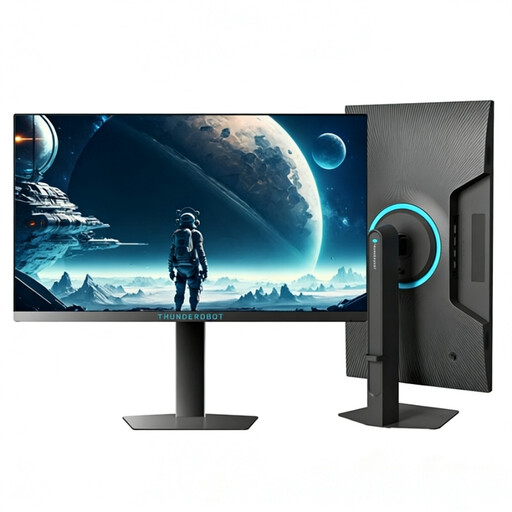 No image available
A good fit if you’re looking for a compact Full HD screen with a high stated refresh rate.
The product name and description list 320 Hz; the product name also mentions a lift-up and swivel stand.
Full HD gives you fewer pixels than QHD for map details and study text.
Your chosen resolution, input and PC can affect which refresh rates are available. In Windows, check the current setting under Advanced display settings and compare your preferred combination with the specifications for the input you’re using.
Check the care instructions for the exact model and consider how long fixed game and desktop elements remain visible. Tests using static images highlight a potential concern, but cannot predict how a specific screen will perform with an individual mix of uses.
For eligible online consumer purchases, you generally have a 14-day cooling-off period. Your statutory rights are separate from any manufacturer’s warranty: if a product is faulty despite normal use, the seller must offer an appropriate remedy free of charge. Check the terms that apply to your purchase and keep your proof of purchase.
The European Commission describes an energy label for electronic displays, including computer monitors, with ratings from A to G. For products covered by the rules, the label must also be shown online. Compare the label and information for the exact version, not just the screen size.