
Player of dark strategy worlds
You mostly play in a darkened room and want dark maps and scenes to look convincing. RTINGS.com describes VA as a panel type capable of displaying deep blacks in dark rooms.


For long strategy gaming sessions in a dark room, OLED is a good choice if deep blacks are your priority and you regularly vary what’s on screen. VA LCD is a sensible option if maps and menus stay on screen for long periods. Also compare the text clarity and resolution of the specific model: an extremely high refresh rate isn’t necessarily a deciding factor for turn-based games, while mini-LED can improve LCD contrast, though performance varies by model.
You mostly play in a darkened room and want dark maps and scenes to look convincing. RTINGS.com describes VA as a panel type capable of displaying deep blacks in dark rooms.
You keep maps, buttons and information panels on screen for long periods, and want to weigh up OLED picture quality against the risk of burn-in. RTINGS.com and Dell identify prolonged static images as a relevant risk factor for OLED.
You view lots of place names, statistics and menus. So compare the resolution and screen size, and check the text clarity of the specific model.
When: if you value deep blacks in dark game worlds and regularly vary what’s on screen.
Trade-off: displaying the same interface for a long time carries a risk of burn-in with OLED. Also check text clarity and the warranty terms for the specific model.
When: if maps, menus and information panels stay visible for a long time and you want good contrast in a dark room.
Trade-off: some models may show dark smearing in motion; mini-LED local dimming can cause halos or other model-specific drawbacks.
When: if you also use the screen for work, other games or viewing from different angles.
Trade-off: standard IPS generally displays less deep blacks than VA in a dark room; assess models with local dimming individually.
| What to consider | What should you check? | Who should prioritise this? |
|---|---|---|
| Black levels and contrast | Compare independent measurements of contrast and, where available, local dimming. RTINGS.com describes VA as having better contrast than IPS. | In a dark room, I want blacks to look truly dark. Around 36% of consumers prioritise black levels and contrast. |
| Interface displayed for long periods | Consider how often the content changes, which panel maintenance features the model has and what the warranty terms for that model say. | During long sessions with the same map, I want to factor in the risk from static elements. Around 29% of consumers prioritise interfaces displayed for long periods and panel maintenance. |
| Map detail readability | Match the native resolution to the screen size and look at tests of the specific model’s text clarity. | If I read lots of place names, statistics and menus, I want small text to remain easy to read. Around 21% of consumers prioritise readability. |
| Other uses and connections | Check the video connections, adjustability and viewing angles of the exact model; choose a refresh rate suited to your other games. | If I also use the monitor for work or watching with others, viewing angles and connections matter. Around 14% of consumers prioritise versatility. |
Turn-based games have different demands from games that rely on quick reflexes. So a high maximum refresh rate isn’t automatically useful for the way you play.
First compare contrast, text clarity and the connection you’ll actually use. Then consider whether the refresh rate matters for other games you play.
Prolonged static images remain a risk with OLED. A feature or general brand claim doesn’t automatically confirm what cover applies to your Dutch model and usage.
Read the terms for the exact model and follow the recommended maintenance instructions. If the same interface stays on screen for a very long time and you want to avoid this risk, consider LCD instead.
VA is a panel type, mini-LED is a backlight technology, and HDR is a display feature. An RTINGS.com test of the AOC Q27G3XMN, without the /BK designation, reported both strong dark-room performance and motion smearing and VRR flicker at varying frame rates.
Compare tests of the exact model for contrast, local dimming, motion handling and flicker, rather than relying on product labels alone.
The Q27G3XMN/BK is a 27-inch QHD VA monitor with a mini-LED backlight; AOC lists 336 dimming zones.
The Evnia 27M2N8500/00 is a 26.5-inch QHD QD-OLED model. Philips Netherlands lists a maximum refresh rate of 360 Hz for this model.
The MAG 272QP QD-OLED X50 is an example of a QHD QD-OLED model with HDMI, DisplayPort and USB-C video inputs.
The 27GS95QE-B is an example of a 26.5-inch QHD WOLED model.
These OLED gaming monitors are selected for anyone who values deep blacks in dark scenes. With long sessions showing the same maps and menus, the risk of burn-in remains a trade-off to consider.
 No image available
A good fit if you’re looking for OLED blacks and QHD resolution for dark game scenes and map details.
26.5 inches; 2560 × 1440; 3rd Gen QD-OLED; 240 Hz; 0.03 ms GtG; HDR10; G-SYNC Compatible and VESA Adaptive-Sync. The stand is height-adjustable. With OLED, an unchanged image displayed for a long time carries a risk of burn-in.
 No image available
A curved OLED option if you’re looking for a larger screen area for game scenes and map information.
34 inches; 3440 × 1440; WOLED; 240 Hz. The stand is height-adjustable. With OLED, an unchanged image displayed for a long time carries a risk of burn-in.
 No image available
Worth considering if you’re looking for QD-OLED picture quality and a wide screen for game scenes and map information.
34.18 inches; 3440 × 1440; 280 Hz; G-SYNC Compatible and FreeSync Premium Pro. With OLED, an unchanged image displayed for a long time carries a risk of burn-in.
 No image available
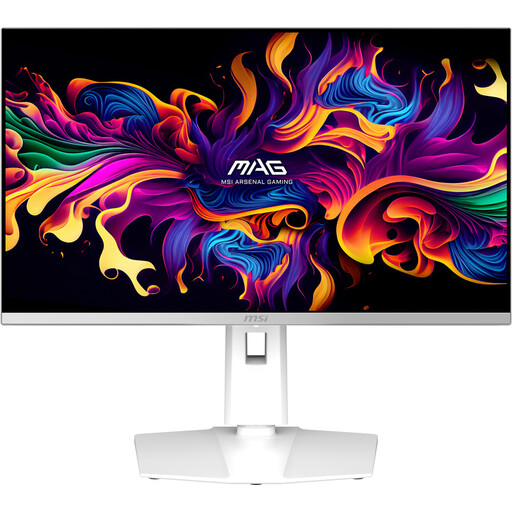
A 27-inch QHD QD-OLED option if you want to view dark game scenes and map text on a smaller screen.
2560 × 1440; 280 Hz; white version. With OLED, an unchanged image displayed for a long time carries a risk of burn-in.
 No image available
A larger OLED screen to consider if you want to view map details across a generous display area.
31.5 inches; 3840 × 2160; 4K; QD-OLED. With OLED, an unchanged image displayed for a long time carries a risk of burn-in.
It can be, if the deeper blacks matter enough to you to make the risk and maintenance worthwhile. Prolonged static images can cause burn-in with OLED; varying the content and using the recommended panel features can reduce the risk, but not eliminate it. VA and IPS LCD don’t have this OLED burn-in risk.
Use the adjustment options and video input actually available on your chosen model. For OLED, follow the maintenance instructions for that specific model; Dell, for example, describes pixel refresh for certain Alienware OLED monitors, not as a universal schedule for every monitor.
No. According to ACM ConsuWijzer, a product must perform as you could reasonably expect under normal use; if a product is faulty, the seller is responsible for providing an appropriate remedy at no cost. A manufacturer’s warranty is separate, and its terms should be checked for each model.
For eligible distance purchases, you generally have a 14-day cooling-off period. The Dutch government lists exceptions and distinguishes between buying from a business and buying from a private seller, so check the specific sales arrangement and terms.