
If you store coffee in portions
If you buy more beans than you’ll use at once, you can seal them in separate portions and open only the portion you need. The Specialty Coffee Association explains how carbon dioxide escapes from roasted coffee.


Choose a sealer with separate bags if you want to divide a larger supply into portions and open them later, one at a time. A reusable vacuum canister is a better fit if you regularly use the same beans. If you’ll get through them within a reasonable time, simply sealing the packaging tightly may be enough, without an extra appliance. The Netherlands Nutrition Centre recommends keeping opened coffee beans in a tightly sealed container in a cool, dry, dark place for three weeks; this is not evidence of an extended storage period for vacuum-packed beans.
If you buy more beans than you’ll use at once, you can seal them in separate portions and open only the portion you need. The Specialty Coffee Association explains how carbon dioxide escapes from roasted coffee.
If you regularly use the same beans, a resealable bag or storage canister may be more convenient than sealing a new portion each time. The Netherlands Nutrition Centre recommends keeping opened coffee beans tightly sealed.
Weigh up a sealer and compatible bags against a reusable pump-and-canister combination, or simply sealing the existing packaging tightly.
Best if: you want to store a supply in separate portions.
Bear in mind: each new portion needs a suitable bag and takes extra handling.
Best if: you regularly open the same supply and want to reuse the packaging.
Bear in mind: the pump and packaging must be compatible; check what’s included too.
Best if: you’ll use the beans within the usual storage period and don’t need separate portions.
Bear in mind: this approach doesn’t remove air like a vacuum system does.
First, decide how often you’ll open the same supply. Then consider compatible packaging, materials and how much space the system takes up.
| What to consider | What to look for | Who this matters most to |
|---|---|---|
| Individual portions | Check whether the appliance can seal bags individually and whether the bags are suitable for the appliance and for food contact. | Want to store portions to open later? Around 36% of consumers prioritise keeping portions separate. |
| Opening repeatedly | Check that the pump and valve are compatible, what’s included and how the packaging is cleaned. | Want regular access to the same beans and to vacuum-seal the packaging again afterwards? Around 29% of consumers prioritise this convenience. |
| Packaging materials | Check which bags, rolls or canisters are included and which refill materials are compatible with the model. | Want to know in advance what materials you’ll need for new portions or a separate canister? Around 21% of consumers look at this first. |
| Space and simplicity | Compare the appliance’s dimensions and the storage space needed for canisters with the option of sealing the existing packaging tightly. | Want to avoid adding much equipment or extra storage space? Around 14% of consumers prioritise space and simplicity. |
For an electric sealer, check the relevant product information for the specific model. Separately, check that the bag or canister that comes into contact with the beans is suitable for food contact; a marking on the appliance alone tells you nothing about the packaging material.
A general claim about food freshness doesn’t give a specific storage period or guarantee for the aroma of coffee beans.
Choose based on how often you open your supply, and don’t treat general claims as coffee-specific test results.
A pump that removes air from a canister or bag through a valve doesn’t automatically create a heat-sealed closure like a bag sealer does.
Decide whether you want to reopen the same packaging or seal individual portions. Then check which type of appliance and packaging is designed for that purpose.
You may need to buy a compatible canister or valve bag separately. Check what’s included in the set you choose.
A bag must not only fit the appliance; it must also be suitable for contact with food.
Check the stated compatibility and food-contact suitability before buying refill bags.
The examples below show different types of systems. A brand mention doesn’t mean that every product or version has the same features.
The VC 10 is a sealer for individual bags and also has a connection for containers.
Fresh & Save uses a separate electric pump with compatible valve bags and canisters.
The EasyVac Pro Type 569, described for the Benelux region, combines bag sealing with a hose connection for containers.
The 492967 is a bag sealer; the separate 492985 set consists of a pump and canisters.
This product selection matches the reusable approach to storing coffee beans: a manual vacuum storage canister.
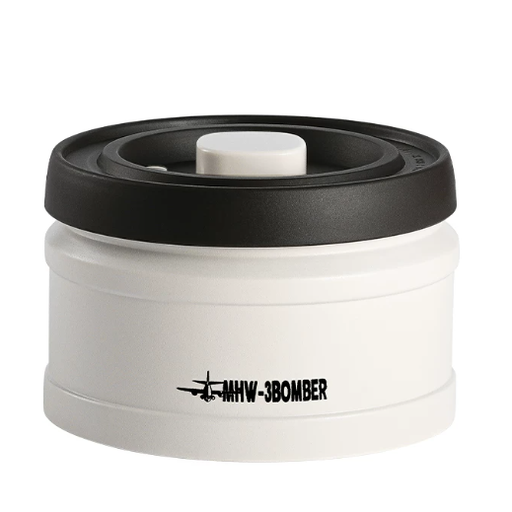 No image available
A manual vacuum storage canister for coffee beans, ideal if you want to keep the same supply in reusable packaging.
Before use, check whether the canister’s material is suitable for contact with food.
The Netherlands Nutrition Centre recommends keeping opened coffee beans in a kitchen cupboard for three weeks, tightly sealed in a cool, dry, dark place. This advice doesn’t say that vacuum-sealing gives you a particular extra storage period.
It depends on the model. CASO lists a separate sealing function for the VC 10; for another appliance, check the instructions and which bags are compatible with it.
For the specific electric appliance, check the relevant product information. Separately, check that the bag or canister that comes into contact with the beans complies with food-contact regulations. These are two different checks.
If you buy from a business in the Netherlands, you’re entitled to a product that works properly. If there’s a fault, the seller must offer a solution. The Dutch government states that there’s no fixed statutory warranty period of two years. When you buy online from a business, you’ll generally have a 14-day cooling-off period, subject to legal exceptions.