
Vandaag of morgen in huis

Kwaliteit gegarandeerd

Welkomstaanbiedingen ontgrendelen: GRATIS bezorging | Tot 80% korting | Gratis 30 dagen JoyPlus-proefperiode
Download de app
Loose papers on the desk, overfilled cupboards and items that keep changing places: many households, students and home workers will recognise the problem. Storage organisers for the office and home can quickly bring more order, but only if their size, load capacity and intended use suit the space.
Marketing copy often focuses on attractive looks or a large number of compartments. That does not automatically say anything about how practical a product is. So pay particular attention to the following common pitfalls.
A compartment does not suit the material you want to store
An A4 document holder should be able to hold more than just A4 paper. Also check the internal width and compartment height for ring binders, magazines or tabbed documents.
The organiser takes up more space than expected
A wall-mounted file holder saves desk space, but it still uses wall depth and height. With a cupboard organiser, the external dimensions and available shelf space are the deciding factors.
Stackability without sufficient stability
Stackable storage boxes are useful for vertical storage, but only when their lids and bases are designed for it. Put heavy items at the bottom and do not exceed the recommended load.
Terms such as ‘rust-resistant’ or ‘extra strong’ should also be considered in context. According to the product information, several metal models have a powder-coated finish and a metal frame. These are verifiable features; the actual service life also depends on the load, moisture, installation and maintenance.
First measure the place where the organiser will go. Note the width, depth and height, and leave enough room to open drawers or remove documents.
For paperwork, A4 is a practical starting point. A mesh file organiser with two compartments and a top holder may be suitable for everyday documents and stationery. According to the product information, the Senhoglb model measures 34 x 24,5 x 17,8 cm and has two tiers plus a holder for office supplies.
For wall storage, height is more important than it is with a desk organiser. According to the stated specifications, a holder with ten compartments is 32,5 cm wide, 10,5 cm deep and 81,5 cm high. So check that there is enough clear wall space and that the door or cupboard next to it can still open fully.
Choose the material according to the items you want to store:
A document organiser with a stated load capacity is easier to assess than a product described only as ‘strong’. If the manufacturer does not specify a maximum load, make a cautious estimate and avoid heavy or sharp objects.
A desk organiser usually requires no assembly. Wall-mounted models, on the other hand, must be secured to the surface with suitable wall plugs and screws. The screws supplied will not automatically be suitable for every wall. Check whether you are working with concrete, brick, plasterboard or a wooden panel.
With a cupboard or open-compartment storage unit, anti-tip protection and a level surface are important. According to the product information, the 5five compartment unit has nine compartments, measuring 100,5 x 32 x 100,5 cm. The unit is designed for self-assembly and has a stated maximum load of 65 kg. Placing heavy items at the bottom helps keep the unit stable.
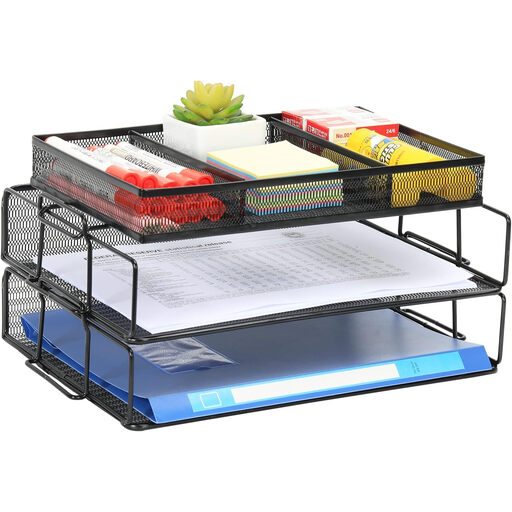
Why it suits this profile: A compact starting point for a home office, student room or small office where everyday papers and pens need to stay together.
The stated A4 layout and dimensions make it easy to check suitability in advance. The two tiers keep incoming and completed documents separate.
Metal mesh construction, two A4 trays, a top holder for stationery and the option to stack.
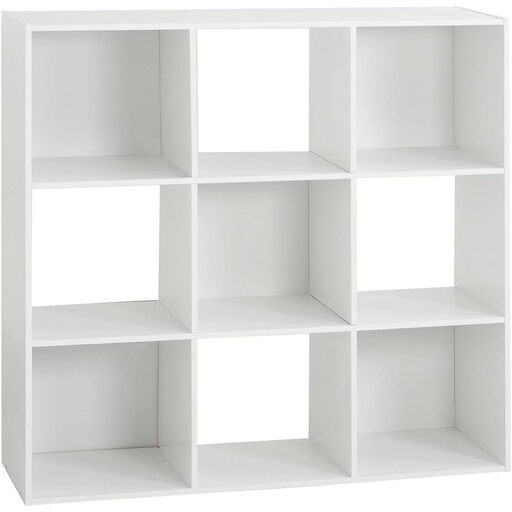
Why it suits this profile: A fixed cupboard organiser for households or home offices that want to arrange different categories of items so they remain visible and accessible.
The external dimensions and maximum load are stated, allowing you to compare the available space and the intended contents before buying.
Nine open compartments, a 65 kg maximum load according to the product information, and floor or wall placement.
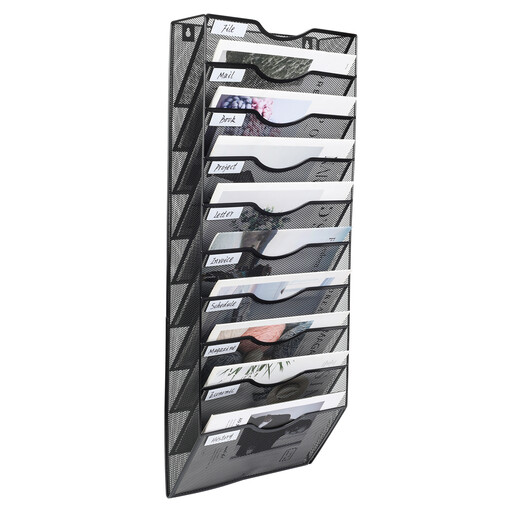
Why it suits this profile: For offices, small businesses and households with lots of invoices, post, files or recurring paperwork.
The ten separate compartments and label plates help prevent documents from disappearing into one untidy pile. However, check the wall and wall plugs beforehand.
Ten A4 compartments, label plates, powder-coated metal and a vertical height of 81,5 cm according to the product information.
We have put together a complete, up-to-date list of products that fully meet these strict selection criteria and the applicable European safety regulations.
Not every space needs a metal document organiser. For clothing, toys or lightweight office supplies, fabric storage baskets may be more convenient. With a set of six boxes measuring 33 x 33 x 33 cm, check the internal dimensions of your cube shelving unit. According to the product information, each box supports a maximum of 5 kg.
For seasonal items or supplies, storage boxes made from PP plastic are worth considering. Models with clip-on lids, handles and non-slip bases are easy to move and stack. Do not place them in high temperatures and do not exceed the stated load.
A smaller desk organiser with five compartments fits in a drawer or on a compact desk. When storing pens, scissors and rulers, check whether the two long compartments are sufficiently long. This prevents a layout that looks practical but still leaves your items sticking out.
Choose an A4 document holder with sufficient internal width and a compartment height that suits your documents. A drawer is often enough for loose papers, while ring binders or thicker folders require a larger compartment. Always check the product dimensions, not just the ‘A4’ description.
Measure the desired height, mark the fixing points and use wall plugs suitable for the type of wall. After installation, check that the holder does not tilt and distribute heavy documents evenly. If you are unsure about the wall structure, professional installation advice is recommended.
Service life depends on the material, moisture, load and frequency of use. Powder-coated metal may be suitable for everyday office work, while fabric is mainly intended for light, dry storage. Clean the organiser according to the product instructions and never use it as a step or seat.
