
Vandaag of morgen in huis

Kwaliteit gegarandeerd

Welkomstaanbiedingen ontgrendelen: GRATIS bezorging | Tot 80% korting | Gratis 30 dagen JoyPlus-proefperiode
Download de app
A storage cupboard may seem easy to choose, until you discover it won’t fit through the hallway, the compartments are too small or the unit becomes unstable without being fixed to the wall. Marketing terms such as “space-saving” and “sturdy” don’t tell you much unless they’re backed up by specifications you can check.
For households in the Netherlands, there are three main pitfalls to watch out for:
Focusing only on how it looks
A white open cupboard or wooden cube unit may look lovely, but it can be impractical if it’s the wrong depth for your space or belongings.
Ignoring the weight capacity
Books, crockery and storage boxes can quickly weigh more than decorative items. A cupboard with lots of compartments doesn’t automatically have a high maximum load per compartment.
Underestimating assembly and safety
A freestanding cupboard may need to be anchored to the wall. This is especially important for families with children, so an anti-tip kit or suitable wall fixings should be an important part of your purchase.
Start by measuring the available space. Check not only the width, but also skirting boards, doors, radiators and sockets.
An open cupboard is handy for things you use often, but it needs to be kept tidy. A cupboard with doors protects the contents from dust and creates a more streamlined look.
Check the height, width and depth. For example, a cupboard that’s 32 cm deep offers less room for large baskets than a 40 cm model. Also check the dimensions of each compartment. A cube unit may have nine or ten compartments, but that doesn’t mean every one is suitable for ring binders or large storage boxes.
Also check the clearance around the cupboard. For a wall unit, you’ll need to allow for the fixing points. Stability is especially important for a room divider, as it won’t be positioned against a wall.
Many models are made from chipboard, MDF, steel, plastic or bamboo. Chipboard and MDF have a smooth surface and are often easy to clean, but you should wipe up spills quickly. Steel is practical for a metal storage cupboard, and the product information may state that its surface is moisture-resistant and easy to clean. This is a supplier’s product specification, not a guarantee that it’s suitable for every damp space.
A bamboo rack works well in a light, airy bathroom or hallway. Check the maximum load, though, and don’t put heavy items on a narrow shelf unless it’s designed to hold them.
Look for two different figures:
For example, the 5five 6-Box Storage Shelf Unit is listed with a maximum load of 3 kg per box and 15 kg for the whole unit. According to the product specifications, the 5five nine-compartment cupboard has a maximum load of 65 kg. These figures aren’t interchangeable.
Always follow the assembly instructions. If an anti-tip kit is included, use it with fixings suitable for your wall. Some products don’t include wall screws and plugs, as the right type depends on whether your wall is brick, concrete or plasterboard.
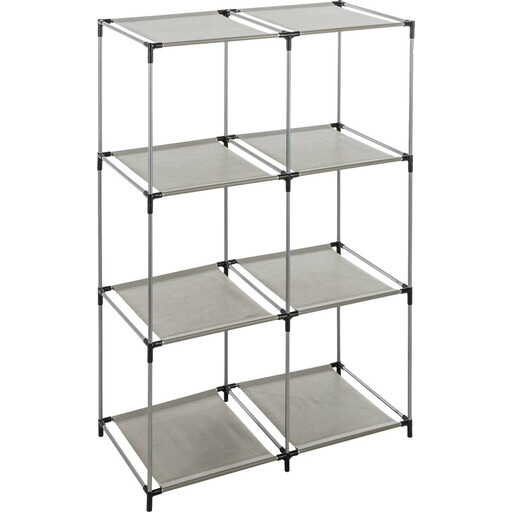
Why it suits this profile: This compact storage unit is suitable for a playroom, bedroom, office or utility room. Its three tiers are designed for storage boxes up to 31 x 31 cm.
The dimensions and weight limits are clearly stated: a maximum of 3 kg per box and 15 kg in total. This helps you avoid overloading it based on looks alone.
68 x 34 x 98 cm; made from metal and PP plastic; suitable for six boxes. According to the safety information, it must be anchored to the wall.

Why it suits this profile: This wide bookcase is ideal if you want to display and organise books, plants, photos and storage boxes in your living room, bedroom or home office.
The product information states a maximum load of 10 kg per compartment. An anti-tip kit is also included, making wall fixing part of the assembly.
Ten open compartments; measures 129.5 x 27 x 129.5 cm; suitable as a bookcase, storage rack or room divider.
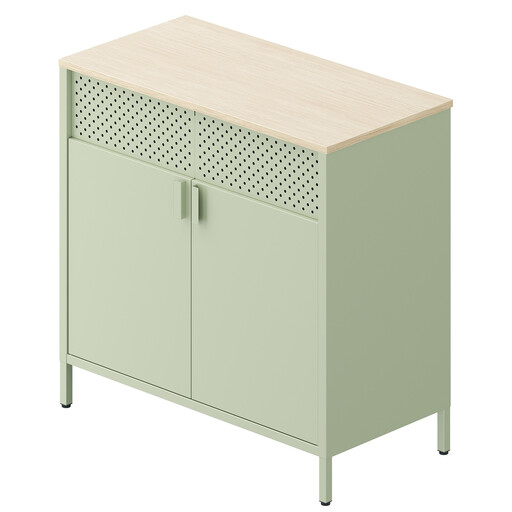
Why it suits this profile: A closed metal storage cupboard is practical for office supplies, household items or larger belongings you want to keep out of sight.
The cupboard has an adjustable shelf, so you’re not limited to fixed compartment heights. The product information also lists an anti-tip kit; the cupboard still needs to be fixed to the wall.
40 x 80 x 76 cm; steel housing with an adjustable shelf; maximum static load for the top surface: 50 kg according to the product specifications.
We’ve put together a complete, up-to-date list of products that meet these strict selection criteria and the applicable European safety regulations.
Follow the assembly instructions and use the anti-tip kit provided, if there is one. Choose plugs and screws that are suitable for your type of wall. Put heavy items on the bottom shelves, and don’t let children climb on the shelves or compartments. A freestanding cupboard can become unstable if it isn’t properly anchored.
Its lifespan depends on the material, weight load, assembly and care. Keep within the stated maximum load and clean the surfaces according to the product information. With chipboard and MDF, it’s best to wipe up any moisture straight away. After assembly, and from time to time, check that all the fixings are still secure.
A standard storage cupboard usually doesn’t need electricity. The main extra costs are often storage boxes, baskets and suitable fixings. Don’t compare only the price of the cupboard; also consider what you’ll need to organise the compartments and assemble it safely.
An open cupboard gives you quick access to books, toys and decorative items. A cupboard with doors keeps everything out of sight and can make a room feel less cluttered. In a living room, the choice mainly depends on how you want to organise your space; in an office or hallway, a closed model may be more practical.
