
Vandaag of morgen in huis

Kwaliteit gegarandeerd

Welkomstaanbiedingen ontgrendelen: GRATIS bezorging | Tot 80% korting | Gratis 30 dagen JoyPlus-proefperiode
Download de app
A storage cabinet can quickly bring extra order to your hallway, bathroom, bedroom or living room. Yet many households buy a cabinet that proves less practical than expected after a few weeks. The dimensions are wrong, the doors bump into furniture or the material doesn’t suit the room.
So don’t focus only on colour and price. Above all, check the available space, the construction and what the cabinet is designed to store.
A tall cabinet may seem to offer plenty of storage, but a narrow one can be less stable. With a model that’s 170 cm high, in particular, it’s important to check whether wall fixing is required. Put heavier items at the bottom and distribute the weight across the shelves.
Don’t just measure the floor space. Also check:
A wooden bathroom cabinet can add warmth to a room, but wood, bamboo, MDF and chipboard need careful maintenance. According to the manufacturer’s product information, moisture and water can cause these materials to swell or warp over time. A plastic storage cabinet is generally easier to wipe clean, but always check whether the product is intended for indoor use only.
Don’t place a cabinet directly in a puddle, and wipe up spills quickly. This is especially important in a bathroom, kitchen or utility room.
A cabinet with lots of compartments isn’t automatically suitable for books, cleaning products or heavy supplies. Check the stated maximum weight per shelf. Put heavy items low down and lighter items higher up. For a shoe cabinet, the number of pairs it holds and the height of the shoes are usually the key considerations; for a bathroom cabinet, shelf spacing and moisture resistance matter more.
A narrow storage cabinet is handy for a hallway or flat, but its internal space may be limited. Measure the item you want to store before you order. For example, tall bottles won’t fit in every compartment, while boots often won’t fit in a standard shoe cabinet.
A cabinet with doors keeps items out of sight and can help limit dust. An open cabinet, on the other hand, gives you quicker access to books, towels or everyday toiletries. A storage cabinet on wheels is handy if you change your layout regularly, but the wheels need to be on a level surface. Also check whether they can be locked.
A storage unit for small spaces should be not only compact, but also well laid out. For example, four wide shelves may be more practical than six small compartments if you want to store larger items.
Check whether assembly requires tools and how many people the product information recommends. With a tall cabinet, securing it permanently to the wall is an important safety consideration. Use fixings suitable for your type of wall and follow the instructions.
Claims about durability or ease of use come from the brand’s product description. Don’t treat them as a guarantee for every home or situation. Always check the verifiable details, such as the material, dimensions, load capacity and assembly method.
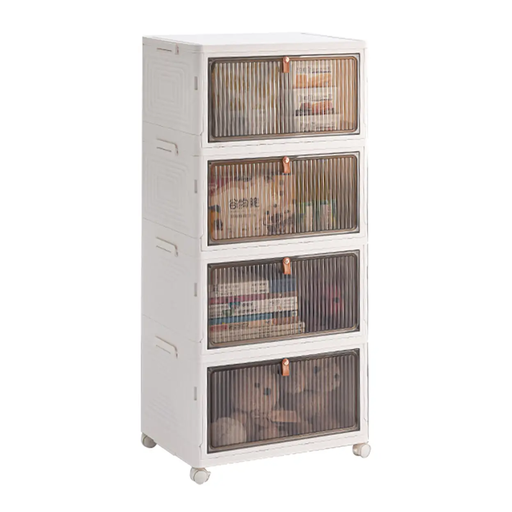
Why it suits this type of buyer: This compact plastic cabinet is designed for anyone looking for extra storage in a bathroom, student room, kitchen or beside the bed, without complicated assembly.
The product information lists four tiers, a smooth PP surface and tool-free assembly. Be sure to check the maximum weight per shelf and place the cabinet on a level surface.
PP plastic, four storage tiers, a smooth surface and a wheeled design, according to the product description.
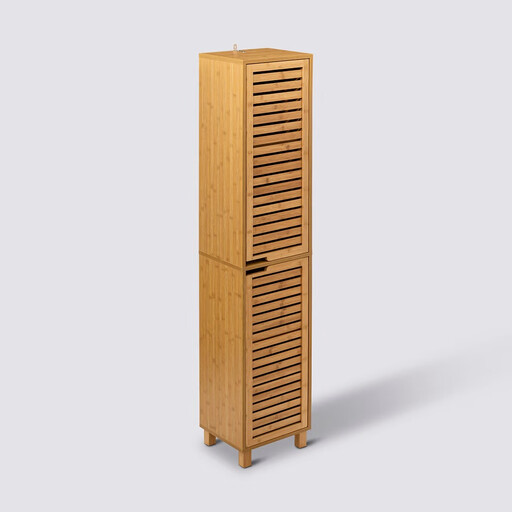
Why it suits this type of buyer: At 170 cm tall and 34 cm wide, this bathroom cabinet makes good use of vertical space in a compact bathroom or toilet room.
The dimensions and maximum load of 30 kg are listed. Because it’s tall, the safety information says to secure this cabinet to the wall and place heavy items at the bottom.
Six shelves, two doors, bamboo on the door fronts and dimensions of 34 × 24 × 170 cm, according to the product specifications.

Why it suits this type of buyer: This shoe cabinet is designed for households that want to keep shoes out of sight in the hallway, bedroom, living room or wardrobe.
The doors help keep dust off shoes, and the product information says it holds around 22 to 25 pairs. Measure taller shoes beforehand; the actual capacity depends on shoe size and style.
Five tiers, closed doors, an open bottom shelf and metal legs, according to the product description.
We’ve put together a complete, up-to-date list of products that meet these strict selection criteria and the applicable European safety requirements.
First, decide on the maximum width and depth. A narrow or tall storage cabinet makes use of wall space, while a model on wheels is easier to move around. Allow extra room for doors to open.
Place the cabinet on a level surface, distribute heavy items across the bottom shelves and use the anti-tip fixing supplied, if there is one. If no fixing is included, choose hardware suitable for your type of wall.
Plastic is easy to wipe clean. Bamboo, MDF and chipboard can also be used, but the product information says they should be protected from excessive moisture. Dry wet surfaces quickly and don’t let the cabinet come into direct contact with standing water.
