
Vandaag of morgen in huis

Kwaliteit gegarandeerd

Welkomstaanbiedingen ontgrendelen: GRATIS bezorging | Tot 80% korting | Gratis 30 dagen JoyPlus-proefperiode
Download de app
A storage cabinet can quickly bring more order to your living room, bathroom, bedroom, kitchen, hallway or utility room. However, a cabinet can look more spacious and sturdier in a product photo than it is in real life. A narrow cabinet may have a low weight capacity, while a wide one may turn out to be too deep for a small hallway.
So if you’re looking to buy a storage cabinet, it’s worth considering more than just the colour and price. Pay particular attention to its dimensions, layout, materials and assembly. Below, you’ll find the key points to consider, followed by some popular options for different households.
A cabinet that’s 100 cm wide doesn’t automatically offer lots of usable space. The side panels, back panel and any doors take up some of the internal space. Pay attention to the depth, too. A cabinet that’s 40 cm deep may be practical in a living room, but could quickly get in the way in a narrow hallway.
Before buying, measure:
An open storage cabinet with compartments is handy for books, toys, decorations and storage boxes. In a bathroom or kitchen, however, open compartments can collect dust, splashes or dirt more quickly. A cabinet with doors is often more practical in these rooms.
For a bathroom cabinet, always check whether the product description mentions moisture resistance. A brand’s claim about a material doesn’t guarantee that a cabinet is suitable for prolonged contact with water. According to the HaluPeit model’s product description, its MDF and metal parts are designed for use in a damp environment. Even so, don’t place the cabinet in standing water, and follow the care instructions.
A cabinet with lots of compartments may look suitable for heavy books or food supplies, but its maximum weight capacity may apply to each shelf or to the whole unit. It’s best to put heavy items on the bottom shelves. This lowers the centre of gravity and makes the cabinet less likely to tip over.
A tall cabinet, a cabinet in a home with children, or a metal storage cabinet with doors should be secured to the wall where required by the assembly instructions. An anti-tip kit improves stability, but it doesn’t replace correct assembly on a suitable wall.
Choose a layout based on what you want to store:
Check the height of the compartments. One that’s suitable for small boxes may not have room for tall bottles or ring binders.
Chipboard and MDF are commonly used materials for affordable furniture. They’re suitable for everyday household use, but damaged edges may be more vulnerable to moisture. A steel frame or metal cabinet is usually easy to wipe clean, and can be useful in a garage, utility room or office.
A white storage cabinet creates a light look, but dirt and fingerprints may show up more easily. Metal surfaces are often easy to clean; just check that the finish is suitable for the room you have in mind.
Don’t just look at the overall maximum weight capacity. Check whether the manufacturer gives a separate weight capacity for each shelf, too. Clear instructions and labelled parts are useful if you’re assembling the cabinet yourself. Check how many people are needed for assembly: a wide or heavy cabinet isn’t always safe to put together alone.
A CE mark or FSC label tells you something about the relevant product information, but doesn’t automatically mean that a cabinet is suitable for every room or load. Use the cabinet as described and keep the assembly instructions.
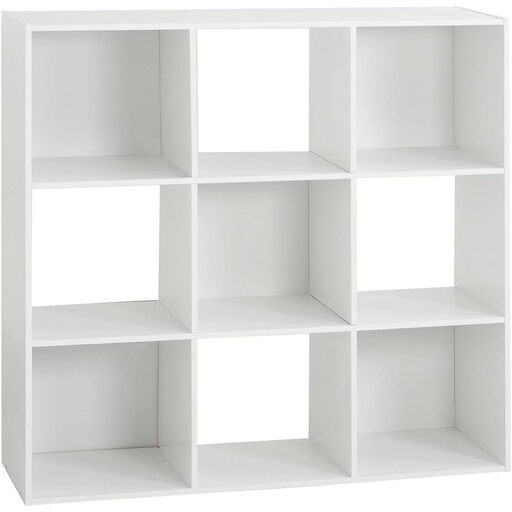
Why it suits this profile: The nine open compartments provide an organised layout for books, toys, baskets or decorations. At 32 cm deep, this white storage cabinet fits into many living rooms and bedrooms.
The dimensions and maximum weight capacity of 65 kg are listed. The cabinet can stand on the floor or be mounted on the wall; heavy items should go on the bottom shelves.
Nine compartments, an FSC label, an MDF back panel and an estimated assembly time of around 30 minutes for two people.
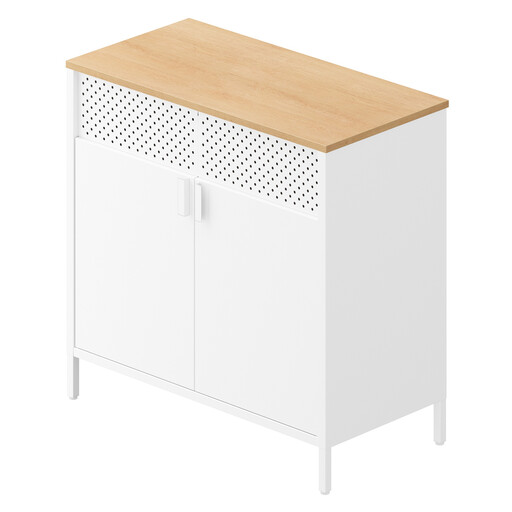
Why it suits this profile: This cabinet combines steel with an adjustable shelf and double doors. That makes it a good fit for an office, living room, dining room or utility room where you want to keep things out of sight.
The adjustable shelf means you’re not restricted to one compartment height. The product information also mentions an anti-tip kit; securing the cabinet to the wall is still important.
Steel cabinet body, dimensions of 80 x 40 x 76 cm and a stated maximum static weight capacity of 50 kg for the top.
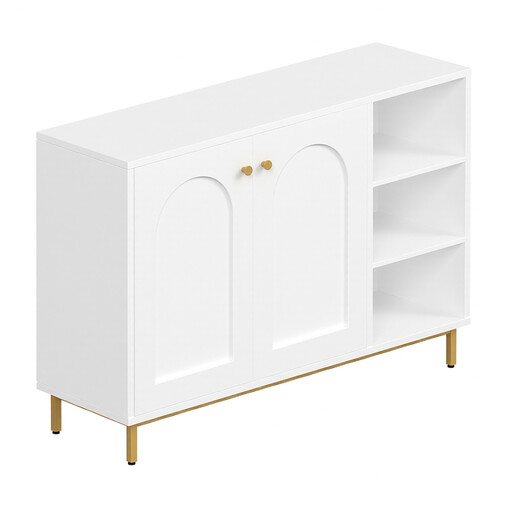
Why it suits this profile: This bathroom cabinet combines closed storage with open compartments. It’s ideal for towels, toiletries and accessories that you want to keep close at hand.
The product description lists three adjustable shelf heights, a raised base measuring 12.5 cm and an anti-tip feature. Check the exact dimensions of 35.5 x 100.5 x 75.5 cm before placing it.
Two doors, three open compartments, adjustable shelves and a combination of chipboard and metal, according to the product information.
For a hallway, student room or small toilet, compact storage may be more practical than a tall, wide cabinet. Choose a model that keeps the walkway clear, and use baskets to group smaller items. For toys, an open cabinet with tubs is often easier to access than one with heavy doors.
For a garage, kitchen or utility room, a metal storage cabinet with lockable doors may be a better choice. If you mainly want to sort loose items, consider a cabinet with baskets. The 5five Storage Shelf Unit has a steel frame, three shelves and six storage baskets. Its stated maximum weight capacity is 30 kg. This makes it suitable for lighter household items, accessories or toys, as long as you distribute the weight evenly.
We’ve put together a complete, up-to-date list of products that meet these strict selection criteria and the applicable European safety regulations.
Assemble the cabinet according to the instructions and use the supplied anti-tip fitting if one is included. Choose fixings that are suitable for your type of wall. Put heavy items on the bottom shelves, and don’t let children climb on or hang from the shelves, doors or cabinet.
Its lifespan depends on the materials, assembly, load and care. Keep MDF and chipboard as dry as possible, check the fixings after assembly and don’t exceed the stated weight capacity. In the Netherlands and the European Union, products are covered by at least the statutory guarantee; some product information specifies a period of two years. Additional rights may apply under the relevant legislation.
A standard storage cabinet doesn’t use electricity. Ongoing costs mainly include care, any baskets or storage boxes you need, and possibly fixings. So don’t just look at the purchase price; also consider the accessories included, assembly and whether it’s suitable for the space.
