
Vandaag of morgen in huis

Kwaliteit gegarandeerd

Welkomstaanbiedingen ontgrendelen: GRATIS bezorging | Tot 80% korting | Gratis 30 dagen JoyPlus-proefperiode
Download de app
A storage cabinet can quickly make a hallway, bathroom, kitchen or home office feel more organised. Even so, a purchase can sometimes disappoint. A cabinet may turn out to be too deep for the walkway, the shelves may not be adjustable, or the material may not be suitable for a damp room. If you only consider colour and price, you often discover these limitations after assembly.
Be sure to look out for the following three common pitfalls:
Attractive finish without a practical layout
A modern storage cabinet may look appealing, but without adjustable shelves or drawers, small and large items end up mixed together.
Confusing “moisture-resistant” with waterproof
A moisture-resistant cabinet is not automatically suitable for direct contact with water. Check the material, the distance from the floor and where you want to place the cabinet.
Underestimating dimensions and stability
A cabinet may look compact on paper but still be too deep for a narrow hallway. With tall or heavy furniture, an anti-tip feature is also important.
Don’t just measure the spot where the cabinet will stand. Also measure doorways, skirting boards and the space needed to open doors or drawers. A narrow storage cabinet is useful in a hallway, but a model with hinged doors needs additional clearance in front of it.
For a bathroom cabinet or hallway cabinet, also check:
A freestanding cabinet must stand securely on a level surface. With tall models, fixing the cabinet to the wall is advisable and is sometimes explicitly required in the product instructions.
MDF, chipboard, metal and fabric each have different characteristics. A metal cabinet is generally easy to wipe clean. MDF and chipboard may be suitable for everyday indoor use, but joints and edges require extra attention in a damp room.
For a moisture-resistant cabinet in the bathroom, check whether the product description mentions moisture resistance. According to the product description of certain models, the materials are designed to cope better with everyday humidity and splashes. This is a product claim, not a guarantee that the cabinet can withstand prolonged immersion or leaks. Do not place the cabinet in standing water and wipe up spilled liquid promptly.
A cabinet with adjustable shelves offers greater flexibility for tall bottles, boxes and smaller items. A cabinet with doors keeps the contents out of sight and limits dust. Open compartments are better suited to books, baskets or decorative items.
Consider the following layout for each room:
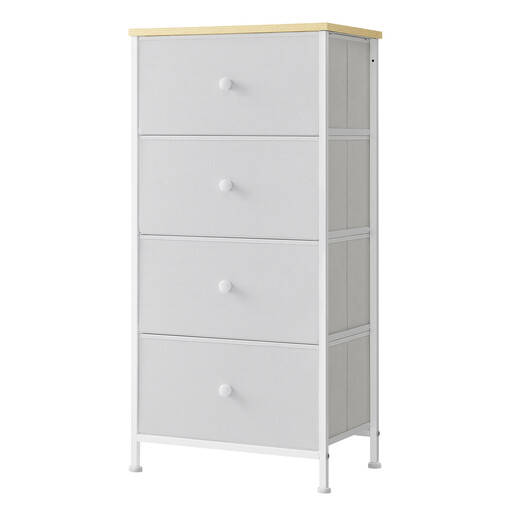
Why it suits this profile: This compact drawer unit is suitable for a bedroom, home office or living room where you want to keep small items organised without adding a heavy cabinet.
The dimensions of 30,1 × 45,1 × 92,4 cm make it clear how much space you need in advance. The four drawers keep small items organised, so you are not choosing based on appearance alone.
Four drawers, a metal frame and a stated maximum static load of 27 kg. The supplied anti-tip kit should be secured to the wall.
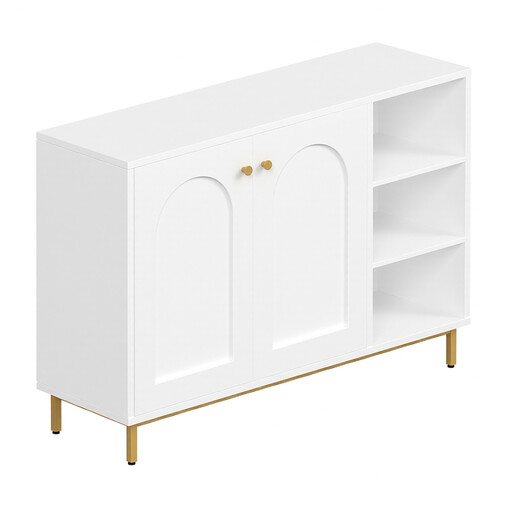
Why it suits this profile: This bathroom cabinet combines closed doors with open compartments, making it ideal for anyone who wants practical storage alongside a modern cabinet with gold-coloured details.
The product description specifies three adjustable shelf heights and a 12,5 cm raised base. This allows you to customise the layout while keeping the base further away from the floor.
Approximate dimensions of 35,5 × 100,5 × 75,5 cm, two doors, three open compartments and an anti-tip feature. According to the product description, the model is made from MDF and metal components.
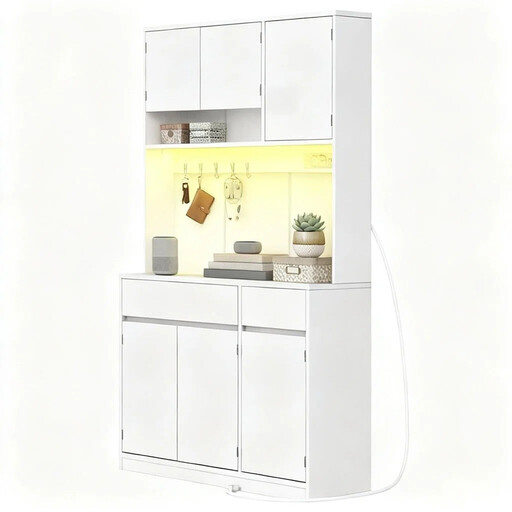
Why it suits this profile: This tall model is designed for households that need plenty of storage in the kitchen, dining room or hallway and want extra functionality such as sockets and lighting.
The layout is specified in advance with glass compartments, adjustable shelves, a base cabinet and two drawers. Before installation, check the height of 180 cm and secure the furniture with the anti-tip kit.
Dimensions of 40 × 100 × 180 cm, two drawers, adjustable shelves, two sockets and two USB ports according to the product description. The weight is 47,9 kg.
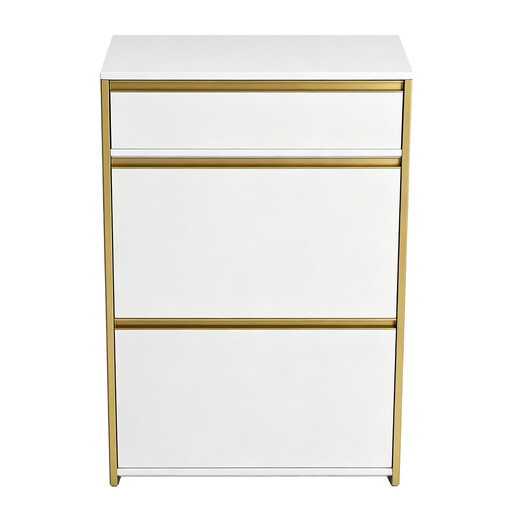
Why it suits this profile: With a depth of 24 cm, this model is designed for hallways where every centimetre counts. The cabinet can also be used for accessories, books or decorative items.
The external dimensions of 60 × 24 × 104,5 cm make it easy to check the required walkway space. The adjustable and removable shelves provide more layout flexibility than a fixed shoe cabinet.
Two hinged doors, one drawer, four adjustable shelves and space for up to 12 pairs of shoes according to the product description. An anti-tip feature is included.
We’ve put together a complete, up-to-date list of products that fully meet these strict selection criteria and the applicable European safety regulations.
First, measure the maximum depth and take the door opening into account. A shoe cabinet around 24 cm deep may be suitable for a narrow walkway. It is also best to choose a model with vertical storage, adjustable shelves or drawers.
No. Check whether the manufacturer mentions moisture resistance and look at the distance between the base and the floor. Do not place a cabinet where water can collect. Good ventilation and quickly drying splashes will help keep the material looking good for longer.
The lifespan depends on the material, load, assembly and environment. Respect the stated maximum load, use the correct fixings and avoid prolonged contact with moisture. Also check the hinges, drawers and wall fixings regularly. A straightforward assembly guide and labelled parts can help you assemble the cabinet correctly.
