
Vandaag of morgen in huis

Kwaliteit gegarandeerd

Welkomstaanbiedingen ontgrendelen: GRATIS bezorging | Tot 80% korting | Gratis 30 dagen JoyPlus-proefperiode
Download de app
An storage cabinet may seem straightforward to choose, but small differences determine how practical the furniture is day to day. Will it fit under your desk? Can the drawers hold A4 documents? Will the castors remain stable? And is the maximum load capacity clearly stated?
For homeworkers, small businesses, creative professionals and households, three pitfalls are particularly important: marketing terms without measurable explanations, insufficient attention to stability and an unsuitable layout for the type of items you want to store.
A cabinet may be described as spacious even when the internal dimensions of the drawers or compartments are limited. So check not only the external dimensions, but also:
For an office storage cabinet, the depth and drawer height are particularly relevant. For a home storage cabinet, narrower compartments may be more useful for toiletries, toys or household items.
A mobile storage cabinet or storage cabinet with castors is practical when you regularly change your layout. However, mobility is only useful if the cabinet can also remain stable when stationary. Check the number of castors, whether brakes are fitted and the type of surface on which the cabinet will be used.
On wooden flooring, laminate or PVC, you should also check that the castors are suitable for frequent movement. Move a loaded cabinet carefully and bear in mind the risk of tipping if the load is unevenly distributed.
A total weight limit does not always tell you enough. A cabinet with several drawers may, for example, have a high total load capacity, while each individual drawer is designed to hold less. Only place heavy tools, piles of paper or equipment inside the stated limits.
When choosing a drawer cabinet, filing cabinet or storage unit, pay attention to the difference between:
Measure the available space before ordering a storage cabinet. Leave enough room around it for drawers, doors and cables. A compact model measuring around 40 cm wide may be suitable for a desk, while a cabinet measuring 80 cm wide may work better as a sideboard or central storage unit.
Choose drawers for small, frequently used items such as stationery, documents and accessories. An open storage rack works better for boxes, baskets and items you want to grab quickly. A cabinet with doors keeps the contents out of sight and reduces the visible amount of loose clutter.
Steel is a good choice for a lockable storage cabinet or filing cabinet in an office environment. It is generally easy to wipe clean and suits a professional interior. Wood, MDF, chipboard and bamboo create a more homely look, but always check the stated load capacity and recommended environment.
For damp areas, the product description is more important than general terms such as “durable” or “water-resistant”. A bathroom cabinet must be specified as suitable for that environment. Never leave a piece of furniture in prolonged contact with water unless this is explicitly permitted.
Check whether assembly is required and how much space you have for it. Some models are delivered pre-assembled, while other cabinets need to be built at home. Follow the instructions and retighten the fixings after a while if this is recommended in the guidance.
For tall, narrow or mobile models, an anti-tip feature is important. A product supplied with fixings must be secured to the wall according to the instructions. Place heavier items towards the bottom wherever possible.
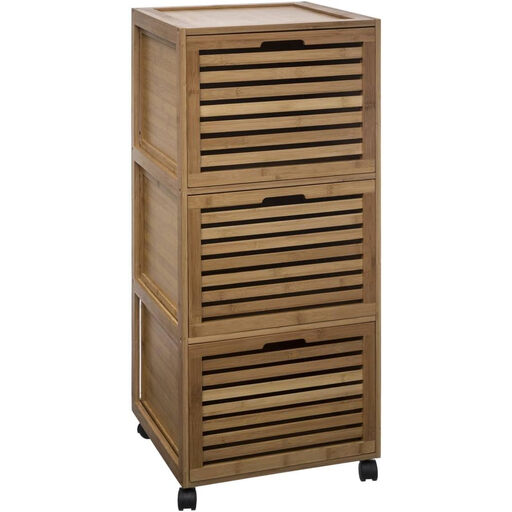
Why it suits this profile: A compact mobile cabinet for anyone looking for extra space in the bathroom, kitchen, pantry or bedroom. The three drawers provide a clear basic layout.
The product details specify concrete dimensions of approximately 41 cm wide and deep, a height of approximately 91 cm and a maximum load capacity of 35 kg.
Bamboo construction, three spacious drawers and castors for easy movement. Assembly by the user is required.
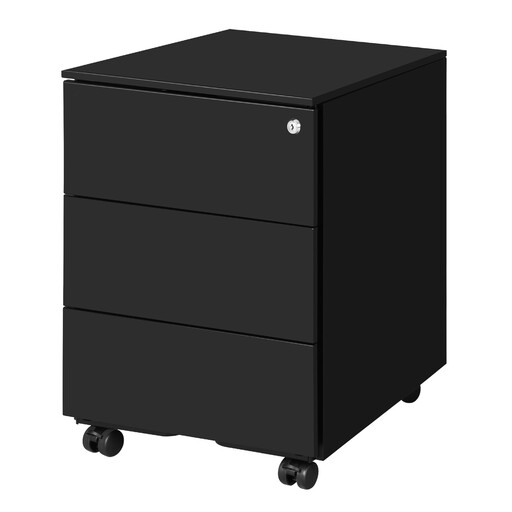
Why it suits this profile: Suitable for an office or home workspace where documents and stationery need to be organised and stored out of sight.
The cabinet has three drawers, a lock, fully extendable runners and four castors, two of which have brakes. This makes its features easy to verify.
Steel frame, a maximum of 15 kg per drawer and largely pre-assembled. Only the castors need to be attached.
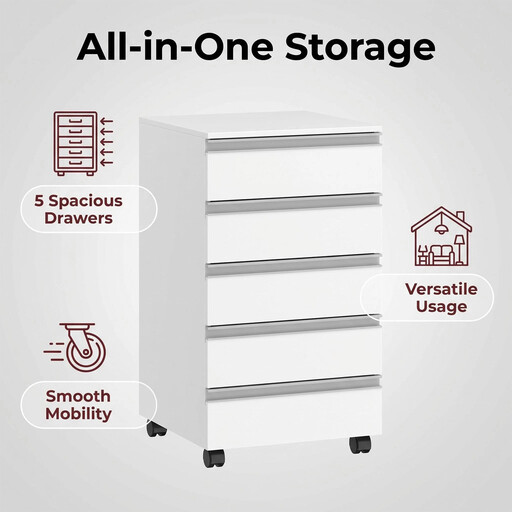
Why it suits this profile: A practical choice for studios, workshops and offices where documents, drawings, tools or materials are used frequently.
The stated specifications include a maximum load capacity of 50 kg, reinforced drawer runners and swivel castors with front locking mechanisms.
Five deep drawers, a top surface measuring approximately 40 × 40 cm and stated dimensions of approximately 40.5 × 40.5 × 65.5 cm.
We have put together a complete, up-to-date list of products that fully meet these strict selection criteria and the applicable European safety regulations.
Distribute heavy items across the bottom drawers or shelves, do not exceed the stated load capacity and avoid moving the cabinet too quickly. Use any fitted brakes when the cabinet is stationary. A tall cabinet must be secured to the wall in accordance with the instructions if an anti-tip kit is supplied.
Its lifespan depends on the material, load, assembly and frequency of use. A cabinet that is continually overloaded or moved while tilted will wear out more quickly. Check the castors, screws, drawer runners and fixing points regularly. Follow the manufacturer’s care instructions.
A standard cabinet does not require electricity. Ongoing costs mainly involve maintenance and the possible replacement of parts such as castors or drawer runners. When buying, clear assembly instructions, a suitable load capacity and easy-to-clean materials are therefore practical points to consider.
