
Vandaag of morgen in huis

Kwaliteit gegarandeerd

Welkomstaanbiedingen ontgrendelen: GRATIS bezorging | Tot 80% korting | Gratis 30 dagen JoyPlus-proefperiode
Download de app
An extra storage cabinet may seem easy to choose, until you find that the doors hit a wall, the shelves don’t fit or the material isn’t suitable for a damp room. In Dutch homes, with their narrow hallways, compact bathrooms and limited storage space, every centimetre counts.
When comparing cabinets, look beyond colour and price. Marketing copy often highlights a versatile design or stylish finish, while important details about load capacity, wall fixings and exact dimensions may be less prominent. Use these checks to choose the right cabinet for your hallway, living room, bathroom, kitchen or home office.
A cabinet that’s 35 cm deep may seem suitable, but the usable interior space is smaller because of the doors, back panel and hinges. So, measure not only the available space but also check:
For a narrow storage cabinet in the hallway, depth and door clearance are particularly important. A shoe cabinet that sticks out too far can make a passageway awkward to use.
A storage cabinet with adjustable shelves is practical, but the shelf height may only be adjustable at a few fixed points. Check how many positions are available and whether the shelves can be removed completely. This matters if you want to store tall bottles, storage boxes, books or boots.
A cabinet with drawers gives you quick access to smaller items, but the drawers also take up space that could otherwise be used for a tall shelf. Choose the layout based on what you actually need to store.
A moisture-resistant cabinet isn’t automatically suitable for prolonged contact with water. Check the material, finish and clearance from the floor. In a bathroom, you should also consider splashes, ventilation and how easy the cabinet is to clean.
According to the product information for some models, they feature moisture-resistant MDF, chipboard or metal components. That’s useful product information, but it doesn’t guarantee that a cabinet can withstand being submerged or exposed to leaks. So, don’t place a bathroom cabinet directly in a pool of water, and follow the assembly and care instructions.
Measure the space in three places: width, depth and height. A storage cabinet for the hallway is often more practical when it’s narrow than when it’s a wide cabinet with large doors. For a storage cabinet for the living room, a wider sideboard with doors may offer more concealed storage.
Also look out for the following:
A shoe cabinet needs a different layout from a cabinet for books or kitchen supplies. Check whether the stated number of pairs of shoes will suit your shoe sizes too; high-top trainers and boots take up more space.
Many models are made from chipboard or MDF. These materials are suitable for normal indoor use, but quality also depends on the finish, edging and assembly. A metal cabinet can be a good choice if you want a surface that, according to the product information, is easy to clean.
Smooth surfaces are practical for everyday use. In the bathroom, it’s worth considering raised legs or clearance beneath the cabinet, as this makes the underside easier to reach when mopping. For a vanity unit, also check the cut-out for the waste trap and pipes.
A tall or deep cabinet can topple if used incorrectly. Choose a model with an anti-tip device and attach it to a suitable wall following the instructions. Before you start, check which fixings are suitable for your wall type, such as concrete, brick or plasterboard.
A piece of furniture with adjustable feet or a sturdy base can help on an uneven floor, but it doesn’t replace proper wall fixing. Where possible, put heavier items at the bottom and spread the weight across the shelves.
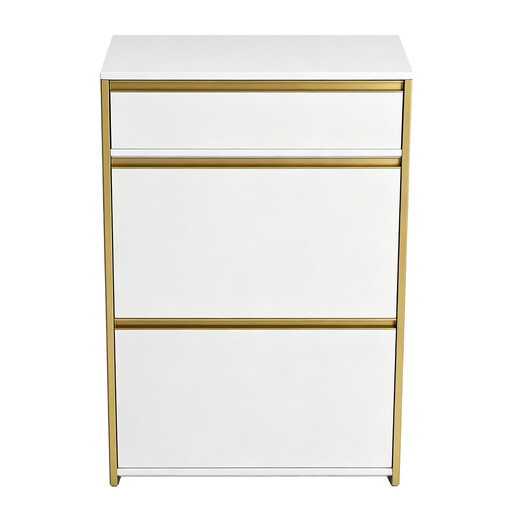
Why it suits this need: Measuring 60 cm wide, 24 cm deep and 104,5 cm high, this shoe cabinet is a good fit for a compact hallway. It combines shoe storage with a drawer and a top surface.
The adjustable, removable shelves let you change the layout. Check in advance, though, that a depth of 24 cm is enough for your shoes.
Four adjustable shelves, a drawer, space for up to 12 pairs of shoes according to the product information, and an anti-tip device included.
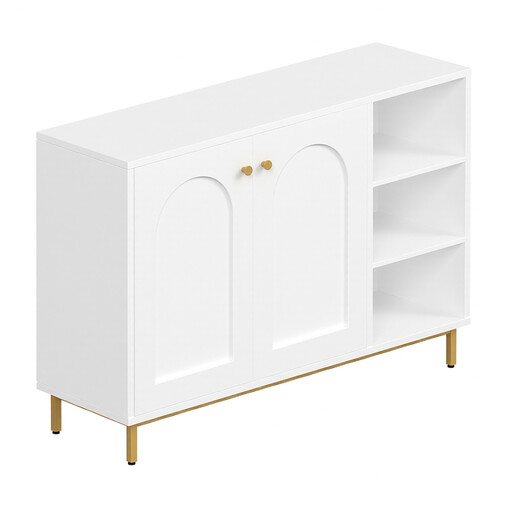
Why it suits this need: Measuring 35,5 x 100,5 x 75,5 cm, this model combines enclosed compartments with three open shelves. It’s a good fit for a bathroom where you want everyday toiletries close to hand.
The product information lists moisture-resistant MDF and metal components, plus a 12,5 cm riser. Suitability still depends on correct placement and care.
Two doors, three open shelves, adjustable shelf heights and an anti-tip device, according to the product description.
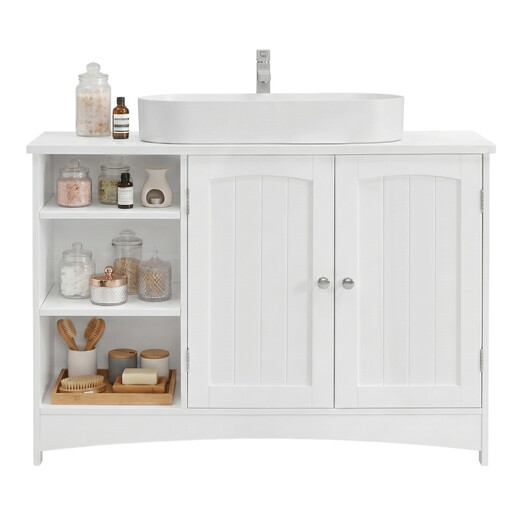
Why it suits this need: This vanity unit is 88,5 cm wide and has an open section alongside an enclosed cabinet. It’s useful when you need space for both pipework and everyday bathroom essentials.
The manufacturer specifies a 20 x 15 cm cut-out for a U-shaped waste trap. Carefully measure your basin and pipework before buying.
Two adjustable shelves in the open compartment, an adjustable shelf behind the doors and an MDF construction, according to the product information.
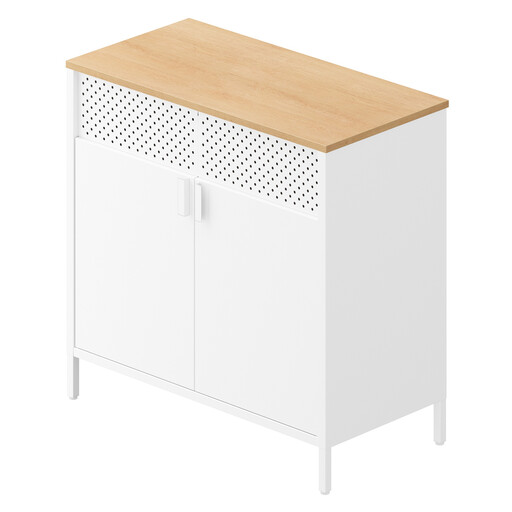
Why it suits this need: Measuring 80 x 40 x 76 cm, this versatile cabinet can be used as a sideboard with doors, a TV stand or a storage cabinet for the office or living room.
The adjustable shelf means you’re not restricted to a fixed layout. According to the product information, the metal cabinet body is moisture-resistant and easy to clean.
Two doors with magnetic closures, an adjustable shelf, a perforated panel and a stated maximum load of 50 kg for the top panel.
We’ve put together a complete, up-to-date list of products that meet these strict selection criteria and the applicable European safety regulations.
Assemble the cabinet according to the instructions and use the anti-tip device supplied. Check your wall type and choose suitable wall plugs and screws. Put heavier items at the bottom, and avoid overloading the doors or drawers.
A narrow storage cabinet or shoe cabinet with a shallow depth is usually a practical choice. Measure the passageway and allow enough room to open the doors. A model with a drawer or top surface can add extra functionality without the need for a second piece of furniture.
Wipe up splashes straight away, ensure good ventilation and avoid prolonged contact between water and the underside of the cabinet. Check the edges, joints and legs regularly. Even with a moisture-resistant cabinet, it’s important to position it correctly and keep it dry.
