
Vandaag of morgen in huis

Kwaliteit gegarandeerd

Welkomstaanbiedingen ontgrendelen: GRATIS bezorging | Tot 80% korting | Gratis 30 dagen JoyPlus-proefperiode
Download de app
A storage cabinet may seem simple, but you quickly notice when you have made the wrong choice. A cabinet can be too deep for the hallway, lack stability in a busy household or fail to fit properly around the pipes beneath a washbasin. Marketing terms such as “water-resistant”, “extra-strong” and “large capacity” only mean something when the underlying specifications are clear.
With this buying guide, you can compare a storage cabinet by its dimensions, material, layout and intended use. That makes it easier to choose the right option for the bathroom, kitchen, living room, bedroom, hallway or workspace.
A cabinet that is 40 cm deep will not automatically fit in the desired location. Allow for skirting boards, doors, sockets, pipes and walking space. So do not just measure the available width and height, but also:
With a bathroom cabinet, the cut-out for the trap is particularly important. For example, the JOYFURNOS under-sink cabinet specifies a cut-out of 20 x 15 cm. Check this measurement against your own washbasin and waste outlet before ordering.
A cabinet with adjustable shelves is more versatile than a fixed layout, but check how many positions are available and how much space there actually is between the shelves. Large bottles, cleaning products, storage jars and small appliances each require a different arrangement.
Also consider the load capacity. A shelf for towels has different requirements from one used to store crockery or equipment. If no specific load capacity is stated, avoid stacking heavy items on a single shelf.
A cabinet in the bathroom or kitchen will be exposed to condensation and occasional splashes. That does not mean every material is suitable for prolonged contact with water. Do not place a cabinet in standing water, and wipe up any spilled liquids immediately.
Look at the material and construction. MDF or chipboard with a protective finish can be practical, while a metal storage cabinet is less sensitive to surface moisture. Also check whether the base is raised and whether the cabinet needs to be secured to the wall.
Start by measuring the available space, then determine how much storage you need. A tall cabinet makes good use of vertical space, while a low cabinet can also serve as a sideboard, worktop or bathroom cabinet.
A cabinet with drawers is ideal for small items that you want to access quickly. For example, the drawers of a filing cabinet on wheels can keep documents, tools or craft supplies organised. For larger items, doors and wide shelves are generally more practical.
When choosing a multifunctional storage cabinet, check:
Chipboard, MDF, metal and plastic each have different properties and uses. MDF generally has a smooth surface that is easy to wipe clean. Steel may be a good choice for a metal storage cabinet in an office, utility room or studio. Plastic drawers are lightweight and suitable for small items, but they usually offer less capacity than a full-sized cabinet.
Look out for terms such as moisture-resistant, hard-wearing and rust-resistant. Treat these as product information rather than a guarantee for every possible condition. Use a lightly dampened cloth and follow the manufacturer’s care instructions.
A tall or deep cabinet needs to stand securely. An anti-tip device is particularly important in households with children, pets or frequent daily use. Secure the cabinet to a suitable wall according to the supplied instructions, and check that the fixings are suitable for your type of wall.
Also consider the assembly process. Clearly numbered parts, a complete set of accessories and an illustrated instruction manual all reduce the risk of mistakes. With a heavy model, it may be wise for two people to assemble it, even if the product description says it can be assembled by one person.
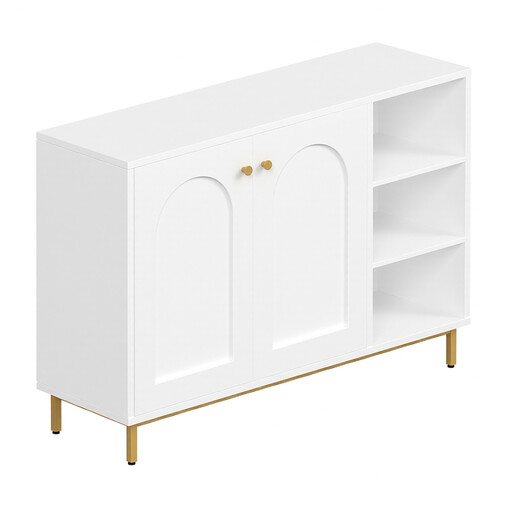
Why it suits this profile: This compact bathroom cabinet combines enclosed storage with three open compartments. According to the product description, the shelves can be adjusted to three different heights. The stated dimensions are approximately 35.5 x 100.5 x 75.5 cm.
The raised base, measuring 12.5 cm, helps keep the cabinet away from direct contact with the floor. However, check that the location is well ventilated and dry.
Enclosed doors, open shelves, adjustable shelf heights and an anti-tip device according to the product information.
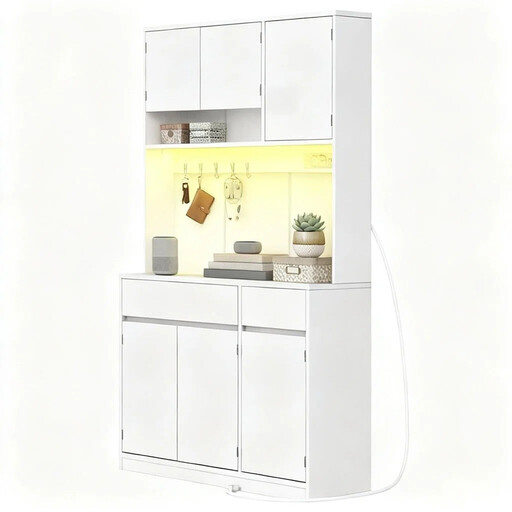
Why it suits this profile: This tall cabinet, measuring 40 x 100 x 180 cm, is designed for anyone who wants to combine kitchen, dining and storage tasks. The product description lists two power sockets, two USB ports, two drawers, adjustable shelves and LED lighting.
The combination of different compartments prevents small and large items from sharing one cluttered space. Check the electrical specifications and total load before use.
Versatile worktop measuring approximately 100 x 38.5 cm, adjustable shelves, two drawers and an anti-tip kit according to the product details.
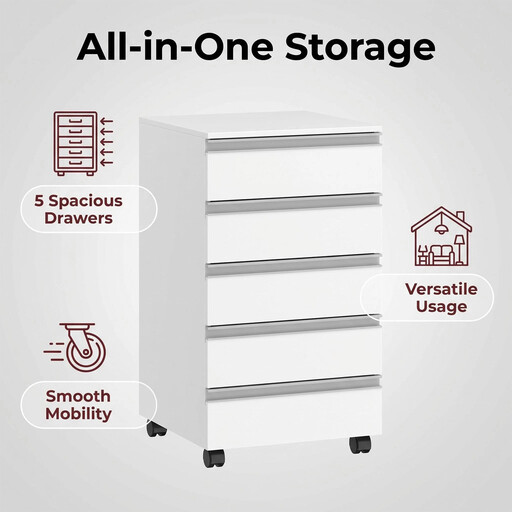
Why it suits this profile: This mobile cabinet, measuring approximately 40.5 x 40.5 x 65.5 cm, is designed for offices, studios and workshops. The five drawers provide a dedicated place for documents, tools, materials and accessories.
The lockable front castors help prevent the cabinet from moving during use. The castors allow for a flexible layout, but check the floor and lifting limits when storing heavy contents.
Five deep drawers, 360-degree swivel castors and a stated maximum total load of 50 kg.
We have compiled a complete, up-to-date list of products that fully meet these strict selection criteria and the applicable European safety regulations.
Choose a model with a smooth, easy-to-wipe surface, a raised base and a layout that suits your toiletries. A bathroom storage cabinet should not be left in standing water for prolonged periods. With a washbasin cabinet, always measure the trap cut-out and the available space for the pipes.
Its lifespan depends on the material, assembly, load, moisture and maintenance. A cabinet will generally remain usable for longer if you respect the maximum load, avoid overloading the hinges and drawers, and remove moisture quickly. Check periodically that the wall fixings and connections are still secure.
That depends on what you want to store. Drawers are suitable for small items and documents you use frequently. Adjustable shelves offer more flexibility for larger objects. For mixed storage, a combination of doors, shelves and drawers is often the most practical option.
