
Vandaag of morgen in huis

Kwaliteit gegarandeerd

Welkomstaanbiedingen ontgrendelen: GRATIS bezorging | Tot 80% korting | Gratis 30 dagen JoyPlus-proefperiode
Download de app
An storage cabinet may seem simple to choose at first glance. In practice, however, many models turn out to be too small, unstable or awkwardly organised. You often only notice this once the cabinet is full. For a home office, bathroom, bedroom or workspace, the dimensions, material and opening mechanism are particularly important.
When comparing options, don’t just look at the appearance or an attractive price. Check these common pitfalls too:
First, measure the place where the cabinet will stand. Take skirting boards, doors, sockets and the space needed to open drawers fully into account. A compact drawer cabinet may fit under a desk, while a taller filing cabinet provides more vertical storage.
As well as the external dimensions, pay attention to:
A drawer needs to be wide enough for A4 documents. For towels, cleaning products or tall bottles, an adjustable shelf is often more practical than several shallow drawers.
Chipboard, MDF, plastic and steel each have different characteristics. Steel is generally a good choice if you’re looking for a sturdy filing cabinet for documents or office supplies. MDF and chipboard work well in living spaces and bathrooms, but check whether the material is suitable for a damp environment.
Look at the stated maximum load capacity. Distinguish between:
For example, a product description may state a load capacity of 50 kg for the complete cabinet or 15 kg per drawer. These figures are not interchangeable. Ideally, only place a printer or heavy appliance on top when the maximum load capacity for the top panel is clearly specified.
A mobile filing cabinet, rolling cabinet or cabinet with castors is useful when you regularly change your layout. Check whether the castors can swivel 360 degrees and whether at least some of them have brakes. Without a lock, a cabinet may move when you open a drawer.
For invoices, contracts or personal documents, a lockable filing cabinet is a sensible choice. A lock helps keep the contents secure, but it does not replace responsible management of confidential information.
Tall furniture and bathroom cabinets must be positioned securely. Use any supplied anti-tip kit in accordance with the assembly instructions and attach the cabinet to a suitable wall where specified.
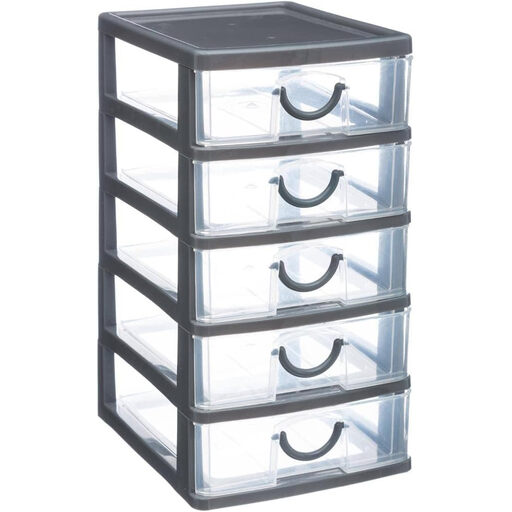
Why it suits this profile: This compact storage cabinet is designed for small items in a home office, bedroom, bathroom or hobby room. The five plastic drawers are ideal for sorting accessories by type.
The dimensions of 12 x 15 x 25 cm and total volume of 3.7 litres make the limited storage capacity clear from the outset. This means you won’t expect it to serve as a filing cabinet for large files.
Five separate drawers, polypropylene construction and a compact size for small items.
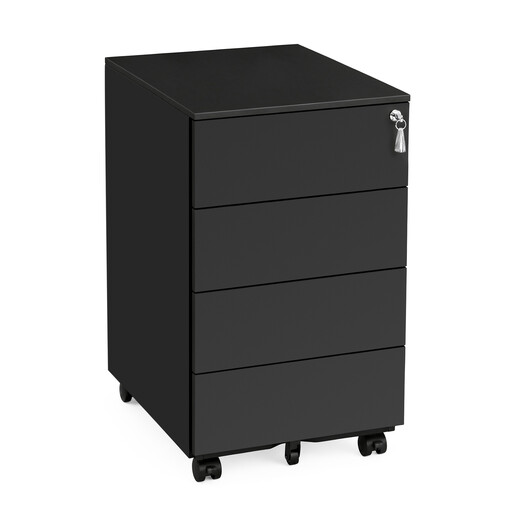
Why it suits this profile: This steel filing cabinet is ideal for an office or home workspace where documents and stationery need to be stored neatly and securely.
The product specification states that it has a steel construction, a lock and a load capacity of 15 kg per drawer. The cabinet arrives pre-assembled.
Four drawers, full-extension runners, a lock and supplied castors; dimensions 39 x 45,1 x 69,3 cm.
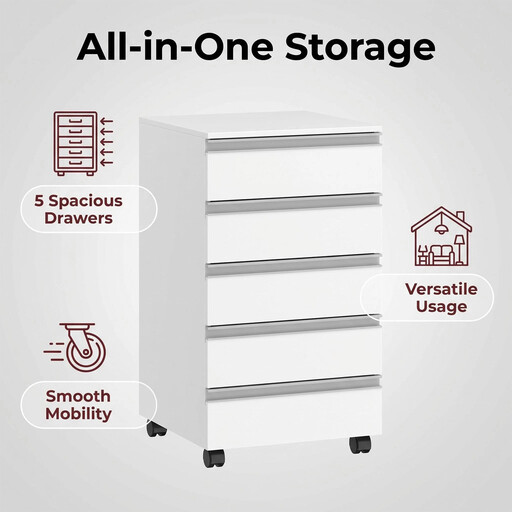
Why it suits this profile: This mobile filing cabinet is designed for studios, workshops and offices where documents, drawings, tools or materials are frequently used and moved around.
The description states that it has five deeper drawers, reinforced drawer runners, 360° swivel castors and locks on the two front castors. The stated total load capacity is 50 kg.
Approximate size of 40 x 40 x 65,5 cm, steel components, a melamine finish and a top panel that, according to the product details, is suitable for small office equipment.
We’ve put together a complete, up-to-date list of products that fully meet these strict selection criteria and the applicable European safety regulations.
A drawer organiser prevents small items from getting mixed up. It’s useful in a bathroom cabinet, kitchen drawer or home-office cabinet. A set with different sizes is practical when you want to sort both small accessories and longer items.
For clothes and household items, a tall fabric drawer cabinet may be sufficient. For files, paperwork or tools, a metal cabinet or a piece of furniture with deeper drawers is usually more suitable. Always look at the stated intended use and maximum weight rather than simply counting the drawers.
Measure the width, depth and height of the available space. Allow extra space in front of drawers and check that doors can open fully. For a cabinet with castors, you should also take skirting boards and any threshold into account.
Its lifespan depends on the material, load, assembly and frequency of use. Steel models are practical for intensive use, while MDF, chipboard and plastic are mainly suitable when the load remains within the product specifications. Don’t leave a bathroom cabinet standing in water for extended periods, and follow the care instructions.
A cabinet with castors does not require electricity. Any additional costs mainly relate to replacing castors or fittings after intensive use. Regularly checking that the screws are tight and avoiding overloading the cabinet helps limit unnecessary wear.
