
Vandaag of morgen in huis

Kwaliteit gegarandeerd

Welkomstaanbiedingen ontgrendelen: GRATIS bezorging | Tot 80% korting | Gratis 30 dagen JoyPlus-proefperiode
Download de app
A storage cabinet may seem like a straightforward purchase, until you discover that it is too deep for the room, the wheels do not roll steadily or the shelves hold less weight than expected. Marketing terms such as “large capacity”, “durable” and “multi-purpose” also mean little without specific dimensions, materials and load limits.
Pay particular attention to these three common pitfalls:
Not paying enough attention to dimensions
A cabinet needs to fit more than just an empty corner. Also check the doorway, walking space, skirting-board height and the room needed to open doors or drawers.
Unclear load capacity
Books, folders, tools and printers can quickly weigh more than decorative items. A stated maximum load is more useful than a general claim about sturdiness. Also check whether the load applies per shelf, per drawer or to the entire piece of furniture.
Confusing mobility with stability
A mobile storage cabinet with wheels is useful in a flexible workspace, but it must also remain stable when stationary. Look at the castors, brakes and flooring. For tall cabinets, wall fixing is important to help prevent tipping.
Measure the available space before looking for a storage cabinet. A compact storage cabinet is suitable for a student bedroom, hallway or home office, while a wide cabinet offers more room for archive folders or household supplies.
Do not only consider width and height, but also depth:
For a bookcase or open storage unit, also check whether the cabinet needs to be secured to the wall. An anti-tip kit is not a substitute for correct assembly, but when used properly it can provide additional stability.
A PP plastic storage cabinet is generally lightweight, easy to clean and practical for the bathroom, kitchen, student bedroom or utility room. However, plastic is not automatically suitable for heavy industrial loads. Check the recommended load per shelf and place the cabinet on a level surface.
A metal storage cabinet is better suited to documents, tools or a heavily used workspace. Steel can provide a sturdy foundation, but also look at the adjustable feet, hinges, locks and assembly instructions. A cabinet with a moisture- or rust-resistant finish can be practical in a garage or a room where humidity varies. According to the brand’s product description, some models have been finished for this purpose; treat this as a product specification rather than a universal guarantee.
Wood-based panels, such as chipboard and MDF, are suitable for many home and office solutions. Quality depends partly on the thickness, edge finish and fixings. Avoid prolonged contact with water, even when a melamine top layer is described as moisture-resistant.
A storage cabinet with drawers works well for documents, cables, stationery and small materials. Drawers provide a clear overview, but take up extra space when fully extended. A lockable filing cabinet is relevant if you do not want documents to be freely accessible. Check that the lock is actually included with the model and whether the cabinet is supplied assembled or flat-packed.
Open compartments are handy for books, baskets, plants and frequently used items. The contents remain visible and accessible, but dust can build up more quickly. Doors keep items more out of sight. A multi-purpose cabinet with adjustable shelves offers greater flexibility when the contents change over time.
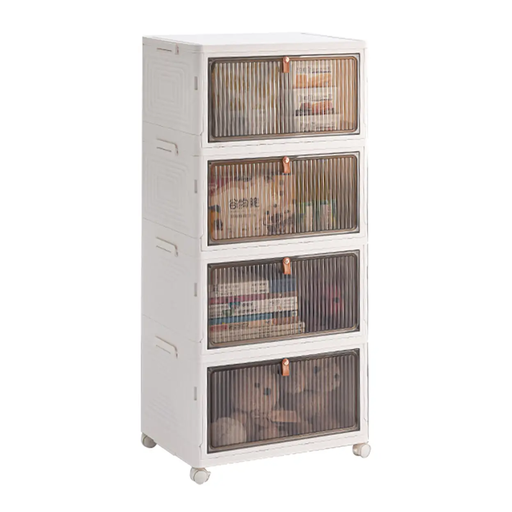
Why it suits this profile: This plastic cabinet is designed for light, everyday storage in smaller spaces such as a bedroom, office or flat.
The product description states that it is made from PP plastic, has four tiers and can be assembled without tools. Check the recommended load per shelf before placing heavy items on it.
Lightweight material, a smooth surface and a four-tier layout for books, toiletries or office supplies.
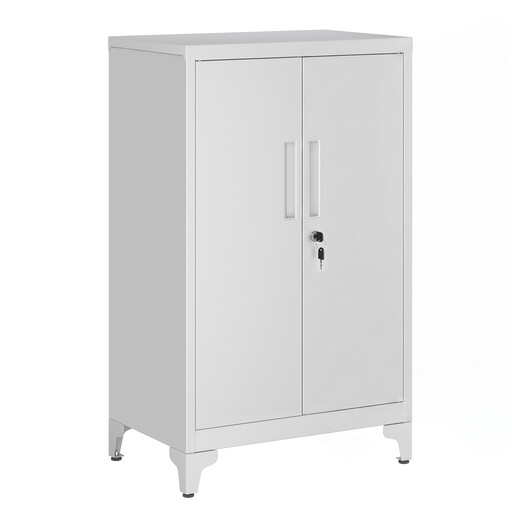
Why it suits this profile: The metal cabinet with double doors, a lock and adjustable shelves is suitable for an office, garage or household with a wide range of items to store.
The specifications mention a steel construction, two adjustable shelves, a lock and an anti-tip kit. Wall fixing is still required according to the safety instructions.
Dimensions of 40 x 60 x 90 cm, a stated load capacity of 30 kg for the top and 25 kg per adjustable shelf.
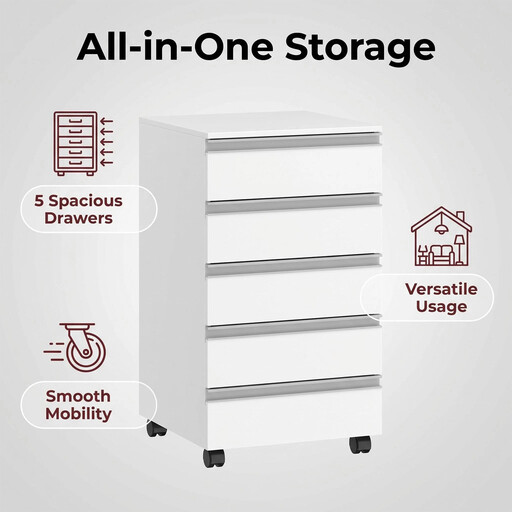
Why it suits this profile: This mobile storage cabinet is designed for studios, workshops, offices and home offices where materials are frequently moved around.
The product information states that it has five drawers, castors, front-wheel locks and a total load capacity of 50 kg. Distribute heavy contents evenly.
A size of approximately 40.5 x 40.5 x 65.5 cm, five deeper drawers and a flat top for small office equipment.

Why it suits this profile: The ten open compartments provide space for books, toys, baskets, plants and decorations in the living room, bedroom or home office.
The maximum load per compartment is stated as 10 kg. The supplied anti-tip kit must be used according to the instructions, especially in a household with children.
Ten compartments, a depth of 29 cm and the option to use the cabinet as a room divider or bookcase.
We have put together a complete, up-to-date list of products that fully meet these strict selection criteria and the applicable European safety regulations.
Before assembly, check that all parts are included and that the surface is level. For self-assembly models, it is wise to read through the entire manual first. Pay attention to the difference between tool-free assembly, assembly by one person and assembly requiring two people.
Heavy items should go at the bottom. Do not place a cabinet with wheels on a sloping floor, and use the brakes when you are not moving it. Clean plastic with a soft, damp cloth and mild detergent. Avoid abrasive products and bleach if the product information advises against them.
That depends on what you need to store. A narrow cabinet or drawer tower may be sufficient for stationery and small accessories. For ring binders, printer paper and equipment, a depth of around 40 cm is more practical. Always measure the space beside or underneath the desk, and allow for opened doors and drawers.
A storage cabinet with wheels can be stable when the wheels are suitable for the weight, the floor is level and the brakes are used. Wall fixing is advisable for tall or wide cabinets. Check the maximum load capacity and place heavy items low down in the cabinet.
Its lifespan depends on the material, load, assembly and frequency of use. A plastic cabinet is practical for lightweight items and easy to maintain. A metal filing cabinet or drawer unit is better suited to frequent opening and heavier contents. Do not exceed the stated load capacity, and check the screws, wheels and fixings regularly.
