
Vandaag of morgen in huis

Kwaliteit gegarandeerd

Welkomstaanbiedingen ontgrendelen: GRATIS bezorging | Tot 80% korting | Gratis 30 dagen JoyPlus-proefperiode
Download de app
Choosing a storage cabinet seems straightforward: pick a colour, check the size and place your order. In practice, problems often only become apparent after assembly. The cabinet turns out to be too deep for the hallway, the shelves don’t suit your belongings or the doors block a walkway. This guide helps you compare storage cabinets by the features that really make a difference in a British home.
A cabinet that’s 30 cm deep might seem suitable for a narrow hallway, but the usable space inside is reduced by back panels, hinges and shelves. So don’t just measure the available space; also check:
A slim storage cabinet can be a practical choice for a hallway or bedroom, but only if the door or drawer can still open fully.
A tall cabinet with fixed compartments isn’t automatically suitable for shoes, towels or ring binders. Tall boots, for example, won’t fit in low shoe compartments, while large bottles need more clearance above them. Adjustable shelves or removable shelves make a cabinet more versatile.
Also consider the combination of compartments and drawers. A chest of drawers is handy for smaller items, while a storage cabinet with doors keeps loose belongings out of sight. An open compartment can save time if you use it every day.
A cabinet with a narrow footprint or tall design can become top-heavy if you store heavy items at the top. Check whether the product description mentions an anti-tip device, and fit it according to the assembly instructions. Fixing the cabinet to the wall is especially important in homes with children or pets.
Also check how many people are needed for assembly. An MDF or chipboard cabinet can be sturdy, but incorrectly tightened fixings or a crooked back panel can affect its stability.
Measure the space in three directions: width, height and depth. Allow for the extra space needed when doors open. In a hallway, it’s important to leave enough room to walk through; a shoe cabinet that sticks out too far can become a nuisance day to day.
For a bathroom cabinet or vanity unit, also measure the position of the drainpipes, trap and skirting boards. Check the cut-out for the pipes in a vanity unit. Some product descriptions give a specific measurement, such as a 20 × 15 cm cut-out.
MDF and chipboard are commonly used for modern storage furniture. Quality depends, among other things, on the thickness of the board, the finish and the construction. In a bathroom, a smooth surface, raised legs and protection from splashes are practical features. However, that doesn’t mean every bathroom cabinet is suitable for prolonged contact with water.
Some product descriptions state that the materials are moisture-resistant. Treat this as a product specification, not a guarantee that the cabinet can withstand leaks or a floor that’s constantly wet. Wipe up spills promptly and follow the care instructions.
Check the stated maximum static load capacity and whether it applies to the whole cabinet, a shelf or a drawer. Where possible, spread heavy books, paper or supplies across several levels. Keep heavier items low down and lighter ones at the top.
A filing cabinet on lockable castors can be useful for documents, office supplies or equipment. If you’ll be moving it often, smooth-rolling castors and a level floor are important.
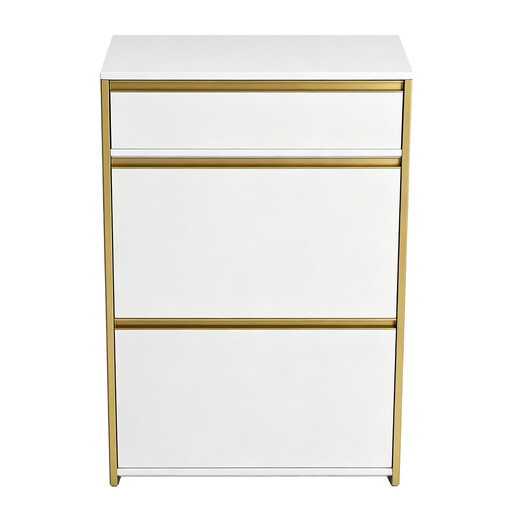
Why it suits this profile: At 60 cm wide and 24 cm deep, this cabinet is designed for hallways and other compact spaces. The combination of shoe compartments, a drawer and a top surface gives you room for everyday essentials.
The product description mentions adjustable, removable shelves, so you can adapt the layout for shoes of different heights and smaller items.
Compact size, four shelves according to the product information, and an anti-tip device for wall fixing.
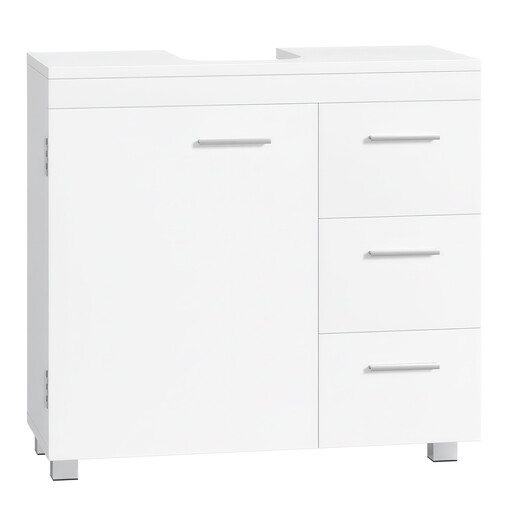
Why it suits this profile: This vanity unit is designed for anyone who wants to store towels, toiletries and cleaning products separately without overcrowding the room.
The product information lists three drawers, two compartments behind a door and an adjustable shelf. Before buying, be sure to check the dimensions of your basin and pipes.
Approximate dimensions of 30 × 70 × 64 cm, adjustable internal storage and a stated maximum static load capacity of 36,2 kg.
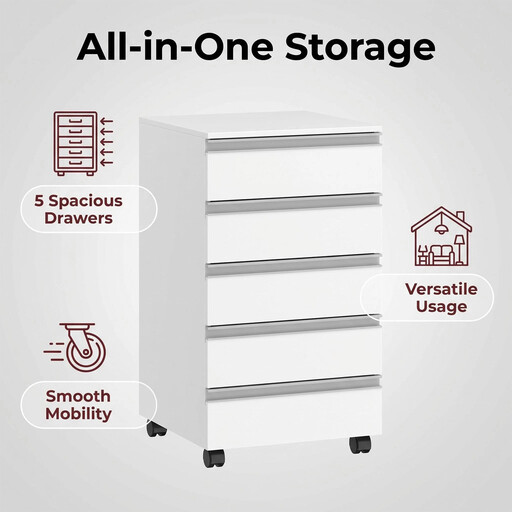
Why it suits this profile: A filing cabinet on castors makes sense in a home office, studio or workspace where you regularly move documents, tools and materials around.
The five drawers keep everything neatly organised. According to the product description, the two front castors can be locked to keep the cabinet in place while you use it.
Approximate dimensions of 40,5 × 40,5 × 65,5 cm, five deep drawers and a manufacturer-stated load capacity of 50 kg for the whole cabinet.
A shoe bench combines a seat with shoe storage, making it a good fit for a hallway where you want to sit down to put your shoes on. Check the stated load capacity and the width of the seat. A shoe cabinet with doors keeps shoes out of sight, while an open compartment makes them quicker to reach.
A chest of drawers works well for accessories, cables, clothes or toys. A cabinet with doors is often more practical for larger items. Open compartments can display decorative items in the living room, while doors help keep dust off your belongings. For a bedroom, choose a layout that suits the type of clothing you’ll store and the available floor space.
We’ve put together a complete, up-to-date list of products that meet these strict selection criteria and the applicable European safety requirements.
Measure the available width, height and depth at several points. Leave room for doors, drawers and skirting boards. For a bathroom cabinet, also check the pipes and the cut-out for the trap.
Its lifespan depends on the material, assembly, load and care. A cabinet will generally stay in good condition for longer if you respect its maximum load capacity, store heavier items at the bottom and wipe up moisture straight away. Wall fixing is important for the stability of a tall or narrow cabinet.
A smooth, finished surface can be easily cleaned with a slightly damp cloth. Don’t use too much water, especially on MDF or chipboard. Always check the manufacturer’s care instructions.
