
Vandaag of morgen in huis

Kwaliteit gegarandeerd

Welkomstaanbiedingen ontgrendelen: GRATIS bezorging | Tot 80% korting | Gratis 30 dagen JoyPlus-proefperiode
Download de app
A storage cabinet might seem simple to choose: pick a colour, check the price and place your order. In reality, problems often only appear after assembly. The cabinet turns out to be too deep for the walkway, shelves don't fit around tall bottles, or the piece offers less usable space than the photos suggest.
With this buying guide, you'll focus on the specifications that really make a difference in a British household. That way, you can compare a kitchen cabinet, bathroom cabinet, sideboard or metal storage cabinet on practical points rather than marketing claims.
An 80 cm wide cabinet isn't automatically spacious. The internal space is reduced by side panels, doors, the back panel and any drawers. So don't just check the height and width, but also:
Also measure skirting boards, pipes, sockets and door frames. Particularly in a flat, a cabinet that fits on paper can be difficult to manoeuvre into position in practice.
The term cabinet with adjustable shelves doesn't tell you how many height positions are available or how much weight each shelf can bear. Check whether the shelves are suitable for your belongings. Crockery, storage jars and small appliances need a different layout to towels or toiletries.
Also pay attention to how the shelves are fixed. A shelf that only rests on small pegs requires an even distribution of weight. Store heavy appliances low down and place light decorations higher up.
A cabinet with drawers, lighting or sockets can be handy, but only if the connections and controls suit your space. With a cabinet that has a power supply, you need to check where the cable runs to the socket and whether ventilation is needed around appliances.
An LED strip creates atmosphere, but it doesn't replace general lighting. With a multi-functional storage cabinet, it's wise to decide in advance which function takes priority: storing supplies, connecting appliances, displaying crockery or hiding loose items away.
For a tall cabinet, stability is more important than just having lots of storage volume. Look at the ratio between height, width and depth. A narrow cabinet that's 180 cm high needs extra attention when anchoring it to the wall.
A cabinet with drawers is practical for small items, while doors work better for larger objects. A sideboard with a wide top can also serve as a display piece or extra work surface. Just check the maximum static load of the top.
For a kitchen or bathroom, maintenance and moisture resistance are relevant features. MDF and chipboard can be suitable for normal household use, but prolonged contact with water can damage edges and joints. So don't place a bathroom cabinet where water splashes directly onto it, and wipe up any spills quickly.
A metal storage cabinet is generally easy to clean and can be practical in an office, utility room or space where moisture is a concern. With steel, pay attention to the finish, ventilation openings and weight. A metal cabinet isn't automatically suitable for outdoor use.
Check whether an anti-tip kit is included. A tall storage cabinet, kitchen cabinet or bathroom cabinet should be fixed to the wall according to the assembly instructions when recommended. Use fixing materials that suit your wall type, such as concrete, brick or plasterboard.
During assembly, also check:
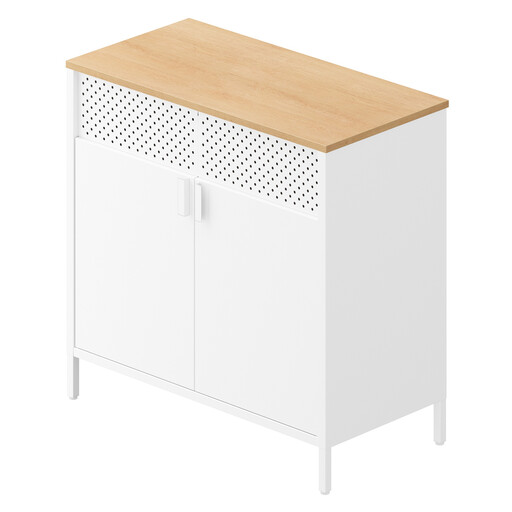
Why this fits the profile: With a width of 80 cm and a height of 76 cm, this compact cabinet suits a hallway, home office, dining room or living room. The adjustable shelf makes the layout flexible for boxes, books and household items.
The stated dimensions, the steel construction and the adjustable shelf make the capacity easier to assess than a cabinet presented only with lifestyle photos. An anti-tip kit is included.
Steel cabinet body, moisture-resistant properties according to the product description, magnetic door closure and a maximum static load of 50 kg for the top panel.
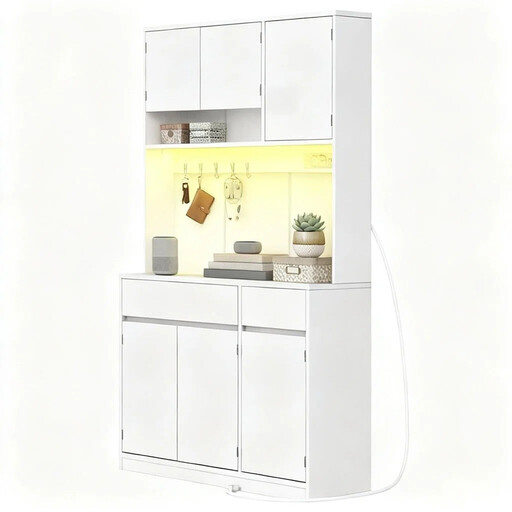
Why this fits the profile: This tall white cabinet combines closed storage, three glass compartments, two drawers and a worktop. That makes it suitable as a kitchen cabinet, sideboard or cabinet for the kitchen and living room.
The layout is clearly described: adjustable shelves, fully extendable drawers and a back panel. Check beforehand whether 180 cm height and 47.9 kg weight suit your space.
Two sockets and two USB charging ports, plus a worktop measuring 100 x 38.5 cm. The product description also mentions 25 adjustable LED modes.
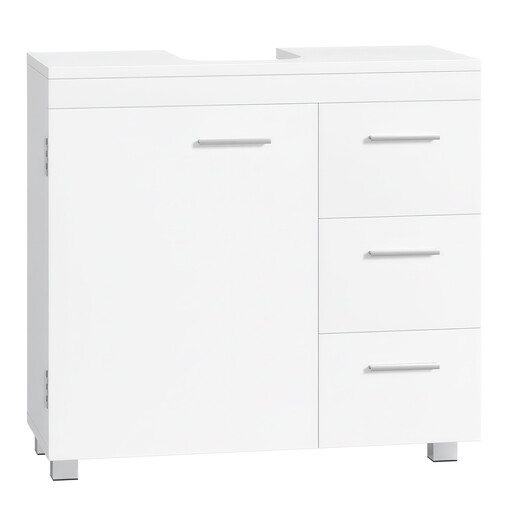
Why this fits the profile: This under-sink cabinet measuring 30 x 70 x 64 cm is designed for the bathroom and offers three drawers, two compartments behind a door and an adjustable shelf for towels and toiletries.
The product information states a maximum static load of 36.2 kg and recommends wall fixing. Also measure the position of your basin and trap before ordering.
Three drawers, two storage compartments and an adjustable shelf. The unit is designed for basins with or without a pedestal, but check the pipe cut-out and your basin type.
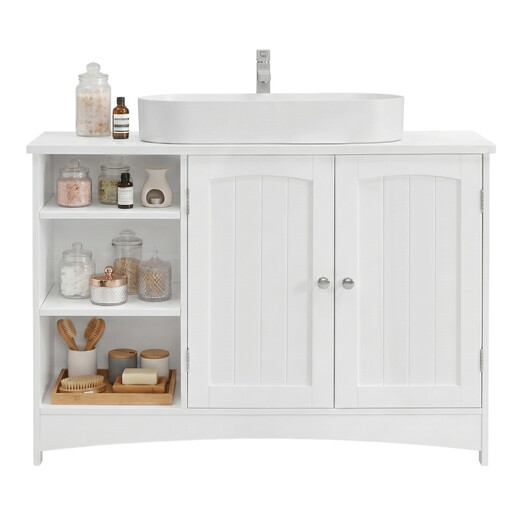
Why this fits the profile: This under-basin cabinet measures 30 x 88.5 x 60 cm and combines an open shelf with a closed cabinet. That works well when you want everyday items within reach but towels and toilet paper stored out of sight.
The dimensions of the pipe cut-out are stated as 20 x 15 cm. Check that measurement and the position of your trap; an adjustable shelf offers extra flexibility, but it won't fix an incorrect connection.
MDF construction, two doors, an open shelf and shelves adjustable to three levels. The manual and labelled parts are designed for straightforward assembly.
For the kitchen, a kitchen cabinet with a worktop, drawers and possibly integrated power supply makes sense. In a living room, a lower sideboard often feels calmer, especially if you want to place a television or decorations on it. A bathroom cabinet or under-sink cabinet mainly needs to fit around pipes, the basin and damp conditions.
Do you want doors, an open shelf or a combination? A cabinet with doors keeps items out of sight and limits dust. Open shelves are handy for everyday items but need more frequent cleaning. For more models, also browse the full range of cabinets with doors.
We've put together a full, up-to-date list of products that fully meet these strict selection criteria and comply with current European safety regulations.
Level the cabinet and fix it to a suitable wall using the included anti-tip kit. Check beforehand whether your wall is concrete, brick or plasterboard and choose appropriate fixing materials. Place heavy items at the bottom.
The lifespan depends on the material, assembly, load and maintenance. Keep MDF and chipboard as dry as possible, don't exceed the stated load capacity and tighten any loose screws promptly. A metal cabinet can be practical in spaces where cleaning and moisture resistance are important.
That depends on the wattage of the LED lighting and how long it's on. Only use the lighting when needed and check whether there's a timer, switch or adjustable mode. Sockets and USB ports only use electricity when a connected device is actively charging, depending on the design and the power consumption of that device.
