
Vandaag of morgen in huis

Kwaliteit gegarandeerd

Welkomstaanbiedingen ontgrendelen: GRATIS bezorging | Tot 80% korting | Gratis 30 dagen JoyPlus-proefperiode
Download de app
A storage cabinet seems like a straightforward purchase – until you discover that folders don’t fit, drawers stick, or the cabinet takes up too much room. For homeworkers, students, families and small businesses, the right choice isn’t just about looks. Size, weight capacity, layout and assembly all determine how well the cabinet works for you day to day.
Pay particular attention to these common pitfalls:
First, measure the available space. Don’t just consider width, height and depth – also think about:
For A4 documents, the internal width matters more than the external measurement. An A4 sheet is 21 × 29.7 cm, but folders and sleeves need extra room. An A4 document holder with an internal width of around 31.5 cm gives you more practical margin for documents, magazines and forms.
An open shelving unit works well for books, dÃcor and labelled storage boxes. For personal documents or items you want to keep out of sight, drawers, doors or closed boxes are more suitable.
Look at both the material and the stated maximum load. Many models are made from chipboard, MDF, metal, plastic or a combination of these.
Place heavy items towards the bottom where possible. With a cabinet that has a stated weight capacity of 65 kg, this doesn’t automatically mean each shelf can carry 65 kg. Check whether the load per shelf, compartment or drawer is specified.
A mobile storage cabinet with castors is suitable when you regularly rearrange your workspace. Check whether the wheels can swivel, whether brakes are fitted, and whether the cabinet stays stable when stationary.
For wall-mounted products, the right wall plugs and screws are important. A plasterboard wall needs different fixings than brick or concrete. Only use the supplied fixings if they are suitable for your wall type. A tall cabinet or storage unit should be anchored to the wall according to the product information to help prevent tipping.
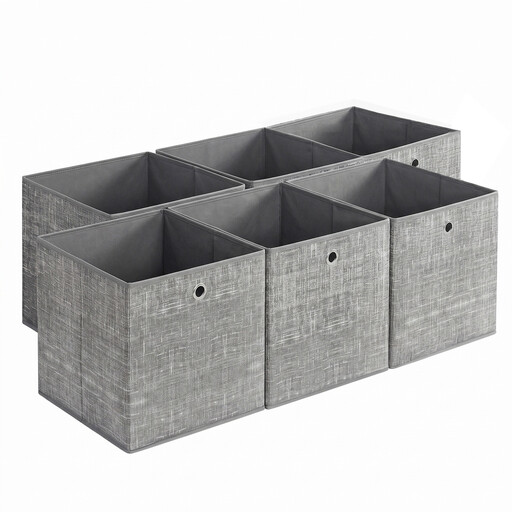
Why This Fits Their Persona: These storage boxes offer a simple way to sort clothing, toys, books or office supplies by category without buying a large cabinet straight away.
The dimensions are clear: 33 × 33 × 33 cm per box. This means you can check in advance whether they fit in your cube shelf.
Set of six; each box has a maximum load of 5 kg according to the product information and features a handle.
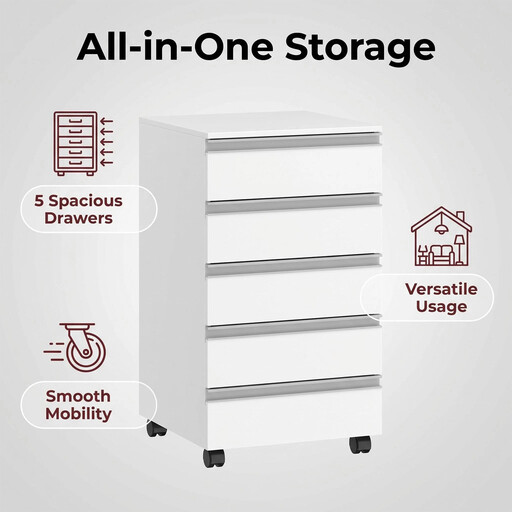
Why This Fits Their Persona: A compact mobile storage cabinet measuring roughly 40 × 40 × 66 cm fits next to a desk and can be moved when the room serves multiple purposes.
The product information states five deep drawers, swivel castors and brakes on the front wheels. Do check the floor surface and assembly before use.
Steel components, five drawers and a stated total load capacity of up to 50 kg.
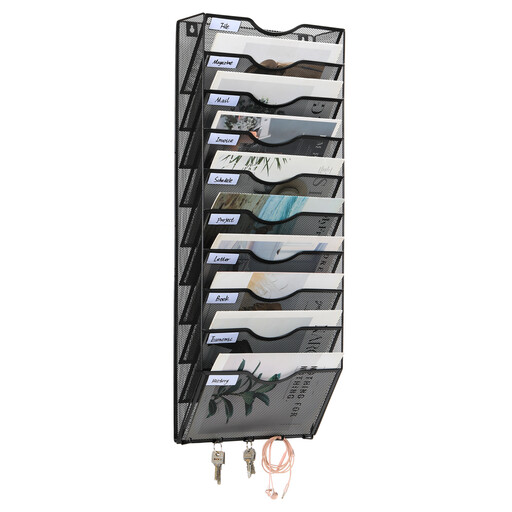
Why This Fits Their Persona: Ideal for a small office, admin corner or study area where lots of A4 documents arrive daily and need to be quickly retrievable.
The ten separate compartments with label plates allow a fixed layout for, say, invoices, post and current files. Wall mounting prevents desk space from being wasted.
Ten A4 compartments, a stated internal width of 31.5 cm and five hooks on the underside.

Why This Fits Their Persona: This bookcase works for books, plants, dÃcor and labelled boxes in a living room, bedroom or home office.
The compartments make the layout visible, while storage boxes keep loose items out of sight. Use the supplied anti-tip kit according to the instructions.
Ten compartments; each compartment has a stated maximum static load of 10 kg.
Not every space needs a full cabinet. A wall organiser for the office is handy for post, invoices and current documents. A model with five or six compartments works for a small paper flow; ten compartments make more sense when multiple projects or family members need their own category.
A stackable A4 letter tray sits on a desk and combines document compartments with space for pens and staplers. For clothing, toys and loose accessories, storage boxes in a shelving unit are often clearer than one deep cabinet. With a metal rack, check that the maximum weight per shelf or box is clearly stated.
A closed filing cabinet is especially useful when documents need to stay out of sight. Pay attention to whether it has a lock, the internal dimensions for ring binders, and how the cabinet sits on the floor or wall. Not every model is fire-resistant or lockable, so don’t assume these features without an explicit product specification.
Browse a current selection of storage solutions for home, home office and workspace. Compare size, material, layout and mobility before you order.
Measure the space next to or under the desk, then choose between a narrow mobile storage cabinet, a chest of drawers or a wall-mounted document holder. A wall-mounted model keeps the floor clear but needs suitable fixings. For daily use, drawers are often more practical than deep open compartments.
Work with fixed categories, such as administration, tax, insurance and current affairs. Use clear labels and place documents you need often at eye level. Check in advance whether A4 ring binders fit upright and leave a little room to add new documents.
Place heavy items at the bottom, stand the unit on a level surface and fix tall or narrow cabinets to the wall with suitable fixings. Check screws, wall anchors and connections regularly after assembly. Keep children away from drawers, doors and shelves that aren’t designed for climbing.
