
Vandaag of morgen in huis

Kwaliteit gegarandeerd

Welkomstaanbiedingen ontgrendelen: GRATIS bezorging | Tot 80% korting | Gratis 30 dagen JoyPlus-proefperiode
Download de app
A storage cabinet can help keep your bedroom, living room, dining room or office tidy. But it’s easy to make the wrong choice when buying one. A cabinet that looks spacious online may be too deep in reality. An attractive material may not be suitable for a damp room. And a cabinet with lots of compartments won’t necessarily have room for larger items.
That’s why the Joybuy Product Recommendation Officer makes selections based on verifiable details such as dimensions, materials, layout, weight capacity and assembly requirements.
An industrial-style cabinet with a metal frame can look great in a modern interior, but remember to check its width, depth and height too. Measure the space available, and allow for skirting boards, doors and room to move around. You should still be able to access a compact storage cabinet easily.
A cabinet with several shelves may seem ideal for books, crockery or food, but the weight capacity can vary from shelf to shelf. Check the stated maximum load, and place heavier items on the bottom where possible. Don’t exceed the specified limit.
According to the product information, several models in this selection need to be fixed to the wall to prevent them from tipping over. This is particularly important for a tall cabinet, a cabinet with a door or a model with drawers. Check in advance that your wall is suitable and that you have enough room to assemble it.
Start by measuring the available space. A bedside table around 34 to 36 cm wide will fit beside many beds, while a tall larder cabinet makes use of vertical space. In a living room, a sideboard or low storage unit may be more practical than a narrow, tall cabinet.
Consider the following:
Engineered wood, MDF, particleboard and metal all have different properties. According to the product information, several models have a smooth surface that can be cleaned with a soft, slightly damp cloth. Don’t use harsh cleaning products unless the manufacturer specifically says they’re suitable.
Take extra care when choosing a cabinet for a damp room. Even if the product description says a material is moisture-resistant, that doesn’t mean the cabinet is suitable for prolonged exposure to water. For bathrooms, garages or cellars, always check the full product description.
The stated weight capacity is a technical limit, not a guide to how much you can regularly exceed it by. Spread heavy items evenly across the shelves. If a cabinet has a glass door, such as a display cabinet, make sure fragile items are stable and follow any safety warnings.
According to the product information provided, the products listed come with a statutory warranty of at least two years. This is separate from correct use and assembly, and from any damage caused by overloading.

Why it suits this profile: This compact bedside table takes up very little floor space and combines a drawer with a shelf and enclosed storage. It can sit beside a bed, armchair or small desk.
Its dimensions of 34 x 35,5 x 50 cm are clearly stated. The product information also lists adjustable feet and wall fixing.
Wood combined with an iron frame, a drawer, a shelf and an enclosed cabinet section.
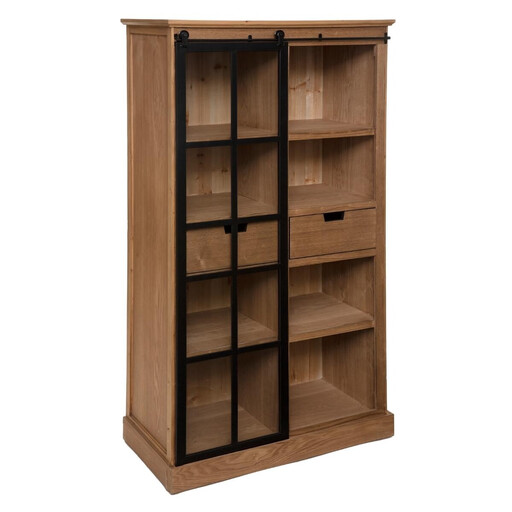
Why it suits this profile: This display cabinet is designed for anyone looking to combine storage and display in the living room, kitchen or dining room. The open compartments are ideal for ornaments, while the drawers keep smaller items out of sight.
The layout is clearly specified: five levels, four compartments, one sliding door and two drawers. The stated weight capacity is 5 kg per shelf.
Dimensions of 80 x 40 x 150 cm, MDF E1, steel and toughened glass, plus two drawers and a sliding door.
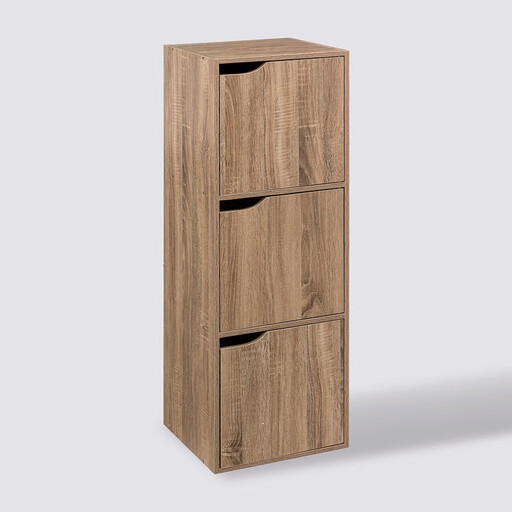
Why it suits this profile: This slim storage unit with three doors is ideal if you want to keep belongings out of sight in a hallway, office, bedroom or kitchen.
The cabinet has a stated maximum load of 60 kg. Its dimensions of 34.4 x 32 x 100.5 cm make it easy to work out how much space you’ll need in advance.
Three doors, a compact design, self-assembly and a stated maximum load of 60 kg.
We’ve put together a complete, up-to-date list of products that meet these strict selection criteria and the applicable European safety regulations.
Follow the assembly instructions and use the supplied anti-tip kit if the product information specifies one. Choose fixings that are suitable for your type of wall. Once assembled, check that the cabinet is stable and adjust the feet evenly if needed.
Its lifespan depends on the materials, weight load, assembly and care. A cabinet will generally stay in good condition for longer if you respect the stated weight capacity, keep it dry and avoid overloading the hinges or drawers. Also check the warranty terms and product information.
A standard storage cabinet doesn’t use electricity. Ongoing costs are mainly for care, any wall fixings and replacement assembly parts. When choosing a cabinet, dimensions, materials and weight capacity are therefore more important than energy consumption.
