
Vandaag of morgen in huis

Kwaliteit gegarandeerd

Welkomstaanbiedingen ontgrendelen: GRATIS bezorging | Tot 80% korting | Gratis 30 dagen JoyPlus-proefperiode
Download de app
A storage cabinet may seem like a simple purchase, until you find it won’t fit through the doorway, wobbles on an uneven floor or can’t hold enough weight. For a student room, home office, bedroom or workshop, the key considerations are its dimensions, layout and stability.
Watch out for marketing terms, too. “Large capacity” doesn’t tell you much without internal measurements or a stated weight capacity. “Mobile” could mean a cabinet with only small nylon wheels, whereas for everyday use you may need sturdier castors with brakes. And a cabinet described as “tool-free assembly” may still require you to check all the fittings and make sure it’s on a level surface.
A storage cabinet that’s 40 cm wide may offer less usable space than you expect because of a thick back panel, door or plinth. So measure not only the space where you plan to put the cabinet, but also:
For small flats, a narrow storage cabinet or tall bookcase may be more efficient than a wide cabinet. Just check that it will fit under the ceiling and can be secured to the wall.
A cabinet with four spacious compartments isn’t necessarily suitable for books, tools or printers. Books and metal components can quickly become heavy. Check the stated weight capacity for each shelf or drawer, or for the whole unit. If only the maximum weight capacity of the top is given, don’t assume it applies to the shelves as well.
A storage cabinet with wheels is handy if you regularly rearrange your space. For everyday use, castors and a brake are useful. If the cabinet will usually stay put, stability and wall fixings matter more than smooth rolling. Tall cabinets and bookcases often need to be secured to the wall using an anti-tip kit, as directed in the product instructions.
A plastic storage cabinet made from PP is lightweight, easy to clean and suitable for lighter items such as toiletries, snacks, toys or stationery. Bear in mind that plastic isn’t designed for heavy industrial loads and should be kept away from direct heat.
A metal storage cabinet is often a good choice for an office, utility room or workspace where moisture resistance and a wipe-clean surface are important. If the cabinet combines steel and chipboard, check which material is used for each part.
Engineered wood with a melamine finish can be suitable for documents, equipment and household items. Always check the assembly instructions and the permitted weight. An FSC label, such as the one on one of the 5Five models mentioned, refers to the source of the wood or engineered wood used; it doesn’t automatically tell you anything about weight capacity or lifespan.
An adjustable shelf makes a cabinet more versatile if you want to store items in different sizes. A magnetic catch or door can keep loose items out of sight, but check that the catch engages properly after assembly.
For a storage cabinet for small spaces, depth and clearance for opening doors are often more important than overall capacity. For example, a 30 cm-deep model may fit more easily in a hallway or beside a desk than a 40 cm-deep cabinet.
Place every cabinet on a level surface. Follow the manufacturer’s warnings about maximum loads, heat sources and wall fixings. The anti-tip kit supplied with a tall cabinet isn’t just for show: use it as instructed whenever necessary.
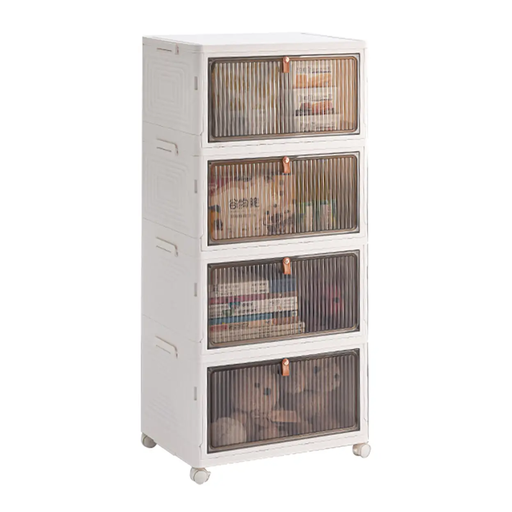
Why it suits this need: This compact mobile storage cabinet is designed for lighter items in a bedroom, bathroom, kitchen, student room or home office. Its four tiers keep everyday essentials within easy reach.
The product description specifies four tiers, PP plastic and tool-free assembly. It’s intended for indoor use, not for heavy industrial loads.
Four open storage tiers, a smooth surface and plastic wheels. According to the description, it can be cleaned with a soft, damp cloth and mild soap.
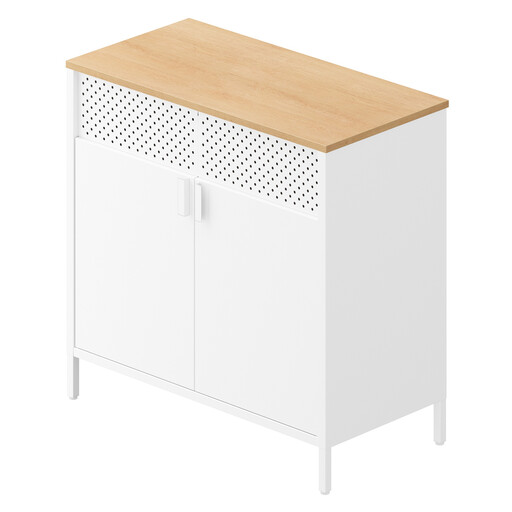
Why it suits this need: This cabinet is a good fit for homes and offices looking for a closed unit with an adjustable shelf. Measuring 80 × 40 × 76 cm, it can also be used as a sideboard or TV stand.
The adjustable shelf means you don’t have to fit everything into fixed-height compartments. The anti-tip kit supplied helps address stability, provided it’s correctly secured to the wall.
Steel cabinet body, magnetic catch, adjustable shelf and a stated maximum static load of 50 kg for the top.
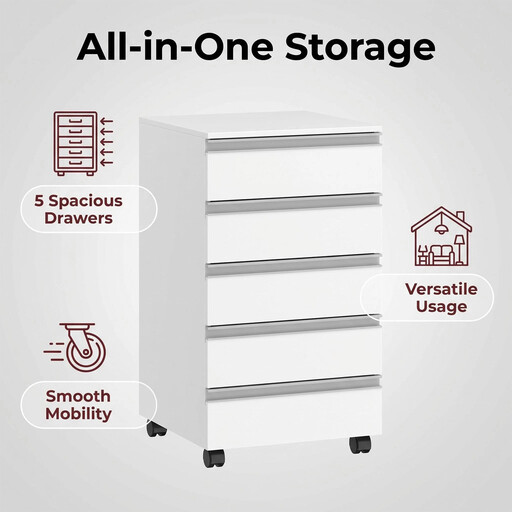
Why it suits this need: This mobile filing cabinet is designed for offices, studios, creative workspaces and DIY areas where documents, tools and materials are moved around frequently.
The specifications list five drawers, 360° swivel castors, lockable front castors and a total load capacity of up to 50 kg. Distribute heavy contents evenly.
Five deep drawers, a flat top and castors with brakes. It measures approximately 40.5 × 40.5 × 65.5 cm.
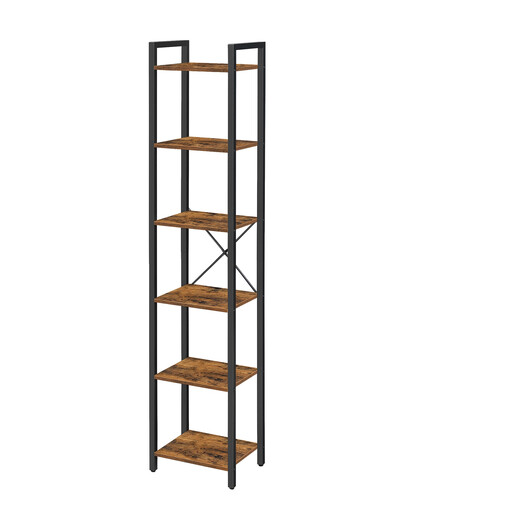
Why it suits this need: This tall, narrow bookcase is designed for a living room, study, bedroom or hallway where floor space is limited. It measures 30 × 40 × 187.5 cm.
Its shallow depth makes it suitable for narrow spaces. The product description lists X-shaped bars, adjustable feet and a supplied anti-tip kit.
Six storage tiers, a steel frame and a stated maximum load capacity of 50 kg. Wall fixings are intended to help ensure safe use.
We’ve put together a complete, up-to-date list of products that meet these strict selection criteria and the applicable European safety regulations.
Place the cabinet on a level surface, keep heavier items on the bottom shelves and don’t exceed the stated weight capacity. For tall models, use the supplied anti-tip kit as directed in the assembly instructions. Also check that the wall and fixings are suitable for installation.
It depends on how it’s made. Check the type of wheels, whether they have brakes and the permitted weight. A mobile storage cabinet with swivel castors is useful in an office or studio, but a cabinet with lightweight plastic wheels is mainly suitable for occasional moving and lighter contents.
Its lifespan depends on the material, assembly, load, moisture and how often it’s used. Clean surfaces with products approved in the product description, avoid overloading the cabinet and tighten the fixings after assembly. With a plastic storage cabinet, it’s also best to avoid direct heat and extreme temperatures.
