
Vandaag of morgen in huis

Kwaliteit gegarandeerd

Welkomstaanbiedingen ontgrendelen: GRATIS bezorging | Tot 80% korting | Gratis 30 dagen JoyPlus-proefperiode
Download de app
A stick blender may seem simple at first glance: a motor, a blade and a button. However, models can differ significantly in ease of use, accessories, cleaning and safety. A cheap hand blender may prove less practical if you regularly puree soup, make smoothies or chop vegetables.
When comparing models, pay particular attention to these three common pitfalls:
For everyday use, a 2-in-1 stick blender with a blending attachment and whisk is suitable for pureeing and whisking. If you also want to chop onions, herbs or vegetables, look for a stick blender with chopper. A measuring beaker makes it easy to prepare small portions of smoothies, sauces or baby food directly.
Check the capacity of the accessories. A 500 ml chopper is practical for smaller quantities, but less suitable if you want to chop enough for a large family in one go. A 600 to 800 ml measuring beaker offers more room for a smoothie or sauce, but avoid overfilling it to help prevent splashing.
A stick blender with a turbo setting can be useful when you temporarily need extra power. For soft ingredients, one or two speeds are often sufficient. When working with different textures, variable controls give you more control.
Also consider the position of the buttons. Controls that can be operated with one hand are more practical when you are holding the bowl or pan steady with the other. According to Braun’s product description, the MultiQuick MQ50051M has a rotary dial with 21 speeds. The Monsga S100, by contrast, is listed with two modes: normal and turbo.
Brands may describe performance in their own way. Claims such as “extra fine” or “powerful” should therefore be considered alongside verifiable details, such as the stated power, number of speeds and included accessories.
A stainless-steel blade and shaft are practical for regular use. Also check the shape of the blade guard. Good splash protection can help reduce splashes on your worktop or clothing, but the result also depends on the quantity, speed and movement used while blending.
A BPA-free stick blender is worth considering when the accessories contain plastic. Check whether the statement applies to all parts that come into contact with food. The product information for the Braun MQ50051M states that all food-contact parts are BPA-free.
A dishwasher-safe stick blender usually means that the detachable accessories are suitable for cleaning in the dishwasher. For example, a ROUNY model has a maximum dishwasher temperature of 60 °C. Always read the instructions before putting any parts in the machine.
The selection below links specific features to familiar usage scenarios. This allows you to compare not only price or motor power, but also how you intend to use the appliance at home.

Why it suits this profile: This set combines a blending attachment, whisk, 500 ml chopper and 500 ml measuring beaker. It is practical for beginners who want to use one appliance to prepare soup, smoothies, batter and small quantities of vegetables.
The accessories are clearly listed in the product description. Splash and pan protection are also mentioned. According to the product information, the detachable accessories are BPA-free and dishwasher-safe.
Normal and turbo settings, a 36.5 cm housing for deeper pans and a 1.5-metre cord.
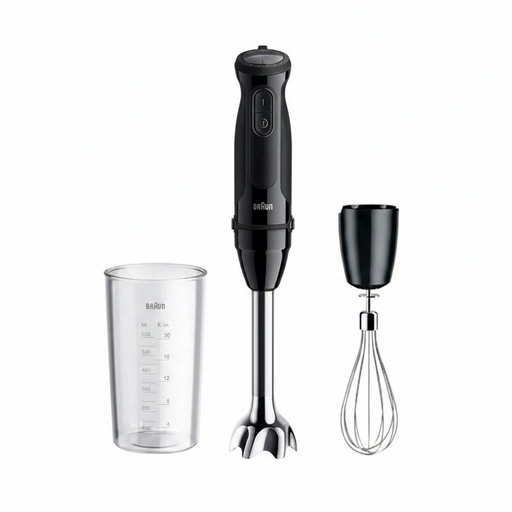
Why it suits this profile: If you cook frequently and want more control, the variable speed selection and 1000 W of power may be appealing. The set includes a whisk and is designed for pureeing, whisking and everyday food preparation.
The product information lists 21 speeds, a housing designed to reduce splashing and an EasyClick system for the accessories. This means you do not have to judge the blender solely by its wattage.
1000 W, 21 speeds, whisk attachment and dishwasher-safe food-contact parts according to the product description.

Why it suits this profile: This powerful stick blender is intended for users who want to chop and whisk as well as puree. The set includes a 700 ml blending beaker, 500 ml chopper and whisk.
The maximum operating time is clearly stated: run the blender for one minute, then let it rest for one minute. This helps prevent overloading caused by prolonged blending.
Up to 1200 W, 15,000 rpm according to the product specifications, variable speed control and splash protection.
Only use a stick blender for soup once the hot liquid has cooled sufficiently. Manufacturers such as Braun and Russell Hobbs advise in their product information that hot liquids should first cool to below 80 °C. This helps reduce the risk of splashes and burns.
Also bear these basic rules in mind:
We have compiled a complete, up-to-date list of products that fully meet these strict selection criteria and the applicable European safety regulations.
Yes, a stick blender is practical for smooth soups, sauces and smoothies. Where possible, use a tall, narrow measuring beaker and do not overfill it. For hot soup, allow the liquid to cool first in accordance with the manufacturer’s instructions.
Its lifespan depends on how frequently it is used, the ingredients, cleaning and whether the recommended resting times are followed. Hard or frozen ingredients can put greater strain on the motor and blades. A model with detachable parts is generally easier to keep properly clean, but always check which parts may and may not get wet.
Actual consumption depends on the power rating and operating time. A 1000 W model uses a maximum of 1 kWh when running continuously at full power for one hour. In practice, a stick blender is usually used for only a few minutes at a time. Higher power therefore does not automatically mean high energy costs; preparation time and the selected speed also play a role.
