
Making small, thick portions
You want to blend cooked peas just before serving without filling a large jug for a small amount. The Consumentenbond discusses stick blenders as an option for puréeing and blending.


For a small or thick portion of pea purée just before guests arrive, a stick blender is often more practical: you can blend it straight in a suitable pan, with less transferring between containers. For larger quantities with enough liquid, a jug blender is a better fit; the Consumentenbond says blenders are particularly suited to larger or wetter preparations. Compare the usable capacity and always check the temperature instructions for the exact model.
You want to blend cooked peas just before serving without filling a large jug for a small amount. The Consumentenbond discusses stick blenders as an option for puréeing and blending.
You want to make enough purée in as few batches as possible, so you’re considering the usable jug capacity and how much liquid you’ll need. The Consumentenbond says blenders are a good fit for larger quantities and wetter preparations.
You’re blending the peas shortly after cooking and want to follow your appliance’s temperature instructions. These can vary by model.
When choosing an appliance, the Consumentenbond considers factors such as portion size, thickness, results and washing up. First, decide whether you want to blend straight in a pan or mix several portions with enough liquid in a jug.
| What to consider | What to look for | Who should pay particular attention? |
|---|---|---|
| Small, thick portion | Check that the blending foot fits in your pan or beaker, and see what the manual says about thick mixtures. | If I’m making a small, thick portion, I want to blend it without adding extra liquid or having to fill a large jug. Around 31% of consumers put small, thick portions at the top of their list. |
| Several portions | Compare the effective or usable capacity with the quantity in your recipe, and consider how much liquid you’ll need. | When I’m cooking for friends, I want to make enough purée without unnecessarily changing the consistency. Around 25% of consumers prioritise having enough capacity for several portions. |
| Warm peas | Check the manual for the exact model to find the permitted temperature and quantity. | I want to blend the peas shortly after cooking and follow the appliance’s instructions. Around 25% of consumers make handling warm ingredients safely their top priority. |
| Quick clean-up | Check which parts can be removed, which are dishwasher-safe and which accessories you’ll actually use. | Just before guests arrive, I want to wash as few extra bowls and parts as possible. Around 19% of consumers prioritise fewer steps and easy clean-up. |
The maximum capacity may be greater than the quantity the manufacturer says you can blend at one time. For example, Philips lists a maximum capacity of 1.9 litres and an effective capacity of 1 litre for the HR2041/00; Tefal gives a total capacity of 2 litres and a usable capacity of 1.5 litres for the BL871D31.
Compare the effective or usable capacity of the exact model with the quantity in your recipe.
If the usable capacity is too small, you may need to blend in several batches.
A label such as ‘heat-resistant’ doesn’t necessarily mean you can process boiling-hot ingredients. Temperature instructions vary by model, so don’t assume that a limit for another model applies to yours.
Before use, read your appliance’s manual and check the instructions for temperature and quantity.
If the instructions say to let the ingredients cool first, you’ll need to allow extra preparation time.
A higher wattage or more attachments doesn’t, by itself, tell you whether an appliance is suitable for a small, thick portion of pea purée. Braun also lists both 1,000 W in the description and 750 W in the specifications table for the MQ50236M.
First choose how you want to prepare your purée and what capacity you need. Then check the model specifications and which parts are included with that version.
A set may include parts you won’t use, while an unsuitable jug could still mean extra blending batches.
The ErgoMixx MS6CB6110 is a stick blender with a detachable foot for blending directly in a container.
The MultiQuick MQ50236M is a stick blender with accessories that vary by model.
The HR2041/00 is a jug blender for preparations that fit within its effective capacity and usage instructions.
The PerfectMix+ BL871D31 is a jug blender with a heat-resistant glass jug, which Tefal says is suitable for hot and cold preparations.
These Joybuy products are stick blenders for blending directly in a suitable pan or beaker. When blending warm peas, always check the usage instructions for the exact model.
 No image available
The stick blender design is suitable for blending directly in a suitable bowl. For warm ingredients, a heat-resistant bowl and small portions are recommended.
The set name lists a chopper and whisk.
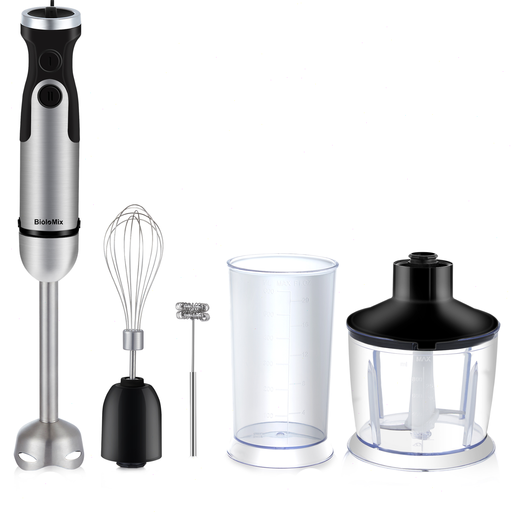 No image available
The stick blender is designed for puréeing, including soup; check the usage instructions for your preparation.
The product name lists 1,200 W, a four-blade knife made from 304 stainless steel, six speeds and a turbo setting.
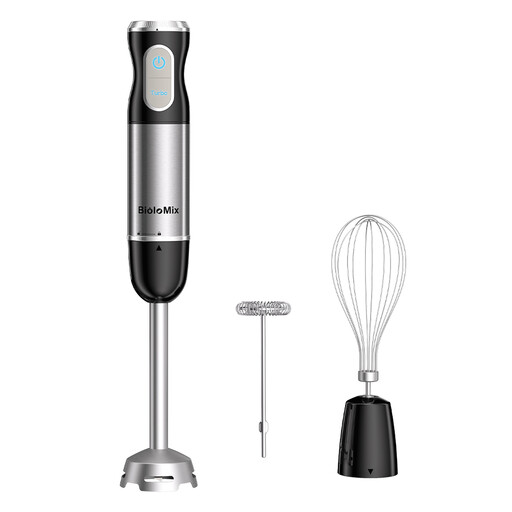 No image available
The stick blender design is suitable for blending directly in a suitable pan or beaker.
The product name lists a turbo setting, a detachable design and splash protection.
 No image available
The stick blender is designed for use with dishes such as soup and sauce. Bear in mind the stated operating time: a maximum of 1 minute of continuous use, followed by 1 minute of rest.
The product name lists up to 1,200 W, 15,000 rpm, a 700 ml measuring beaker, a 500 ml chopper and a whisk.
 No image available
The product description mentions puréeing purée and soup; the stick blender design is suitable for blending directly in a suitable pan or beaker.
The product name lists two speeds, a whisk, a 500 ml chopper and an 800 ml measuring beaker.
No. A stick blender may be more practical for a small or thick portion. A jug blender is a better fit for larger quantities with enough liquid; the final result also depends on the recipe and the appliance.
No. Don’t assume the same temperature limit applies to every model. Check the manual for your exact appliance: Philips specifies a limit below 60 °C for certain named jugs, while Tefal says the BL871D31 is suitable for hot preparations without giving an exact upper temperature on the product page.
No. There isn’t one fixed statutory warranty period for every blender. ACM ConsuWijzer explains that with normal use, you can expect a product to work properly, and that the seller is responsible for providing an appropriate solution if it doesn’t meet that expectation.
Yes. According to the Netherlands Food and Consumer Product Safety Authority, CE marking is mandatory for electrical products. This general requirement doesn’t, by itself, confirm the status of a specific model; also check the product identification and instructions for use.