
Cook with limited storage space
You make small portions of chilled tomato soup and want to store as few appliances and separate parts as possible. The Consumentenbond and Voedingscentrum describe blending soup with a stick blender as one option.


If you’re making small portions of chilled tomato soup and have limited storage space, a stick blender is an obvious choice. The Consumentenbond describes blending directly in a pan or bowl as a practical use for one. If you mainly want to blend a smooth soup in a sealed cup, compare compact cup blenders and check their usable capacity. A jug blender may suit you if you’re making several portions, but remember to allow space for the appliance and the extra washing-up.
You make small portions of chilled tomato soup and want to store as few appliances and separate parts as possible. The Consumentenbond and Voedingscentrum describe blending soup with a stick blender as one option.
You prioritise an even texture and are comparing a jug or cup blender with a stick blender. The Consumentenbond describes a sealed blender jug as practical for liquid or semi-solid preparations.
You’re making soup for several people or for later and need enough blending capacity without overlooking your limited worktop space.
When it comes to chilled tomato soup, your choice mainly depends on storage space, the texture you want, the quantity you’ll blend at a time and how easy the appliance is to clean.
| What to consider | What to look for when buying | Who should pay particular attention? |
|---|---|---|
| Space and small portions | Measure the available cupboard and worktop space, and check the dimensions of the appliance and the parts you want to store. | If I have limited cupboard space and usually make one small portion, I also want to be able to store the separate parts easily. Around 36% of consumers give top priority to the space an appliance takes up and making small portions. |
| Smoothness of the soup | Where possible, compare test results for the exact model; wattage alone doesn’t tell you how smooth the soup will be. The Consumentenbond describes differences between blending with a stick blender and using a jug blender. | If you want your chilled soup to be as smooth as possible, you may want to prioritise texture over blending directly in a bowl. Around 29% of consumers put their preferred level of smoothness first. |
| Quantity per blending session | Compare the usable filling capacity with your recipe. The stated cup or jug capacity isn’t necessarily the maximum amount you can blend at a time. | If I’m making soup for several people, I want to know how much the appliance can hold at a time. Around 21% of consumers give the portion size per blending session top priority. |
| Cleaning | Check which parts are removable and what the manual says about using the dishwasher. Don’t assume parts are dishwasher-safe unless this is specified. | If you want to clean as few parts as possible after cooking, pay particular attention to the blending foot, blades and separate cups. Around 14% of consumers choose ease of cleaning as their main consideration. |
Power is a product specification, but on its own it doesn’t tell you how evenly raw tomatoes will be blended.
First decide whether you want to blend small portions directly in a bowl or blend soup in a cup or jug. Where possible, look for information about the texture produced by the exact model.
The stated capacity doesn’t automatically tell you how much you’re allowed to blend at a time according to the instructions.
Before choosing a cup blender, compare its permitted filling capacity with the amount in your usual recipe.
A smaller working capacity may mean extra blending sessions and washing-up if you’re making several portions.
A larger capacity can be useful for making several portions, but the base and jug also take up space.
Measure your cupboard and worktop before choosing a larger model, and consider whether you’ll regularly need the extra capacity.
Remember to allow space to store the jug, as well as the parts that need washing after use.
The ErgoMixx MSM66110 is a stick blender option for small quantities, without a separate blender jug.
The MultiQuick 5 range includes stick blenders in several configurations. Compare the exact package if you want to prepare other things too.
The Original 600 NB603DG is a personal cup blender for small chilled preparations.
Tefal also promotes the Blend Up BL19H4 for making chilled soup.
This selection includes stick blenders and blenders with a cup or jug, so you can match the preparation method and capacity to your kitchen space and the number of portions you’re making. Check the filling instructions for the exact model and whether the appliance on offer has the applicable CE marking. The Rijksoverheid says that compliance with European safety requirements and a CE marking are required for appliances placed on the EU market.
 No image available
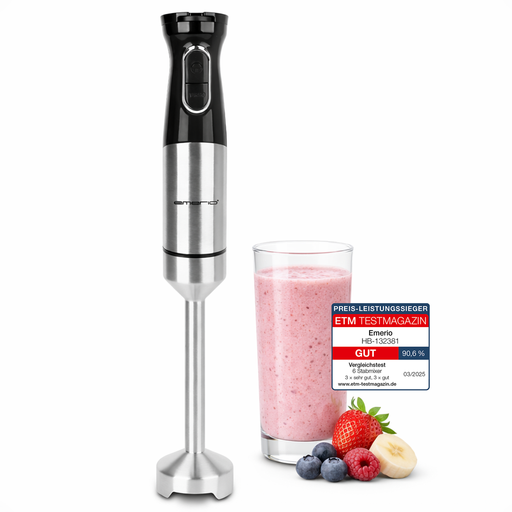
A stick blender for anyone who wants to blend soup directly in a suitable bowl.
1000 W; variable speed; removable blending shaft.
 No image available
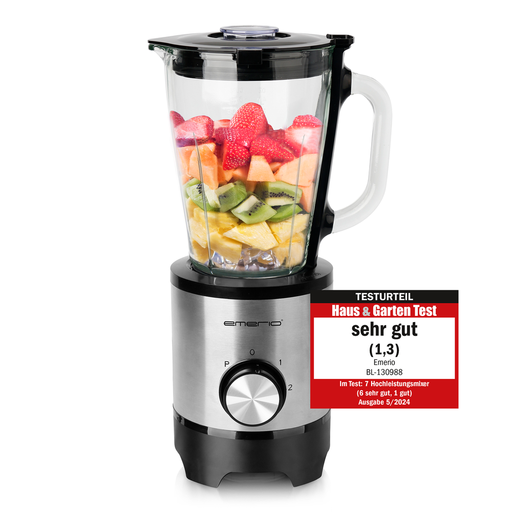
The jug capacity is worth considering if you want to blend several portions at once. Also think about where you’ll store the jug and base.
1.5-litre glass jug; two speed settings; pulse function; safety lid. Stated dimensions: 14 × 14 × 38,5 cm.
 No image available
A compact blender for anyone who wants to blend a small quantity in a blender jug.
0.6-litre capacity; 350 W; two speed settings; pulse function.
 No image available
The product description mentions soup and a mixing beaker. Check whether its capacity suits the quantity you want to make at a time.
Variable speed control; removable blending shaft; 700 ml mixing beaker; 500 ml chopper bowl. According to the product information, use for no more than 1 minute at a time, then leave to rest for 1 minute.
 No image available
A hand blender for anyone who wants to blend soup in a bowl or measuring beaker and remove the separate parts.
Two speed settings; 800 ml measuring beaker; 500 ml chopper bowl; whisk; removable parts.
Yes. The Voedingscentrum uses washed, chopped raw tomatoes in a gazpacho recipe and blends them with a stick blender or food processor. In that recipe, the soup is then chilled in the fridge for at least 1 hour. This is a recipe instruction, not general storage advice.
Follow the manual for the exact model. Bosch lists a removable blending foot for the MSM66110. For the NB603DG, nutribullet instructs you to rinse the blade with soap and water and put the cups on the top rack of the dishwasher. Don’t automatically apply these instructions to other models or parts.
When you buy as a consumer in the Netherlands, you’re entitled to a product that is fit for purpose. The seller must resolve problems covered by the legal guarantee. The Rijksoverheid states that there is no fixed statutory guarantee period for all products in the Netherlands. A manufacturer’s guarantee is in addition to your statutory rights.
For many distance purchases from a business, there is a 14-day cooling-off period, and the seller must inform you about it. The Rijksoverheid also lists exceptions. Check the terms of the specific purchase; buying from a private individual is a different situation.
According to the Rijksoverheid, electrical appliances placed on the EU market must meet the applicable European safety requirements and have a CE marking. Check the marking and product information for the appliance on offer. A product page in Dutch alone doesn’t show that these requirements have been met.