
Workshop leader preparing several portions
If you’re blending cooked peas in several batches, check the intended quantity and the instructions for repeated use. The Consumentenbond includes cooked peas in one of its test set-ups for vegetable purée.


Choose your stick blender based on the quantity and thickness of the pea purée. For repeated or heavier blending, a model that’s easy to operate, with a detachable blending foot and a suitable pan or bowl, is a sensible choice. Then compare the speed controls, cord and cleaning instructions. Also check that the appliance on offer and the parts that come into contact with the purée meet the relevant requirements.
If you’re blending cooked peas in several batches, check the intended quantity and the instructions for repeated use. The Consumentenbond includes cooked peas in one of its test set-ups for vegetable purée.
If you want participants to adjust the texture themselves, consider the controls and the shape of the blending foot. A manufacturer’s claim of an anti-splash feature doesn’t guarantee that no splashes will occur while blending.
If you want to clean up between preparations, check which parts can be detached and which cleaning instructions apply to that exact model. This helps you avoid assuming that every part is dishwasher-safe.
First, consider how much purée you’re making, how thick it is and how often you’ll be blending in succession. Then look at the controls and cleaning. Only choose extra attachments if you’ll also need them for other workshop recipes.
| What to consider | What to look for when buying | Who should consider this? |
|---|---|---|
| Even blending | Match the blending foot, speed settings and instructions to the quantity and thickness. The Consumentenbond recommends at least 600 W as a guide for heavier blending; this doesn’t guarantee a particular result. | If I’m making several portions of pea purée, I want to know whether the blender suits the quantity and texture I need. Around 36% of consumers put blending results first. |
| Controls and splashing | Compare the number of speed settings, the grip and the shape of the foot. Also consider the pan or bowl and the instructions for use. | If participants are adjusting the texture themselves, I want controls that suit the task and cause as little disruption as possible at the workstation. Around 29% of consumers prioritise splash control. |
| Cleaning between batches | Check whether the foot is detachable and which removable parts the manual says are dishwasher-safe. | If I want to tidy up between workshop batches, I want to know which parts I can easily clean separately. Around 21% of consumers prioritise ease of cleaning. |
| Extra features and cord | Check whether you need a chopper or whisk for the workshop programme and whether the cord will reach the socket by the pan. The Consumentenbond says a cord longer than 150 cm is useful when the socket is further away. | If I also want to chop or whisk, or I’m working further from the socket, I want to know which features and reach I need. Around 14% of consumers put extra features or workstation reach first. |
Wattage alone doesn’t tell you how well a blender will purée. The Consumentenbond assesses purée using ingredients including cooked peas. What’s more, Braun’s product page for the MQ50001M lists both 1000 W in the sales copy and 750 W in the technical specifications.
Compare the portion sizes you have in mind, the controls and reliable model specifications. Treat power as a guide, not a guarantee of a particular texture.
The Consumentenbond describes a purée foot as an accessory for mashed potatoes. That doesn’t mean you need one to blend cooked peas.
Start with the standard blending foot and only choose extra attachments if you’ll also use them for other workshop recipes.
Unused attachments take up extra storage space and still need to be cleaned.
Cleaning instructions and dishwasher-safe labels apply to specific parts and models.
Before buying and using the blender, check the manual for the exact model variant and follow the stated cleaning method for each part.
Cleaning the appliance in a way that goes against the model-specific instructions could damage it or one of its parts.
The ErgoMixx MSM66110 is a straightforward stick blender option if your main aim is to purée.
According to Tefal, the Intention HB46E8, reference HB46E838, is designed for blending without a chopper or whisk.
According to Braun, the MultiQuick 5 MQ50001M offers several speed settings if you want to tailor the controls to the preparation.
According to Philips, the Philips 3000 Series HR2520/00 is a 400 W stick blender suitable for tasks including making purée.
This selection includes stick blenders for puréeing, where speed control, splash control, cord length and extra attachments may all be worth considering.
 No image available
This could suit you if you want to adjust the speed while blending. The product description lists 21 speeds and SplashControl; this splash-control feature doesn’t guarantee that no splashes will occur.
 No image available
The product description lists puréeing and thick soups among its uses. It also lists 20 speeds, a turbo setting and a detachable foot. The cord is 0.95 m long, which may be inconvenient if the socket is further from the pan.
 No image available
This could suit you if you’re working in a deep pan and splash control is important. The product description lists a reach of 36.5 cm, standard and turbo settings, and a chopper and 500 ml beaker. The stated cord length is 1.5 m.
 No image available
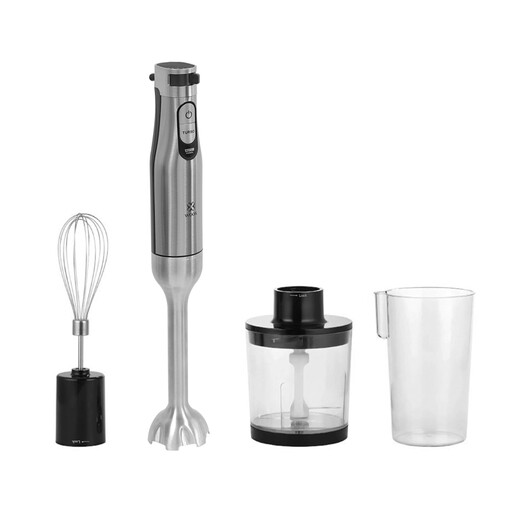
The product description lists variable-speed trigger control and a splash-resistant blending head. The title mentions a chopper, whisk and milk frother; check whether you’ll use these extra attachments in the workshop.
 No image available
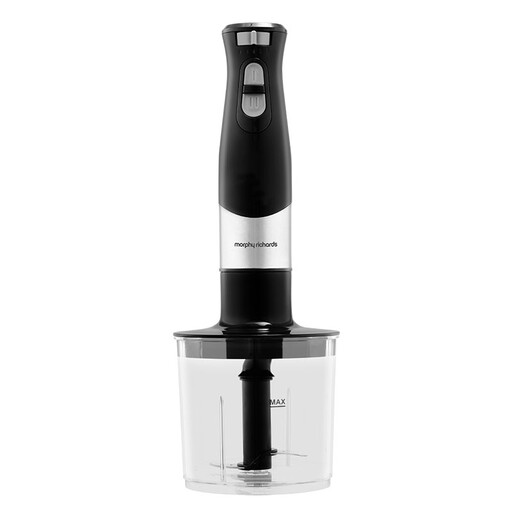
This could suit you if you want to adjust the speed while blending and will use the separate attachments for other preparations too. The product description lists five variable speeds, a turbo setting, a detachable stainless-steel blending foot, and a measuring beaker, whisk and chopping bowl.
Not based on the name alone. The Consumentenbond describes a purée foot specifically as an accessory for mashed potatoes. For cooked peas, first compare the standard blending foot with the texture you want.
That depends on the model and its parts. Check the manual. For the models covered by the relevant support page, Philips says to detach the blending shaft from the motor unit and rinse it. This instruction doesn’t automatically apply to other brands or models.
According to the Netherlands Food and Consumer Product Safety Authority (NVWA), CE marking is compulsory for electrical products covered by the relevant rules. The NVWA also sets requirements for articles that come into contact with food. Check the information for the appliance on offer and the parts that touch the purée. A brand or model name alone doesn’t confirm that these requirements have been met.
If you buy as a consumer in the Netherlands, you’re entitled to a product that is fit for purpose. According to the Dutch government, there’s no fixed statutory guarantee period, and the retailer is your point of contact if there’s a problem. A manufacturer’s guarantee is separate from this.
It depends on the circumstances. The NVWA outlines food safety obligations for businesses that prepare, process or sell food. If your workshop takes place within such a business, check which food safety rules apply to that organisation.