
The quick evening cook
You want to blend cooked peas straight after your class and care most about the result and ease of use. The Consumentenbond includes vegetable purée with peas in its testing approach.


For blending cooked peas after an evening class, a simple stick blender with a removable blending foot is often enough; you don’t need extra attachments. If you also want to chop ingredients or prepare other dishes, compare the speed controls and accessories for the exact model. A relevant test of vegetable purée with peas will tell you more about the texture you can expect than the stated wattage alone, as the Consumentenbond’s testing approach also shows.
You want to blend cooked peas straight after your class and care most about the result and ease of use. The Consumentenbond includes vegetable purée with peas in its testing approach.
You’re making a small meal and want to be able to remove the blending foot after use and clean it separately, without unnecessary attachments. The Consumentenbond recommends detaching accessories after use.
You may also want to use your stick blender to chop onions, herbs or nuts. The Consumentenbond recommends a chopper for these tasks, so check which accessories come with the model you choose.
For pea purée, start by considering the results and how easy it is to clean. Choose extra features only if you’ll use them for other dishes too.
| What matters when buying | What to look for | Who cares most about this |
|---|---|---|
| Even blending | Look for a test of vegetable purée with peas, and check the included blending foot and speed controls. | If I mainly want a smooth pea purée after an evening class, I look for evidence of blending performance. Around 36% of consumers prioritise even blending. |
| Less splashing and quick cleaning | Check whether the blending foot is removable and which separate parts the manual says are dishwasher-safe. | After cooking, I want to remove the foot quickly and avoid extra cleaning. Around 29% of consumers prioritise easy cleaning and minimal splashing. |
| Small portions and storage space | Check whether a measuring beaker is included, how large it is and how many separate parts you’ll need to store. | For a small meal, I want a practical container for blending and only a few parts to store in the cupboard. Around 21% of consumers prioritise small portions and limited storage space. |
| Other kitchen tasks too | Check whether the model includes a chopper and whether a whisk or purée foot is actually included. | If I want to chop onions or herbs as well as blend, I check which accessories are in the box for those tasks. Around 14% of consumers prioritise extra kitchen tasks. |
A higher stated wattage doesn’t, by itself, tell you how evenly a stick blender will purée cooked peas. The Consumentenbond assesses vegetable purée with peas, among other things. Braun lists both 1000 W and 750 W for the MQ50001M, so its wattage isn’t a reliable basis for choosing.
Look for a test that’s relevant to pea purée and check the specifications for the full model code. Don’t treat the conflicting wattage figures for the MQ50001M as decisive evidence.
A chopper and a whisk do different jobs from blending with the foot. Extra parts also mean more cleaning and storage space.
Choose accessories only if you expect to use them for the tasks they’re designed for. Check what’s in the box for each model: a chopper, whisk and purée foot are different accessories.
A Joybuy product page lists HR2683/00 in the title and HR2681/00 in the description. This makes it unclear which version the offer refers to.
Before choosing based on the offer, check the full model code and the contents of the box with the seller.
The ErgoMixx MSM66110 is a simple model with two settings and a removable metal blending foot.
The Quickchef HB6598 is a model with variable speed and a chopper.
The MultiQuick 5 MQ50001M is a model with a measuring beaker, metal foot and variable speed.
The Philips 5000 Series HR2683/00R1 reviewed here is explicitly a refurbished model with a chopper.
These Joybuy product options are relevant for peas, soup or other dishes made with a stick blender. Features and accessories vary by model.
 No image available
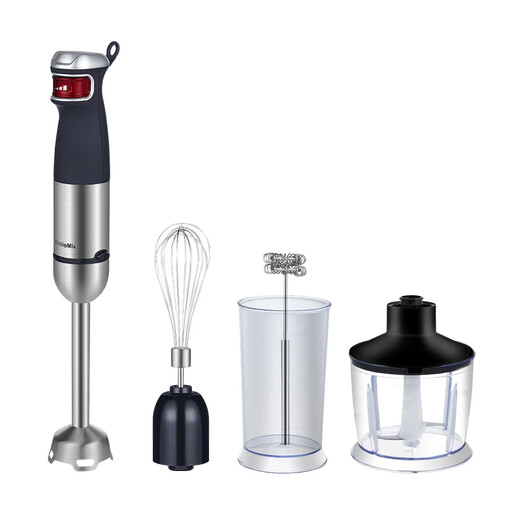
The listed stick-blender function and continuously variable speed control are useful for blending and adjusting the speed for different dishes.
The product name lists 1200 W and a stainless steel blade.
 No image available
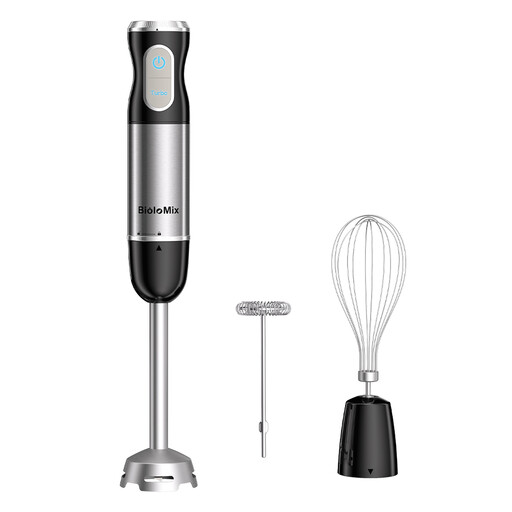
The product name describes a detachable design, which may be useful if you want to take the blender apart for cleaning after use.
The product name lists splash protection and materials suitable for food contact.
 No image available
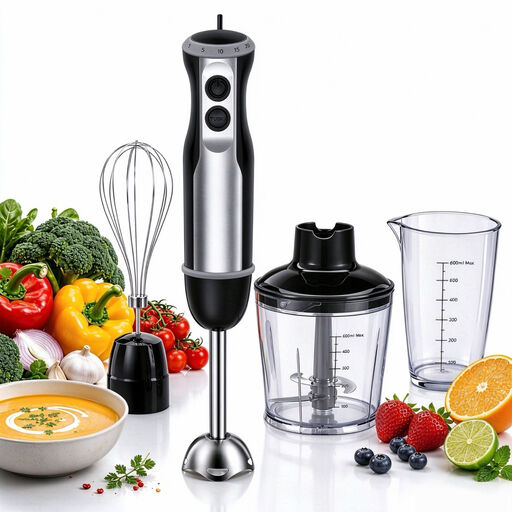
The product name lists soup and purée as uses, along with six speeds and a turbo function.
 No image available
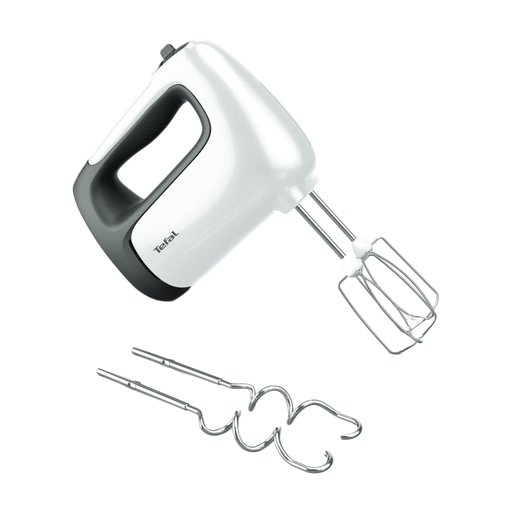
The listed blending foot is designed for uses including soup and sauce; check whether this model suits the way you want to blend.
The product name lists 450 W and 5 speeds.
 No image available
This stick blender may be useful if you want to prepare a small portion; check which measuring beaker and parts come with the exact model.
Place the blending foot on the bottom of the pan or bowl before switching on the stick blender, following the Consumentenbond’s usage tips. Also follow your model’s manual when using it with hot ingredients.
Don’t assume so: check the manual for each separate part. Unplug the appliance before cleaning and detach the accessories, as the Consumentenbond advises.
No, a purée foot isn’t generally necessary for pea purée; a regular stick blender is designed for blending vegetables. The separate purée foot described by the Consumentenbond is specifically designed for mashed potatoes.
Report the problem to the seller. According to the Dutch government, there’s no fixed statutory guarantee period in the Netherlands; what you can expect from a product depends on the circumstances. A manufacturer’s guarantee doesn’t replace your statutory rights.
For electrical equipment within the applicable voltage range, EU regulations cover matters including conformity assessment and CE marking. Parts intended to come into contact with food must comply with the relevant Dutch and European rules on food contact materials, as explained by the Netherlands Food and Consumer Product Safety Authority. A CE mark on its own doesn’t mean that a specific item has been independently checked.