
Cook who wants a firm purée
Wants to purée cooked peas straight in the pan and control how coarse they are. Albert Heijn Allerhande describes a method where you drain the peas and use a stick blender to make a coarse purée.


If you want to blend cooked peas straight in the pan into a firm or coarse purée, a stick blender is the obvious choice. A jug blender is a better fit if you also want to make liquid or semi-solid dishes; compare its usable capacity with your portion sizes, and check the temperature guidance for the exact model. A higher wattage alone doesn’t tell you whether an appliance will make better purée.
Wants to purée cooked peas straight in the pan and control how coarse they are. Albert Heijn Allerhande describes a method where you drain the peas and use a stick blender to make a coarse purée.
Wants to make enough purée for the meal, so compares the usable capacity of a jug rather than just its maximum capacity. Philips Netherlands and Tefal give different maximum and effective or usable capacity figures for the models mentioned.
Wants to blend after cooking and checks what the instructions say about hot ingredients for the chosen jug or stick blender. Tefal describes the jug of the PerfectMix+ BL871D31 as heat-resistant; always follow the instructions for the exact model.
Start with the texture you want and the quantity you’re making. Then check the temperature guidance and cleaning requirements, rather than basing your decision on a single motor specification.
Choose this option: if you want to blend cooked peas straight in the pan into a coarse, firm purée.
The trade-off: you work the blending foot around the pan yourself; check the guidance for hot ingredients and which attachments are included.
Choose this option: if you want to blend liquid or semi-solid dishes as well as pea purée, and the usable capacity suits your portion sizes.
The trade-off: you need to transfer the peas to the jug and clean it afterwards; maximum and effective capacity can differ.
Choose this option: if you regularly want to blend hot dishes and the manual for your chosen model allows it.
The trade-off: heat-resistant does not mean you can blend boiling-hot ingredients or fill the jug without limit, so follow the instructions for your model.
The table below summarises the main buying considerations for pea purée as part of a family meal.
| What to consider | What to look for | Who is this important for? |
|---|---|---|
| Texture you want | Compare blending in the pan with blending in a jug; check which blending foot and adjustable settings are included. | If I want to keep the peas coarse or firm, I’ll choose an appliance that lets me control how much I blend them. Around 28% of consumers prioritise their preferred texture. |
| Portion size | Compare the usable capacity with the quantity in your recipe; allow for multiple batches if it won’t all fit at once. | For a family meal, I want to know how much purée I can make at a time, not just the jug’s maximum capacity. Around 22% of consumers prioritise having enough usable capacity. |
| Hot ingredients | Read the model’s manual for guidance on temperature, filling and the lid before putting cooked peas in a jug. | If I want to blend after cooking, I want to know in advance what temperature my appliance can handle according to its instructions. Around 22% of consumers prioritise this feature. |
| Cleaning | Compare cleaning in the pan with the instructions for the jug, lid and blades; check which parts are dishwasher-safe. | After cooking, I want to clean as few parts as possible and know which ones I can safely put in the dishwasher. Around 17% of consumers focus mainly on cleaning. |
| Features and aftercare | Compare accessories and programmes with what you’ll actually use; also check the warranty terms. | I don’t want to pay for features I don’t need, and I want to know who to contact if the appliance doesn’t meet my expectations. Around 11% of consumers prioritise features and aftercare. |
The Philips HR2041/00 lists a maximum capacity of 1,9 l and an effective capacity of 1 l. For the Tefal BL871D31, the listed figures are 2 l total capacity and 1,5 l usable capacity. The larger figure doesn’t tell you how much purée you can actually blend at once.
Compare the usable capacity with the quantity in your recipe, and split it into several batches if needed.
A smaller usable capacity can mean more batches and extra cleaning.
Whether an appliance is suitable for hot ingredients depends on the model. Tefal describes the jug of the BL871D31 as heat-resistant, but you still need to follow the instructions on temperature, filling and the lid.
Read the manual for the exact model before blending hot peas, and follow the instructions for use.
According to ACM ConsuWijzer, your statutory rights exist alongside any retailer or manufacturer’s warranty.
First check which statutory rights apply to your purchase, then compare the terms of any paid add-on.
The MultiQuick stick blenders are an option for puréeing peas in the pan. The Dutch product page for the MQ50236M lists a blending foot, chopper, whisk and measuring beaker.
The 3000 Series HR2041/00 is a jug blender with one speed setting and a pulse setting.
According to Bosch, the VitaPower Serie 4 MMB6174S has a 1,5 l ThermoSafe glass jug.
The PerfectMix+ BL871D31 is a jug blender with a heat-resistant glass jug, 1,5 l usable capacity and automatic programmes, according to Tefal.
The Joybuy options below are stick blenders for anyone who wants to purée peas straight in the pan.
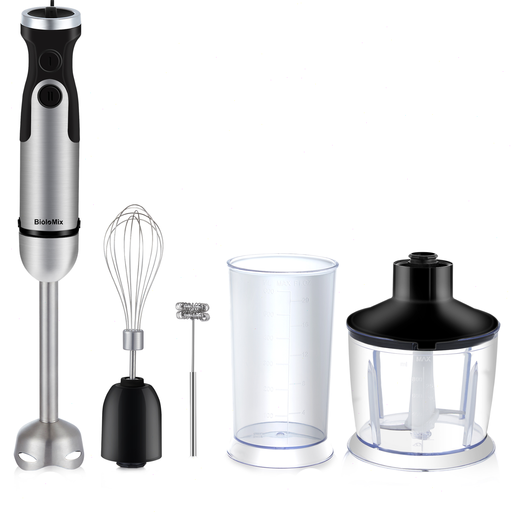 No image available
The stick blender attachment is suited to puréeing peas in the pan.
The product name lists 1200 W, 6 adjustable speeds and a turbo setting.
The product name mentions a detachable blending shaft, a four-blade knife made from 304 stainless steel, a measuring beaker and a 500 ml chopper.
 No image available
The stick blender is suited to puréeing in the pan; bear in mind the product instructions say not to process boiling liquids.
The product description lists 25 speeds and a turbo function.
 No image available
The stick blender attachment is suited to puréeing peas straight in the pan.
The product description lists 21 speeds, a measuring beaker and an EasyClick system.
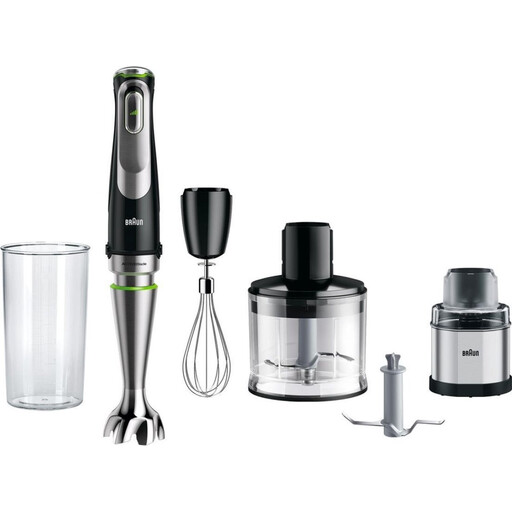 No image available
The blending foot is suited to puréeing in the pan; the set description also lists accessories for other kitchen tasks.
The product description lists a 1200 W motor, a whisk, chopper and measuring beaker.
 No image available
The stick blender attachment is suited to puréeing peas in the pan.
The product name lists 6 speeds, turbo and up to 1200 W. The description mentions a 700 ml measuring beaker and a 500 ml chopper.
The product description lists 15.000 rpm and a maximum continuous operating time of 1 minute; observe the prescribed rest period afterwards.
No, you don’t need a jug blender to make pea purée. Albert Heijn Allerhande describes draining peas and using a stick blender to make a coarse purée; a jug blender is mainly an option if you also want to blend other liquid or semi-solid dishes.
Don’t assume you can: the permitted temperature varies by model. Tefal describes the jug of the BL871D31 as heat-resistant and suitable for hot dishes, but follow the guidance on temperature, filling and the lid for your chosen appliance.
According to Voedingscentrum, you should leave leftovers to cool and put them in the fridge or freezer, covered, within two hours. Leftovers can be kept in the fridge for up to two days; freeze them if you want to keep them for longer.
In the Netherlands, statutory rights exist alongside any manufacturer’s warranty. According to ACM ConsuWijzer, the appropriate solution depends on the circumstances; if the product doesn’t meet what you could reasonably expect, the retailer may need to offer a repair or replacement, for example.