
Vandaag of morgen in huis

Kwaliteit gegarandeerd

Welkomstaanbiedingen ontgrendelen: GRATIS bezorging | Tot 80% korting | Gratis 30 dagen JoyPlus-proefperiode
Download de app
A stick blender might seem simple: plug it in, press the button and start blending. However, models vary significantly in power, controls, accessories and maintenance. A cheap hand blender can be perfectly fine for soup or sauce, but less suitable for large quantities or hard ingredients.
If you're planning to buy a stick blender, it's worth looking beyond just the wattage or a flashy marketing term. Below, you'll discover which features are genuinely practical, which pitfalls to avoid, and which models suit different cooking needs.
A higher wattage sounds appealing, but it doesn't tell you everything about the blending result. The shape of the blending foot, the blade, the speed control and the recommended operating time all play a part. A model with 450 watts can be sufficient for smoothies and soft vegetables, while a powerful stick blender with 800 to 1,000 watts offers more scope for thick purées or larger quantities.
Also check whether the stated power is the nominal or maximum wattage. Product descriptions can display these values differently.
A stick blender with a whisk, chopper, measuring jug and potato masher might seem versatile. In practice, unused accessories take up cupboard space and make cleaning more time-consuming. So first decide what you actually prepare:
The motor unit on electric models generally cannot be submerged. So look for a detachable blending foot and check exactly which parts are dishwasher-safe. A dishwasher-safe stick blender doesn't always mean the entire appliance is dishwasher-safe.
For light preparations such as milkshakes, sauces and soft vegetables, 300 to 500 watts can be enough. For thicker mixtures, nuts or regular use, 600 to 1,000 watts is more suitable. Also look at the maximum continuous operating time. Different models in this selection indicate around one minute of continuous use, after which the motor needs to cool down.
Do not use a stick blender in boiling liquid unless the manual explicitly allows it. Let soup cool slightly first and keep the blending foot fully submerged to minimise splashing.
A single-speed model is straightforward and often fine for basic use. A stick blender with multiple speeds gives you more control for things like thin sauce, batter and thick purée. A turbo function can temporarily provide extra power, but it doesn't replace the right technique or appropriate portion size.
Also pay attention to the controls. A dial, push button or variable-speed button affects ease of use, especially when you're working with one hand.
Check whether parts that come into contact with food are labelled as BPA-free. This is a product specification, not a guarantee of a particular cooking result. A stainless steel blending foot is practical for daily use and may be less prone to discolouration than some plastic parts.
An ergonomic handle, an anti-splash blending foot and a reasonable weight make a difference during longer preparations. A cordless stick blender offers more freedom of movement, but check the battery capacity, charging time and operating time before choosing one.
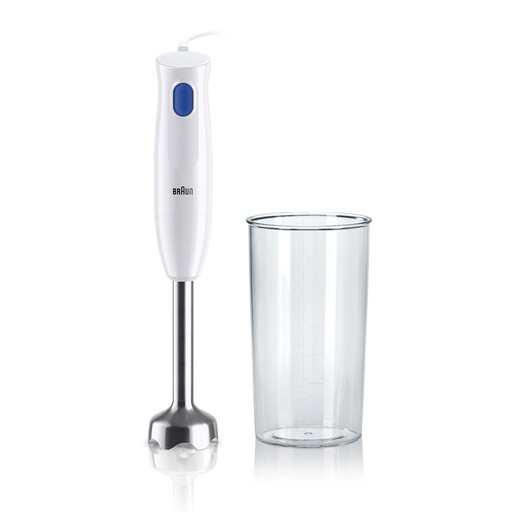
Why this suits the profile: A lightweight model with a single button for smoothies, sauces and simple preparations. The included 600 ml measuring jug helps with portioning and mixing.
The specifications are straightforward: 450 watts and one speed. So you're not paying for a large accessory set when basic use is the goal.
450 watts, lightweight design, BPA-free food contact parts and EasyTwist connection. According to the product description, some parts are dishwasher-safe.

Why this suits the profile: For home cooks who value variety. This model combines 1,000 watts with 25 speeds, a turbo function and a chopper with three texture settings.
The many settings offer more control than just a separate turbo button. Do check the manual for suitable portions and operating time.
25 speeds, 1,000 watts, SizeControl chopper and, according to the product description, dishwasher-safe parts.
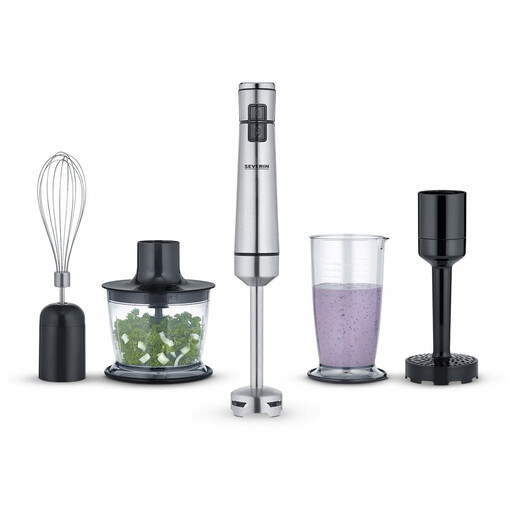
Why this suits the profile: This cordless model is designed for those who don't want to be tied to a power socket. The set includes a chopper, whisk, measuring jug and potato masher.
The accessories are clearly tailored to different tasks. Bear in mind the stated 2,000 mAh battery, single speed and the advice not to clean the parts in the dishwasher.
Cordless use, 0.7 litre measuring jug, 0.5 litre chopper and BPA-free parts according to the product specifications.
We've put together a full, up-to-date list of products that fully meet these strict selection criteria and comply with current European safety regulations.
Always follow the manual for your chosen model. Pay particular attention to these points:
Products are generally supplied with a minimum of two years' statutory warranty under EU consumer rules. Check the current warranty terms and the responsible seller at the time of purchase.
For soup, sauce and smoothies, around 300 to 500 watts is often sufficient. If you regularly make thick purées, nuts or larger portions, look at models from 600 to 1,000 watts. The wattage should always be assessed alongside the blade construction, speeds and operating time.
That depends on your cooking routine. A whisk is useful for batter and whipped cream, while a chopper is suitable for herbs, onion and nuts. If you only use a blender for soup and sauce, a simpler model with a measuring jug may be more practical.
The lifespan depends on usage, cleaning and following the maximum operating time. Do not overload the motor, avoid ingredients that the manual says are unsuitable, and regularly check the blending foot, connections and cable. A detachable blending foot and replaceable or available accessories can make maintenance easier.
