
Single-portion blender
You mainly make a small portion of beetroot hummus and want a suitably sized beaker rather than a comprehensive set.


For a single portion of beetroot hummus, a stick blender with a blending shaft that fits neatly into a suitable, stable beaker is a sensible starting point; the Netherlands Nutrition Centre lists blending with a stick blender as one preparation option. A stick blender on its own keeps the number of parts to a minimum, while a set with a chopper is mainly useful if you’ll also use it for other ingredients. Compare the accessories supplied and the cleaning instructions for the exact model, rather than looking at wattage alone.
You mainly make a small portion of beetroot hummus and want a suitably sized beaker rather than a comprehensive set.
You want to adjust the thickness and smoothness as you blend, so you pay attention to the controls and the space inside the beaker.
You want to chop ingredients as well as blend them, and weigh that convenience against the extra parts to clean and store.
The Netherlands Nutrition Centre’s recipe recommends using a stick blender to blend beetroot and chickpeas. So focus on how the blending shaft fits in the beaker; a chopper is designed for additional chopping tasks.
| What to consider | What to look for | Who should pay particular attention? |
|---|---|---|
| Blending a small portion | Compare the shape of the blending shaft with the beaker supplied, and check that the beaker is stable. | If I’m mainly making one small portion, I want the shaft to suit the beaker and the quantity. Around 36% of consumers prioritise suitability for their portion size. |
| Being able to adjust the texture | Check the speed settings and how you control them while blending. | If you want to adjust the consistency of the beetroot and chickpeas yourself, choose controls that make this easy. Around 29% of consumers prioritise control over texture. |
| Cleaning after use | Check whether the blending shaft is detachable and read the manual to see which parts are dishwasher-safe. | If I want to wash as few parts as possible after preparing a small amount, I check what can be detached and needs cleaning. Around 21% of consumers consider ease of cleaning a top priority. |
| Do you need a chopper? | Check whether a chopper is included and the capacity of its bowl. | If you also want to chop onion, herbs or nuts, a chopper can come in handy; you don’t need this extra function just for blending. Around 14% of consumers particularly value extra chopping options. |
The capacity alone doesn’t tell you whether the blending shaft will make good contact with a small amount of mixture.
Check the beaker and blending shaft combination for the exact model, and make sure the beaker is stable.
The Netherlands Nutrition Centre recommends a stick blender for blending; a chopper mainly adds a separate function for ingredients such as onion, herbs or nuts.
Choose a chopper if you expect to use it for those extra chopping tasks too.
Wattage doesn’t tell you how well a blender will make beetroot hummus. The manufacturer also lists different power ratings for the Braun MQ50201M in its product description and technical specifications.
Compare the beaker, controls and accessories too, rather than basing your choice on wattage alone.
The Dutch government says there is no fixed statutory warranty period in the Netherlands, and that you can contact the retailer if a product is faulty.
Check what any additional warranty offers on top of your rights.
The ErgoMixx MSM66110 is worth considering if you mainly want to blend and are looking for a measuring beaker for small quantities.
The MultiQuick 5 MQ50201M is worth considering if you want a chopper as well as a stick blender.
The Quickchef HB659838 could suit you if you want a larger beaker and a chopper as well as equipment for smaller preparations.
These stick blenders are designed for blending; some models also include a measuring beaker, chopper or whisk.
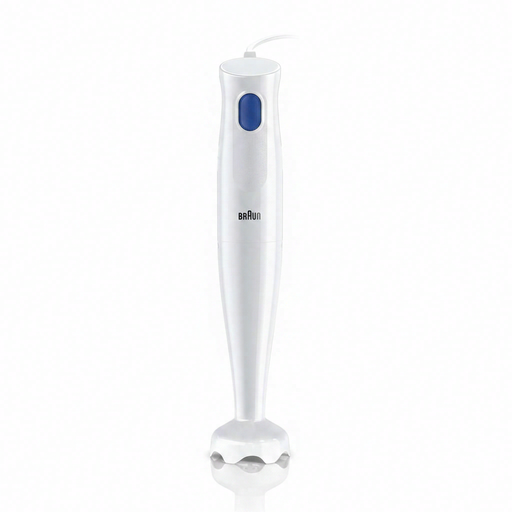 No image available
Worth considering if you’re looking for a stick blender with a measuring beaker for blending.
The product description lists one speed setting, a 600 ml measuring beaker and a detachable blending shaft.
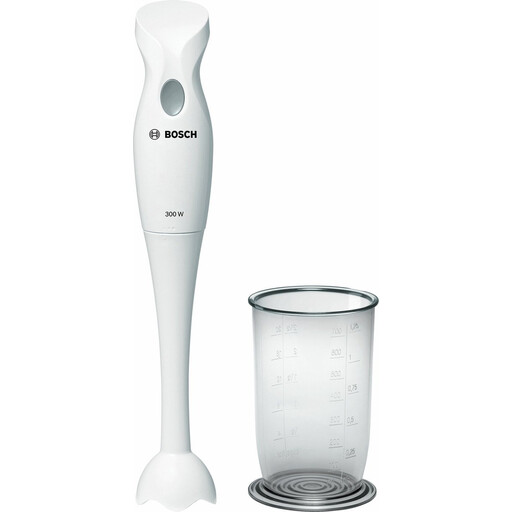 No image available
A stick blender to compare if you’re looking for a measuring beaker and detachable parts.
The product description lists a measuring beaker and a turbo function.
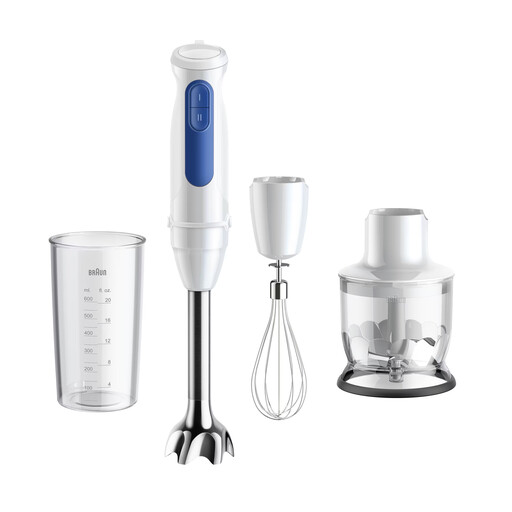 No image available
Worth considering if you want to choose between speeds while blending.
The product description lists two speeds.
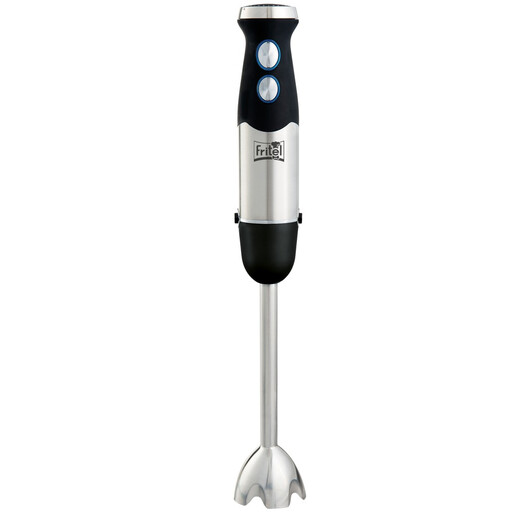 No image available
The product description lists blending soup and mixing ingredients among its uses.
The product title lists 800 W and a length of 25 cm.
 No image available
A set to consider if you want to use a chopper and whisk as well as blend; the extra parts need more washing-up and storage space.
The product description lists a 700 ml beaker and a 500 ml chopper. According to the product instructions, the maximum continuous operating time is 1 minute, followed by 1 minute of rest.
Yes. For a recipe using cooked beetroot and chickpeas, the Netherlands Nutrition Centre recommends either a stick blender or a food processor. If blending is difficult, the recipe suggests adding a splash of water.
The Dutch Consumers’ Association recommends placing the blending shaft in the bowl before switching on the appliance. After use, unplug it and detach the attachments; check the manual for the exact model to see whether they’re dishwasher-safe.
The Netherlands Nutrition Centre recommends keeping homemade plain hummus in the fridge for 1–3 days. This advice applies to plain hummus; the page mentioned does not give a separate storage time for the beetroot version.
For an online purchase from a business, the Dutch government says you generally have a 14-day cooling-off period. You’re also covered by statutory consumer rights in the Netherlands, with no fixed legal time limit; if a product is faulty, contact the retailer. Any manufacturer’s warranty offered does not replace these rights.