
Cooking for a crowd of neighbours
You’re making several portions and want to know how much you can practically blend in each batch. The stated total bowl capacity won’t answer that on its own.


For a modest amount, you can blend cooked beetroot and chickpeas with a stick blender, adding a little liquid at a time if needed. If you’re making several portions or want a thick, even spread, also compare the practical working capacity of a chopper bowl or food processor. The bowl’s total capacity doesn’t automatically tell you how much you can process at once.
You’re making several portions and want to know how much you can practically blend in each batch. The stated total bowl capacity won’t answer that on its own.
You want an even spread made with chickpeas and cooked beetroot, and you’re happy to add a little liquid or work in smaller batches if needed. The Netherlands Nutrition Centre lists blending with a stick blender as one way to prepare it; the Consumers’ Association points out that thick ingredients can be harder to blend evenly.
You’re factoring in beetroot juice and extra washing-up, so you’re looking for a detachable blending foot and checking the cleaning instructions for the exact model. The Consumers’ Association notes that a detachable foot is handy for cleaning.
A good fit if: you’re blending in a bowl, making smaller portions and want fewer extra parts to wash up.
Bear in mind: with a very thick mixture or a larger quantity, you may need to blend in batches.
A good fit if: you want to chop ingredients as well as blend them, or you’ll make good use of the bowl included.
Bear in mind: extra attachments take up space and mean more washing-up. The bowl’s total capacity doesn’t tell you how much hummus you can make in each batch.
Compare these if: making one larger batch matters more to you than the convenience of a stick blender.
Bear in mind: according to the Consumers’ Association, a blender is less suitable for thick or dry ingredients, so a large jug won’t necessarily guarantee an even result.
| What to consider | What to look for | Who it matters to |
|---|---|---|
| Amount per batch | Check the maximum working capacity and operating time in the manual, not just the bowl’s total capacity. | For a neighbourhood meal, I want to know how much thick hummus I can make at once, so I’m not caught out needing extra batches. Around 36% of consumers prioritise the amount per batch. |
| Smooth texture | Use cooked beetroot and compare the blending foot and speed settings. Consider whether you’re happy to work in batches. | If I want a thick spread, I look for the option to add a little liquid if needed, without losing sight of the texture I’m after. Around 29% of consumers prioritise a smooth result when making thick hummus. |
| Cleaning up after using beetroot | Check the material of the blending foot and see which parts the manual says are dishwasher-safe. | After preparing the food, I want to clean the parts easily and limit visible staining on the foot. This is the main buying concern for around 21% of consumers. |
| Whether extra attachments are useful | Compare the parts included with the dishes you’ll want to make with them after your get-together, too. | I only want extra functions if I’ll genuinely use them later, as they also take up space and mean more washing-up. This wider range of uses matters most to around 14% of consumers. |
A bowl capacity of, say, 500 ml or 1 litre doesn’t tell you how much thick hummus the manual says you can process at once.
Check the maximum working capacity and operating time for the exact model. Otherwise, you may need to work in several batches.
Wattage alone doesn’t show how evenly a stick blender will blend beetroot hummus. Compare the blending foot included, the controls and the guidance for thick mixtures, too.
Don’t use wattage as your only guide to the expected result, and check the stated operating time separately.
In the Netherlands, statutory consumer rights apply alongside any manufacturer’s or seller’s warranty. ACM ConsuWijzer explains that the seller is responsible if a product breaks too soon under normal use.
Before deciding whether extra cover is right for you, compare any additional warranty with your statutory rights.
The Quickchef+ HB67MB30 is worth a look if you’re after a set that includes a chopper bowl and whisk.
The ErgoMaster MSM6M8X1 shows how a set with a blending foot, chopper and extra accessories differs from a basic stick blender.
The MultiQuick 9 MQ9138XI is an option to compare if you’re looking for a blending foot with a chopper and whisk.
The Triblade XL HBM40.002WH is another product line to compare for the accessories included with a stick blender set.
This selection of Joybuy products includes stick blenders with a detachable blending foot, as well as sets with a chopper bowl or extra attachments for blending and other tasks.
 No image available
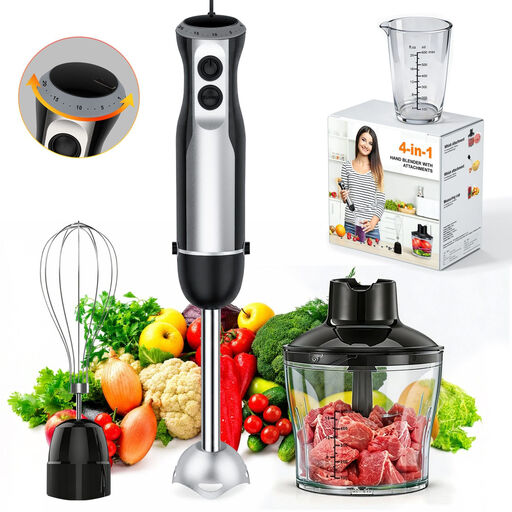
A set to consider if you want to chop or whisk as well as blend.
Detachable stainless steel blending foot, turbo function and 500 ml chopper.
The individual parts must be washed by hand; the motor unit must not be immersed in water.
 No image available
A set to compare if you’re looking for a stick blender with several speed settings and extra accessories.
The product information lists 1000 W, 20 speeds, a turbo function, a chopper and a measuring beaker.
 No image available
A standalone hand blender to compare if you’re mainly looking for a blending foot for puréeing.
The product information lists a stainless steel hand blender, 20 speeds and a turbo function.
Detachable and dishwasher-safe parts are mentioned; check the manual to see exactly which parts these are.
 No image available
A set to consider if you want to chop or whisk as well as blend.
The product name lists 600 W, two speeds, a 500 ml chopper and an 800 ml measuring beaker.
A whisk is included, according to the product name.
 No image available
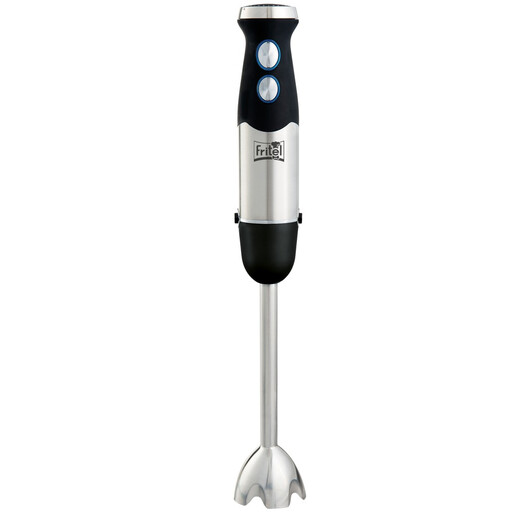
A standalone hand blender to compare if you’re looking for a stainless steel blending foot for puréeing.
The product information lists a 25 cm blending foot and six blades.
The instructions say hard ingredients such as ice cubes are unsuitable, unless the manual says otherwise.
Use cooked beetroot and cooked chickpeas. The Consumers’ Association advises cooking hard vegetables first; the Netherlands Nutrition Centre suggests adding a little water for a creamier texture. Add liquid gradually if you want to keep the spread thick.
The bowl’s total capacity doesn’t automatically show how much thick hummus you can process at once. Check the maximum working capacity and operating time in the manual for the exact model.
Unplug it after use and remove the attachments. Check the manual for your model to see which parts are dishwasher-safe; this doesn’t automatically apply to every accessory or the motor unit.
For plain homemade hummus, the Netherlands Nutrition Centre recommends keeping it in the fridge for 1–3 days and setting the fridge temperature to 4 °C. Don’t leave food that spoils quickly out of the fridge for more than 2 hours. Beetroot hummus may have a different composition from plain hummus.
Yes, if you use tahini: it’s made from sesame, and the Netherlands Nutrition Centre lists sesame seeds as an allergen. Check the ingredients and ask your guests about any allergies.