
Family meal dressing maker
You want to blend soft ingredients until smooth in a suitably sized beaker, without unnecessary attachments. StudioKOOK describes blending avocado dressing in a tall beaker.


A stick blender with a blending foot and a tall beaker is usually all you need for avocado dressing. Extra attachments are mainly useful if you also want to chop or whisk ingredients. Choose based on portion size, ease of use and how you want to clean the parts, rather than the stated power alone. Before buying, check that the product on offer meets the applicable requirements.
You want to blend soft ingredients until smooth in a suitably sized beaker, without unnecessary attachments. StudioKOOK describes blending avocado dressing in a tall beaker.
You also make small quantities of sauce or dip and want to keep splashing to a minimum while blending. The Consumers’ Association offers tips on using stick blenders.
As well as puréeing, you want to chop ingredients or whisk them with a whisk attachment; the attachments you need will determine which set is right for you. The Consumers’ Association distinguishes between these tasks when advising on choosing a stick blender.
First decide whether you need the stick blender just to purée dressing or for other kitchen tasks too. Then consider portion size, ease of use and cleaning.
| What to consider | What should you check? | Who is this important for? |
|---|---|---|
| Blending dressing until smooth | Check that the blending foot is suitable for puréeing and that the supplied tall beaker is the right size for the quantity you make. | I mainly want a smooth dressing for a family meal and don’t need extra functions. Around 36% of consumers prioritise smooth puréeing. |
| Managing portions and splashes | Check the usable filling capacity in the manual and how to keep the blending foot submerged while blending. | When I make a small portion, I want to blend it in a tall beaker without making a mess. Around 29% of consumers prioritise portion size and splash control. |
| Cleaning | Check whether the blending foot detaches and which removable parts are dishwasher-safe according to the manual. | If I use it regularly, I want the blending foot and attachments to be easy to clean. Around 21% of consumers prioritise easy cleaning. |
| Extra attachments | Choose a chopper or whisk only if you’ll actually use them, and check what’s included with the specific model variant. | I want to use the same set to chop herbs or whisk ingredients, not just make dressing. Around 14% of consumers choose a stick blender mainly for these extra functions. |
Wattage alone doesn’t tell you how well a stick blender will mix avocado dressing. The Consumers’ Association assesses blending results for different preparation tasks. Braun Household Netherlands lists both 1000 W in the product description and 750 W in the technical specifications for the MQ50201M.
Compare the features that matter for your recipe. If the wattage information conflicts, check which specification applies to the model variant on offer.
Avocado dressing is made using the standard blending foot; a chopper and whisk are intended for other preparations, such as chopping or whisking ingredients.
Choose extra attachments only if you’ll use them regularly for those tasks.
Tefal lists a total beaker capacity of 800 ml for the Quickchef+ HB67MB30. That figure doesn’t tell you how much dressing you can blend at once in practice.
Check the manual and take into account the quantity you usually prepare.
The Bosch Netherlands product page describes the ErgoMixx MSM66110 as a stick blender supplied with a blending foot and measuring beaker.
Braun Household Netherlands describes the MultiQuick 5 MQ50201M as coming with a beaker and a 350 ml chopper, as well as 21 speed settings.
Tefal Netherlands describes the Quickchef+ HB67MB30 as a set with a blending foot, beaker, whisk and XL chopper/blender.
This selection includes simple stick blenders and models with extra attachments for anyone who wants to chop or whisk as well as purée. Compare the listed features with your portion size and intended use. Before buying, check that the product on offer meets the applicable requirements.
 No image available
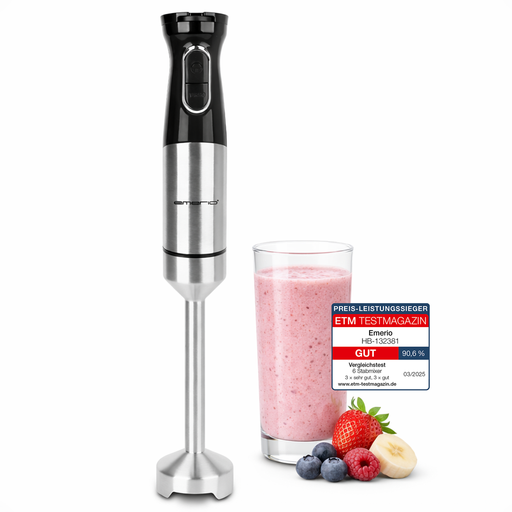
The description lists sauces and purées as possible uses and recommends submerging the blades in a suitable beaker or bowl to help prevent splashing.
The title lists 1000 W, variable speed and a black and stainless steel finish. The description mentions a detachable stainless steel blending shaft with two blades.
 No image available
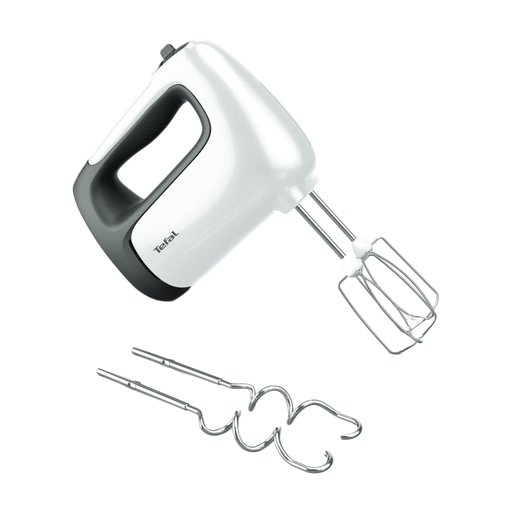
The product description says the stainless steel blending foot is suitable for sauces and smoothies; the set also includes beaters and dough hooks for other mixing tasks.
The title lists 450 W and five speeds. The description also mentions a turbo function.
 No image available
According to the product description, the blending foot is designed for mixing; a low speed is recommended for liquids. The chopper is an extra feature for anyone who also wants to chop ingredients.
The description lists 25 speeds and a splash-control system. Do not use this model to process boiling liquids.
 No image available
The measuring beaker is designed for mixing; the chopper and whisk offer extra functions if you also want to chop or whisk.
The title lists up to 1200 W, 15000 rpm, a 700 ml beaker and a 500 ml chopper. The maximum operating cycle is 1 minute of use, followed by 1 minute of rest.
 No image available
The product description lists puréeing and making sauces as possible uses, with variable speed and a design that helps minimise splashing.
The description lists 20 speeds, a turbo function, two blades and dishwasher-safe parts. No collection container is included; check the manual to see which parts can go in the dishwasher.
Put the ingredients in a tall beaker and blend until smooth. Place the blending foot in the mixture before switching the blender on to help prevent splashing.
Don’t assume that you can. Unplug the blender after use and detach any attachments; check the manual to see which removable parts are dishwasher-safe.
In the Netherlands, you’re entitled to a product that works properly, but there’s no fixed statutory guarantee period. The Dutch government notes that the expected lifespan varies from one product to another. If there’s a fault, contact the seller; the appropriate solution depends on the circumstances and what you could reasonably expect from the product.
CE marking is compulsory for electrical products covered by the relevant regulations. The Netherlands Food and Consumer Product Safety Authority explains the rules for electrical appliances and CE marking; before buying, check that the product on offer meets the applicable requirements.