
Vandaag of morgen in huis

Kwaliteit gegarandeerd

Welkomstaanbiedingen ontgrendelen: GRATIS bezorging | Tot 80% korting | Gratis 30 dagen JoyPlus-proefperiode
Download de app
A steamer pan can be useful for vegetables, fish, dumplings, rice and baby food. However, not every saucepan with a steaming insert is equally practical. An insert that is too small, a lid that lets too much steam escape or a base that is unsuitable for your hob can quickly make cooking frustrating.
Joybuy Product Recommendation Officer has summarised the key points to consider. This makes it easier to compare a stainless steel steamer pan, electric steamer and steam-cooking pan based on verifiable features rather than marketing claims alone.
A 24 or 28 cm pan may sound spacious, but the usable space also depends on the height of the steaming insert and the distance between the tiers. Therefore, check:
A single low insert is suitable for a small portion of vegetables or fish. For a family meal, a 2-tier or 3-tier steamer pan may be more practical.
An induction steamer pan needs a magnetic base. The requirements are different for gas, electric and ceramic hobs, but a flat, stable base remains important. Also check whether the handles and lid knob are heat-resistant.
According to the product information for various models in this range, they are suitable for induction, gas, electric and ceramic hobs. Always check the specifications of the individual product, especially if you have an older hob.
A stainless steel steamer pan may have a ceramic coating on the outside, while the interior is uncoated stainless steel. These are different properties. If you want to cook without Teflon, it is worth checking specifically:
According to the brands’ own product information, the 304 and 316 stainless steel models mentioned are designed for contact with food. This does not automatically mean that every component has the same material composition. Therefore, read the full product specifications.
304 stainless steel is widely used in cookware and, according to the product descriptions, offers resistance to rust and corrosion. 316 stainless steel is described in the product information as a variant with higher corrosion resistance. This may be relevant if you often cook with acidic ingredients or use the pan intensively.
However, the material name alone does not determine cooking performance. The construction of the base, wall thickness and connection between the pan and insert are just as important.
A 3-tier steamer pan or tri-ply saucepan consists, according to the product information, of layers of stainless steel with an aluminium core. Aluminium conducts heat well, while stainless steel forms the inner and outer layers. This construction is intended to distribute heat more evenly.
Pay attention to the difference between:
For steaming, stable water distribution is particularly important. For boiling, simmering and steaming at the same time, a multi-layer base can be especially practical.
For one or two people, a steamer pan with an insert of approximately 2 to 2.5 litres is often sufficient. Families will generally benefit more from a 5-litre pan or a model with multiple tiers. If you want to prepare dumplings, fish and vegetables at the same time, a larger steamer pan with separate baskets may be useful.
An electric steamer does not take up space on the hob and often has a timer. According to the product specification, the Tefal VC2048 has three bowls of 3 litres each, a power rating of 800 watts and a timer of up to 60 minutes. An electric option does require space near a socket and has additional parts to clean.
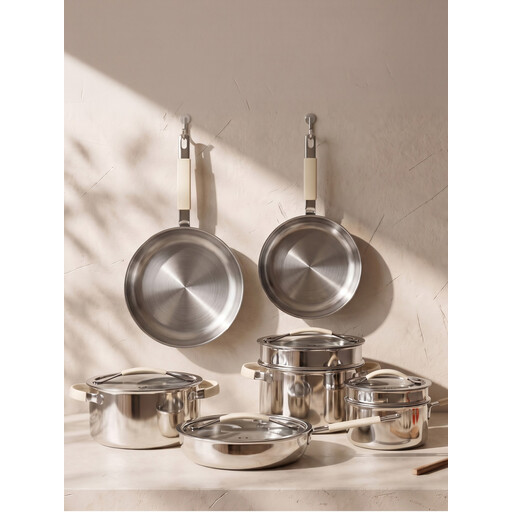
Why it suits this profile: This compact 18 cm pan with a capacity of around 2.5 litres is suitable for small households, breakfast, heating milk and simple steamed dishes.
The product information states that a steaming insert and glass lid are included, and that the pan is compatible with gas, induction and ceramic hobs. This means you do not need to source these components separately.
304 stainless steel, 18 cm diameter, steaming and simmering functions in one pan, plus a transparent lid.

Why it suits this profile: This model is aimed at users looking for a compact pan with 316 stainless steel on the inside and a multi-layer base.
The product specification clearly states the interior material, base construction and compatible hobs. The ceramic layer is on the outside; the interior is made from 316 stainless steel.
316 stainless steel, steaming insert included, suitable for induction and a handle with a silicone covering.
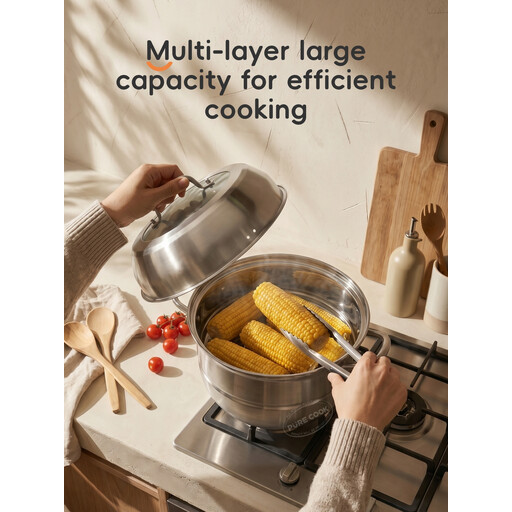
Why it suits this profile: According to the product information, this set is intended for preparing several dishes at once and has a capacity of 13 litres for approximately 6 to 8 people.
The stated capacity, number of components and hob compatibility are clearly specified. This makes it easier to plan capacity and storage space in advance.
304 stainless steel, multiple steaming tiers, glass lid, dishwasher-safe according to the product information, and compatibility with induction, gas and ceramic cooking.
We have put together a complete, up-to-date list of products that fully meet these strict selection criteria and the applicable European safety regulations.
Fill the lower pan according to the instructions and make sure the water level does not rise above the steaming insert. Place ingredients with a longer cooking time at the bottom. Open the lid away from you to reduce the risk of contact with hot steam.
Ideally, wash stainless steel with a soft sponge and mild washing-up liquid. According to the product information, white marks or a rainbow-coloured haze can be caused by minerals or overheating. A little vinegar can help remove this residue. Avoid steel wool and check glass lids for cracks. Allow a hot pan to cool down before rinsing it.
Yes, provided the manufacturer states that it is induction-compatible and the base is magnetic. Models with a multi-layer magnetic base are designed for this purpose. Always check this for each product, particularly with older or smaller pans.
For one or two people, around 2 to 2.5 litres is often sufficient. For families, models of 5 litres or more are generally more practical. Multiple tiers are useful when you want to prepare vegetables, fish and dumplings in a single cooking session.
Consumption depends on the power rating and how long the appliance is used. An 800-watt appliance running for half an hour theoretically uses around 0.4 kWh. In practice, heating time, thermostat control and the amount of water can affect actual consumption. A hob-top model does not use a separate electrical appliance, but it does draw heat from the hob.
